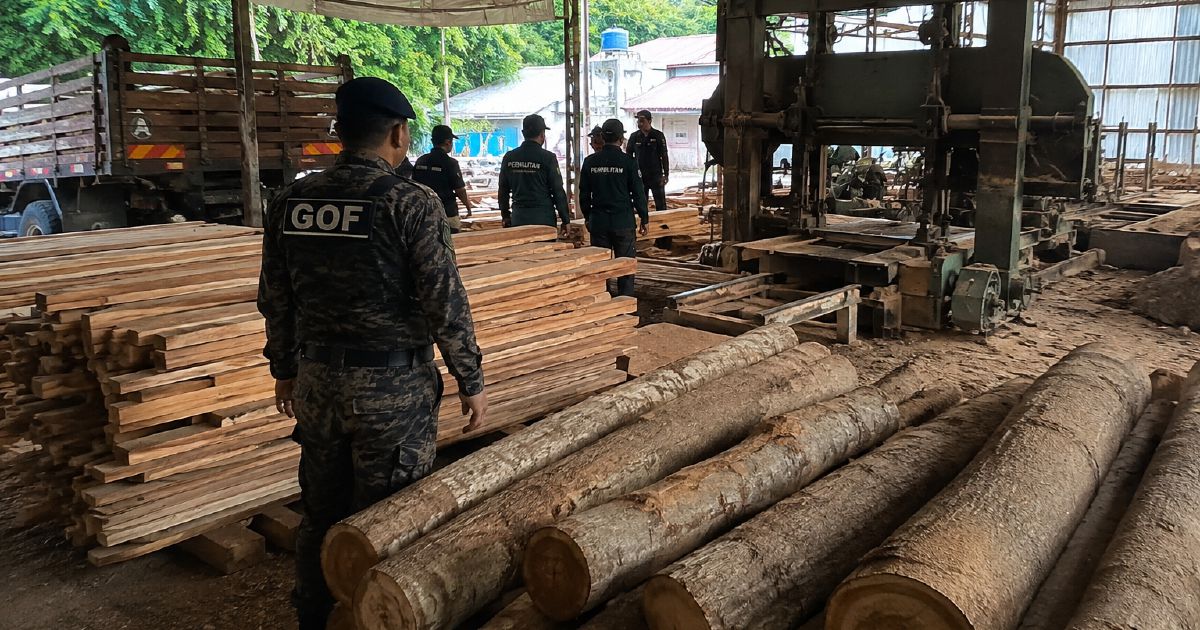
The General Operations Force conducted a significant enforcement operation against illegal timber processing in Terengganu, uncovering a facility stocked with controlled materials and machinery in Kuala Berang. Officers seized timber stocks and mechanical equipment totalling RM640,510 in value during the raid, marking another instance of coordinated action against undocumented forest product movements in the state. A 20-year-old individual was arrested at the scene as authorities expanded their investigation into the operation's scope and supply chains.
The raid underscores mounting concern among Malaysian enforcement agencies regarding unregulated timber operations across peninsular states. While timber harvesting and processing remain legitimate commercial activities subject to licensing and forest management regulations, the discovery of this facility suggests operational gaps in oversight mechanisms. Sawmills operating without proper documentation or licenses pose dual challenges—they undercut legitimate timber merchants competing on regulated terms whilst potentially facilitating the movement of logs beyond transparent supply chains that government agencies monitor.
Terengganu, like neighbouring states in the east coast, has historically been a focal point for timber extraction given its extensive forest reserves. The state's geography and proximity to port facilities make it strategically significant within Malaysia's timber export infrastructure. However, this positioning also creates opportunities for irregular operators to establish themselves, particularly in less densely populated areas where monitoring capacity may be stretched. The Kuala Berang location suggests authorities are extending their reach into smaller production centres rather than focusing exclusively on major industrial hubs.
The equipment seized during this operation—details of which remain under investigation—would typically include sawing machinery, log handling equipment, and processing tools essential for converting raw timber into commercial products. The combined valuation suggests a moderately sophisticated facility rather than a small-scale informal operation. Such machinery often represents substantial capital investment, raising questions about funding sources and whether this represents isolated entrepreneurship or part of a larger supply network utilising multiple production points to distribute risk and avoid concentrated enforcement attention.
Malaysia's timber industry operates within a complex regulatory framework combining federal forestry codes with state-level administration, as forest management falls under state jurisdiction. This division of responsibility occasionally creates enforcement coordination challenges, though the GOF's involvement indicates that federal forces are actively supporting state-level investigations when suspicions of serious violations arise. The interplay between federal and state authorities has become increasingly important as concerns about illegal or irregular logging persist despite Malaysia's sustained efforts to improve forestry governance and certification standards.
The arrest of a 20-year-old individual raises broader questions about labour demographics within informal timber operations. Younger workers often occupy vulnerable positions within unregulated sectors, sometimes unaware of the legal status of their employment or complicit under economic pressure. As investigations proceed, authorities will seek to determine whether this individual operated the facility independently, managed it on behalf of others, or participated in a larger organised concern. The cooperation level of detainees frequently proves instrumental in uncovering supply chains and upstream suppliers of raw logs.
The seized materials themselves face disposition procedures within Malaysia's law enforcement framework. Timber of confirmed illegal origin typically cannot re-enter commercial supply chains without comprehensive documentation establishing its legitimacy—effectively rendering the material an enforcement asset rather than recoverable merchandise. The equipment's fate depends similarly on investigation findings and whether it was manufactured for legitimate purposes but employed illegally, or whether the machinery itself carries suspicious provenance. These technical distinctions shape both the investigation's trajectory and subsequent prosecution pathways.
From a regional perspective, Malaysia's enforcement actions against informal timber operations contribute to broader regional discussions about forest governance and supply chain transparency. Neighbouring countries including Indonesia and Thailand face similar challenges with undocumented timber movements, and transnational enforcement cooperation remains limited despite shared concerns. The visibility of operations like the Kuala Berang raid reinforces Malaysia's positioning as a state attempting to uphold documented supply chains, even as critics argue that enforcement remains insufficient relative to the scale of suspected irregular activity.
Government agencies have progressively upgraded detection and monitoring infrastructure targeting timber movement, deploying checkpoint systems, documentation verification protocols, and intelligence gathering focused on suspicious transactions. The GOF raid suggests these monitoring networks are generating actionable leads converting into physical enforcement outcomes. Sawmills represent fixed locations amenable to targeted operations, whereas mobile timber trading presents greater enforcement difficulty. Each successful facility discovery provides lessons informing future prevention strategies and resource allocation decisions.
The incident also reflects evolving enforcement priorities balancing timber regulation with other criminal concerns competing for operational resources. The GOF's involvement indicates this case met thresholds warranting federal-level attention, suggesting either high valuation, evidence of organised structures, or intelligence connecting the facility to broader criminal networks. Such prioritisation decisions shape which infractions receive active investigation versus administrative processing, and influence deterrent effects the enforcement system produces.

