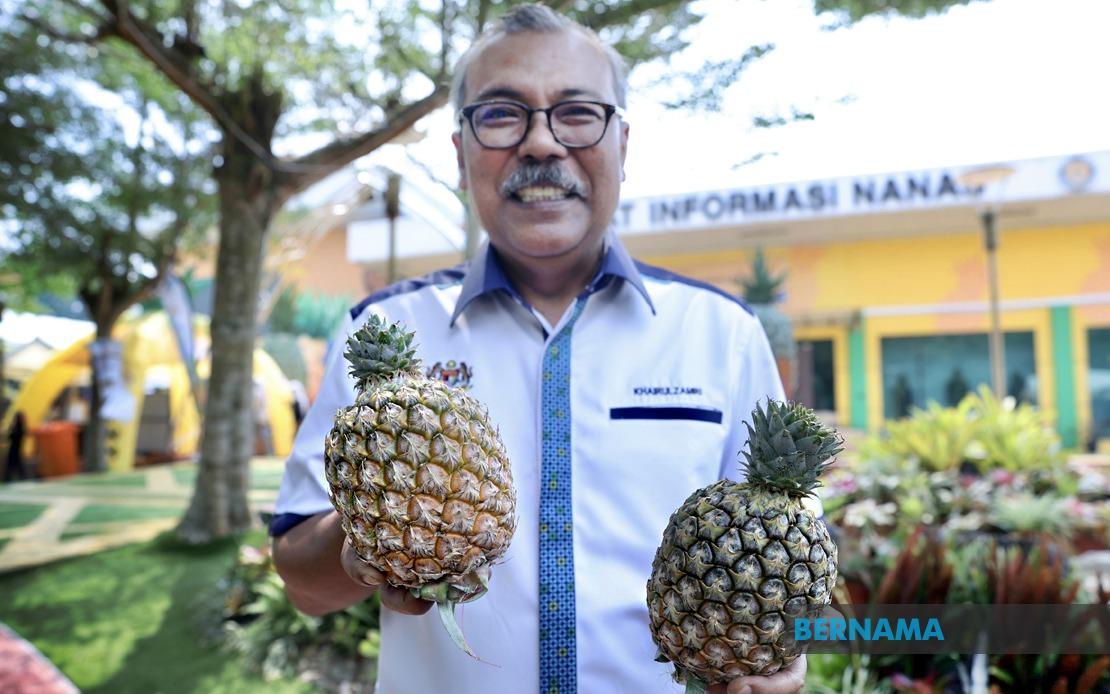
A promising new pineapple variety is drawing considerable attention at MAHA 2026, where the Malaysian Pineapple Industry Board is showcasing seven tonnes of Sarawak Gold (SG1) pineapples at the Malaysia Agriculture Expo Park in Serdang. The discovery and cultivation of this premium variety in Miri represents a potentially significant development for Malaysia's tropical fruit sector, one that could reshape export competitiveness and farmer profitability across the region.
Mohd Khairuzamri M. Salleh, director-general of the Malaysian Pineapple Industry Board (LPNM), characterises the SG1 as a game-changing agricultural innovation. What distinguishes this variety from existing cultivars lies not merely in taste but in a constellation of commercial advantages that address longstanding challenges within Malaysia's pineapple farming community. The fruit achieves sweetness levels comparable to the widely cultivated MD2 variety, a crucial factor for consumer acceptance in competitive international markets. Equally striking is the distinctive rose-shaped crown, a visual characteristic that enhances marketability and consumer appeal, particularly in premium segments where presentation commands premium pricing.
The most transformative advantage centres on cultivation timescale. SG1 reaches maturity in approximately nine months, compared to the fourteen months required for MD2 from planting to harvest. This accelerated production cycle has profound implications for farmer economics, allowing multiple harvests within compressed timeframes and enabling faster return on agricultural investment. For Malaysian growers operating within competitive global markets where timing directly influences profitability, this six-month reduction represents a substantial competitive advantage. The consistent quality and flavour profile throughout each fruit further reduces post-harvest losses and rejection rates, issues that routinely diminish earnings for producers.
Planting density emerges as another crucial differentiator. SG1 thrives at remarkably high densities ranging between 25,000 and 30,000 plants per acre, substantially exceeding conventional spacing requirements. This intensification allows farmers to dramatically increase output per unit of available land, a particularly valuable attribute in Malaysia where agricultural land remains under constant pressure from competing development interests. The ability to generate higher yields from existing farmland without territorial expansion presents genuine economic opportunity for smallholder farmers throughout Sarawak and Peninsular Malaysia, where land scarcity constrains agricultural expansion.
The LPNM is actively pursuing geographical expansion of SG1 cultivation beyond its Sarawak origins into Peninsular Malaysia, with seedlings expected to reach growers through wider distribution channels during the coming year. This planned rollout demonstrates official confidence in the variety's performance and indicates institutional commitment to scaling production capacity. The transition from experimental cultivation to mainstream farmer adoption requires coordinated investment in extension services, training programmes, and supply chain infrastructure—elements typically demanding substantial government and industry collaboration.
International market penetration already shows encouraging momentum. Trial shipments from Sarawak to Singapore have successfully navigated export protocols and market reception, validating the variety's suitability for established regional trade channels. The demonstrated resilience of SG1 opens possibilities for accessing more demanding and lucrative markets including China and New Zealand, territories where stringent quarantine requirements and quality standards typically challenge emerging suppliers. Successfully establishing SG1 in these markets would substantially elevate Malaysia's positioning within global pineapple commerce and generate substantial foreign exchange earnings.
Beyond fresh fruit production, MAHA 2026's broader pineapple exhibition advances a sophisticated value-creation narrative that extends industry perception far beyond conventional commodity production. The theme "Value Creation for Food Security" consciously reframes pineapple cultivation as a comprehensive agricultural system generating multiple income streams. The concept of "one planting, three harvests" encapsulates this integrated approach: primary fresh fruit production, secondary seed harvesting, and tertiary transformation of agricultural residue into high-value derivatives.
This residue utilisation demonstrates particular innovation potential. Plant waste previously discarded or burned as field disposal traditionally represents lost economic value. Contemporary processing capabilities now convert these materials into ruminant feed supplements, textile-grade fibres for clothing manufacture, and cellulose derivatives for paper production. Each value-added application generates employment within processing sectors whilst reducing agricultural waste volumes and associated environmental consequences. For Malaysian farmers, particularly smallholders lacking capital for diversification, these secondary income opportunities provide meaningful economic resilience.
The broader MAHA 2026 exhibition context amplifies the SG1 showcase significance. Operating from August 28 through September 6 at the Malaysia Agriculture Expo Park in Serdang, the exhibition attracts approximately 2,000 exhibitors and anticipates exceeding four million visitor attendances. This substantial platform provides domestic and international exposure for agricultural innovations, connecting producers with potential distributors, exporters, and government policy architects. The timing and scale enable effective dissemination of information regarding SG1 capabilities to farming communities, agricultural extension officers, and agricultural finance providers whose support proves essential for farmer adoption of new varieties.
For Malaysia's broader agricultural modernisation agenda, SG1 represents tangible evidence that domestic research and innovation can generate genuinely competitive advantages within global commodity markets. The variety's emergence from Miri cultivation efforts demonstrates capacity within existing institutions to identify and develop commercially viable improvements to established crops. This capacity-building achievement carries implications extending beyond pineapples, suggesting comparable potential within other tropical fruit sectors facing globalised competition and margin pressures.
The economic implications for affected farming communities warrant careful consideration. Smallholder pineapple growers throughout Sarawak and Peninsular Malaysia face persistent challenges including volatile commodity pricing, competition from lower-cost international producers, and limited market access. SG1's superior characteristics—faster maturation, higher density cultivation, enhanced export suitability—address multiple dimensions of these structural challenges simultaneously. Successful widespread adoption could materially improve farmer incomes, increase agricultural productivity, and strengthen rural economic viability, particularly within East Malaysia where pineapple cultivation represents significant livelihood importance.
The planned expansion into Peninsular Malaysia will test institutional capacity to coordinate variety adoption across disparate farming communities operating within distinct geographical and climatic conditions. Success requires investment not merely in seedling distribution but in comprehensive extension support, agronomic training, market linkage development, and farmer financing mechanisms. The quality of implementation during this scaling phase will substantially determine whether SG1 fulfils its commercial promise or remains a regionally limited success.
Looking forward, SG1's international trade performance during forthcoming years will significantly influence Malaysian pineapple industry trajectory. Successful penetration of premium markets in China, New Zealand, and other demanding territories could establish SG1 as a distinctly Malaysian pineapple brand commanding price premiums over commodity-grade competition. Conversely, slower market acceptance or competitive responses from other pineapple-producing nations could limit upside potential. Nevertheless, the fundamental innovation advantage demonstrated through SG1's agronomic and commercial characteristics validates continued investment in crop improvement research and positions Malaysia favourably within increasingly sophisticated global agricultural competition.

