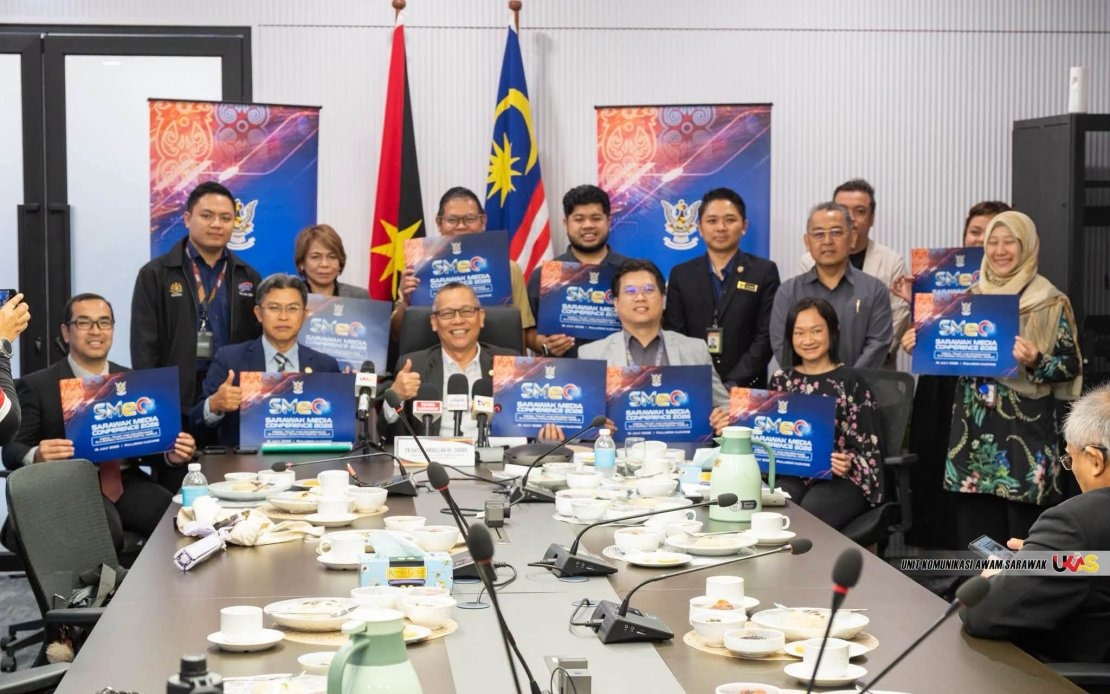
Sarawak will host its inaugural media conference this week, assembling roughly 800 stakeholders from journalism, academia, government and technology sectors to deliberate on the evolving media landscape in Southeast Asia's digital age. The Sarawak Media Conference 2026, scheduled for Thursday in Kuching, represents an ambitious attempt by the state government to bring together fragmented voices within the communications industry and create a coherent dialogue around institutional trust and responsible journalism. The event, organised by the Sarawak Public Communications Unit (UKAS) under the Sarawak Government, will proceed under the patronage of Premier Tan Sri Abang Johari Tun Openg, underscoring the administration's commitment to media governance as a priority concern.
The conference adopts the thematic framework "Media, Trust and Governance in a Rapidly Evolving Digital World," a title that encapsulates contemporary anxieties across Southeast Asia regarding misinformation, algorithmic amplification and the erosion of institutional credibility. According to Datuk Abdullah Saidol, Deputy Minister in the Sarawak Premier's Department overseeing corporate affairs and communications, the gathering will centre deliberations on reinforcing public confidence in news media while simultaneously grappling with the transformative potential and inherent risks posed by emerging technologies. The emphasis on governance signals a recognition that media regulation in Malaysia and the broader region cannot remain static; state administrators and industry players must actively reshape institutional frameworks to accommodate digital realities while preserving journalistic integrity.
The digital transformation component of the conference assumes particular significance for Malaysian and regional audiences. Artificial intelligence, algorithm design and automated content generation have begun reshaping newsrooms worldwide, and Southeast Asian media organisations face distinctive pressures as they navigate between commercial imperatives, political sensitivities and professional standards. By bringing together technology entrepreneurs alongside traditional journalists and academics, SMeC 2026 provides a rare platform for examining these tensions in concrete, localised contexts. The inclusion of SOL Digital founder Lunnie Gan and Malaysian Media Council deputy chairman Premesh Chandran among featured speakers suggests the conference will feature voices with direct experience implementing digital strategies and wrestling with ethical dilemmas inherent to modern journalism practice.
The recognition of ethical journalism within the conference agenda reflects broader regional concerns about the relationship between press freedom and institutional accountability. Malaysia has experienced considerable debate in recent years regarding media ownership concentration, editorial independence and the boundaries between legitimate state communication and propaganda. By positioning ethical journalism as central to discussions around trust and governance, organisers implicitly acknowledge that technical solutions alone cannot restore confidence in media institutions. Rather, sustainable trust depends upon transparent editorial processes, clear accountability mechanisms and demonstrated commitment to serving public interest rather than narrow factional interests.
The evening programme featuring Deputy Prime Minister Datuk Seri Fadillah Yusof's participation alongside a National Journalists' Day celebration anchors the conference within Malaysia's broader political ecosystem. This inclusion signals federal-level interest in media governance matters and potentially foreshadows national-level policy considerations emerging from state-level deliberations. The presentation of the Sarawak Premier's Special Appreciation Awards across five categories—encompassing traditional journalists and photographers alongside social media influencers—demonstrates official recognition that contemporary media production extends far beyond institutional newsrooms into distributed networks of independent content creators.
The award structure itself merits analytical attention. By explicitly honouring social media influencers alongside radio presenters and newspaper journalists, the Sarawak Government acknowledges a demographic reality confronting media industries throughout Asia: younger audiences increasingly obtain information from independent creators rather than legacy outlets. This recognition does not necessarily imply abandonment of professional journalism standards; rather, it suggests a pragmatic understanding that influence and reach have decoupled from institutional affiliation. The categorisation invites reflection on whether traditional competencies—accuracy verification, source authentication, editorial rigour—can be adapted to evaluation of social media content, a question that will likely surface during conference deliberations.
For Malaysian and Southeast Asian readers, the conference carries implications extending beyond Sarawak's borders. Digital media challenges transcend state boundaries; platform algorithms operate regionally, misinformation spreads across national frontiers, and technology companies make globally standardised policy choices affecting local journalism economics. By convening regional practitioners and thought leaders in Kuching, organisers create opportunities for knowledge exchange and collaborative problem-solving that could influence media policy trajectories across Malaysia. The conference may also serve as a model for similar gatherings in other states, potentially fostering a more networked, coordinated approach to digital media governance across the federation.
The attendance of approximately 800 participants across multiple professional categories suggests the conference will function as much as networking forum as policy-setting venue. Journalists seeking to understand technological change, academics researching media ecosystems, policymakers formulating regulatory frameworks and technology entrepreneurs pitching solutions will inhabit shared conference spaces, creating informal learning opportunities beyond formal presentations. Such cross-sectoral mixing proves essential in contexts where media policy remains highly contested and where stakeholders often operate in professional silos, rarely encountering perspectives from adjacent sectors.
The timing of the conference, occurring amidst global debate about artificial intelligence regulation and social media's societal impact, positions it within an urgent international conversation. Jurisdictions worldwide struggle to formulate coherent approaches to platform accountability, content moderation standards and algorithmic transparency. Southeast Asian governments and media sectors have particular interest in these questions given the region's high social media penetration rates, young demographic profiles and ongoing struggles with misinformation during election cycles. Sarawak's initiative to create dedicated space for examining these issues domestically contributes to regional capacity-building even if conference conclusions remain non-binding.
Ultimately, the Sarawak Media Conference 2026 represents an institutional response to digital disruption affecting journalism across Malaysia and Southeast Asia. By assembling journalists, academics, officials and entrepreneurs to examine trust, governance and technological transformation in structured dialogue, organisers acknowledge that media futures will be shaped through deliberate choice rather than technological inevitability. Whether conference recommendations translate into concrete policy changes remains uncertain, but the gathering itself signals that Malaysian states increasingly recognise media governance as a legitimate domain for official engagement rather than deferring entirely to market forces or federal authorities.

