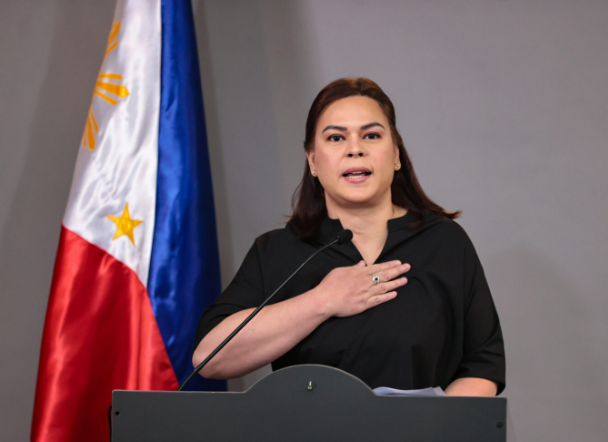
Vice President Sara Duterte moved swiftly to frame a major public gathering along Manila's EDSA avenue as a referendum on President Ferdinand Marcos Jr's administration, declaring on Tuesday that the assembled crowds embodied a "growing sentiment" she has championed throughout 2024. Speaking with apparent confidence in the political moment, Duterte positioned herself as an interpreter of public grievance, suggesting that thousands taking to the streets validated her long-standing criticisms of the sitting president's stewardship of the nation.
The immediate context for Duterte's remarks involved tens of thousands of members from the Iglesia ni Cristo, one of the country's most organized religious movements, who converged on EDSA to protest what they characterized as selective enforcement of justice and distortion of legal processes. The church's mobilization specifically concerned the filing of a plunder complaint against Senator Rodante Marcoleta, whom the organization viewed as unfairly targeted. However, Duterte seized on the broader pageantry of the rally to articulate a much wider indictment of Marcos administration performance, transforming what began as a religious organization's specific grievance into a symbol of generalized discontent.
At the heart of Duterte's critique lay an economic argument, one with particular resonance for Malaysian and regional observers watching Philippine politics unfold. She accused Marcos of remaining detached from the daily struggles confronting ordinary Filipinos—spiralling prices for basic goods, employment insecurity, and the general erosion of purchasing power in households across income brackets. Rather than marshalling concrete policy responses to these material challenges, the vice president contended, the administration had instead opted to delegitimize critics through accusations of wrongdoing. This rhetorical strategy, she suggested, amounted to substituting solutions with suppression.
Duterte's language escalated beyond mere policy disagreement into constitutional territory, invoking the foundational principles of democratic governance. She characterized the administration's approach toward political opponents and skeptical voices as fundamentally at odds with the freedoms enshrined in Philippine law. Those who questioned alleged corruption within Malacañan Palace, who assessed the president's performance unfavourably, or who levelled accusations against Marcos himself, she argued, faced institutional pressure designed to chill legitimate discourse. This framing transforms her political opposition from partisan disagreement into a defence of democratic norms themselves—a rhetorical move that carries particular weight in a region where concerns about democratic backsliding remain salient.
The vice president went further in characterizing what she termed an "increasingly oppressive political environment" as reflective of leadership failures at the most fundamental level of character. She suggested that a government responding to criticism through intimidation rather than engagement commits an act of institutional self-sabotage, undermining the very democratic machinery it claims to defend. This argument operates on multiple registers simultaneously: it attacks Marcos's competence, questions his commitment to democratic principles, and positions Duterte as guardian of institutional integrity.
Notably, Duterte reframed the entire dispute as transcending ordinary partisan politics. She contended that what unfolds between her camp and the Marcos administration now concerns "the honor of the State" rather than narrow factional interests. This rhetorical move carries strategic significance for her political positioning, elevating her criticism above the realm of personal or political rivalry into questions of national character and collective future. For an audience watching from Malaysia and elsewhere in Southeast Asia, such language echoes broader regional anxieties about the health of democratic institutions and the capacity of governments to respond constructively to dissent rather than resorting to coercive measures.
The backdrop to Duterte's statements involves escalating institutional conflict between herself and the Marcos administration. The House of Representatives impeached the vice president on grounds including alleged threats directed at Marcos and his wife, unexplained accumulations of wealth, and allegedly improper handling of confidential government funds. Rather than a resolution, this legal action intensified political tensions. The Senate Impeachment Court was scheduled to commence her trial on July 6, converting what might have remained a political dispute into a formal constitutional proceeding with potentially significant ramifications for her political future and the broader trajectory of Philippine governance.
Duterte's deployment of the EDSA rally as a political vindication reflects an understanding that public mobilization, particularly when involving organized religious groups with substantial membership and institutional capacity, carries symbolic weight in Philippine politics. EDSA itself holds historical resonance as the site of the 1986 People Power Revolution that ousted Ferdinand Marcos Sr, the current president's father. The invocation of EDSA in opposition to Marcos Jr therefore carries layered historical meaning, connecting contemporary grievances to the founding narrative of post-authoritarian Philippines.
The substantive grievances Duterte articulated—economic hardship, inflation, employment precarity—represent genuine concerns affecting broad segments of the Philippine population. These issues transcend factional politics and connect to material conditions that shape daily lives across income levels. Malaysia's own experience with inflation pressures and cost-of-living concerns during comparable economic periods suggests that such issues possess considerable mobilizational potential when citizens perceive governmental indifference or incompetence in addressing them. The resonance of Duterte's economic critique thus extends beyond narrow Philippine partisan interest.
From a regional perspective, the unfolding drama between Duterte and Marcos illuminates broader questions about democratic resilience in Southeast Asia. The simultaneous occurrence of major public gatherings, impeachment proceedings, and escalating accusations between senior officials demonstrates both democratic capacity—legal mechanisms for accountability do exist and function—and democratic stress. The question of whether governance challenges receive principled policy responses or whether they become submerged in personalised institutional conflict between leaders remains unresolved and consequential for the region's democratic trajectory.

