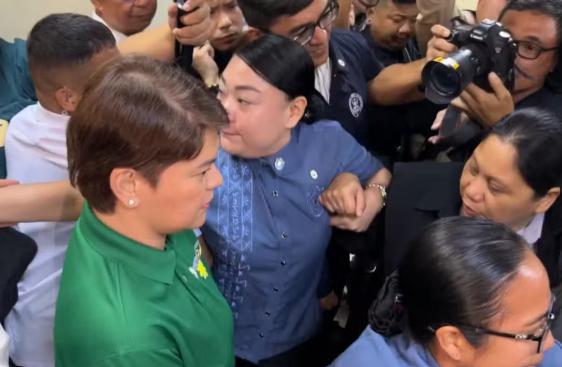
Philippine Vice President Sara Duterte has adopted defiant rhetoric surrounding her impeachment trial, declaring on Tuesday that whilst the proceedings may wound her politically, she will not yield or surrender. Arriving at the Senate to consult with her legal team, Duterte told reporters: "In this bloodbath and bludgeoning, I will be bloodied but unbowed." The phrasing deliberately channels William Ernest Henley's famous poem "Invictus," a work centred on themes of perseverance and refusal to capitulate when facing overwhelming difficulty. The literary reference underscores Duterte's effort to position herself as a figure of principled resistance rather than a politician defending against serious constitutional charges.
Duterte's latest comments represent a continuation of rhetoric she initiated in May 2025, when she first characterised her impeachment proceedings as a "bloodbath" and indicated she actively wanted the trial to proceed. Her phrasing has proven controversial, drawing criticism from political opponents and observers who note the apparent contradiction between her earlier statements expressing eagerness for the trial and her subsequent absence from most House impeachment hearings across 2025 and 2026. This pattern of engagement has fuelled questions about the sincerity of her rhetorical defiance and whether her framing serves primarily as a messaging strategy rather than a reflection of her actual litigation approach.
The charges Duterte confronts represent a substantial threat to her political future and constitutional standing. Four Articles of Impeachment detail allegations spanning financial impropriety, unexplained wealth accumulation, procurement irregularities, and threats against national leadership. Article I concerns the alleged misuse of approximately 612.5 million Philippine pesos in confidential funds—comprising 500 million pesos from her Office of the Vice President and 112.5 million pesos from the Department of Education. These allegations strike at questions of governmental fiscal accountability and the proper management of public resources entrusted to senior executive officials.
Article II raises concerns regarding Duterte's financial disclosures and asset declarations. The charge encompasses allegations of unexplained wealth, incomplete or misleading statements in her Statements of Assets, Liabilities and Net Worth filings spanning 2022 to 2024, and her failure to properly divest business interests or separate herself from commercial ventures. Such allegations carry particular weight in Philippine governance, where transparency in official wealth declarations remains a cornerstone of anti-corruption frameworks. The implications extend beyond Duterte personally to broader questions about elite accountability and whether high officials face meaningful consequences for disclosure violations.
Article III alleges bribery and irregularities in procurement processes involving Department of Education officials. This charge potentially implicates Duterte in systematic abuse of her executive authority to benefit particular vendors or contractors whilst compromising the integrity of government purchasing procedures. Such allegations, if substantiated, would suggest deliberate manipulation of processes designed to ensure competitive bidding and fiscal prudence in educational spending—a sector whose integrity directly affects service delivery to Philippine students and institutions.
The final charge, Article IV, represents perhaps the most serious in its implications. Duterte faces allegations of making assassination threats against President Ferdinand Marcos Jr., first lady Liza Araneta-Marcos, and former House Speaker Martin Romualdez. Such allegations transcend typical political disputes and implicate questions of national security, the safety of senior government officials, and the stability of constitutional governance. These charges suggest conduct fundamentally inconsistent with the responsibilities of vice-presidential office and the constitutional oath to uphold the nation's laws.
The procedural trajectory of the trial carries significant implications for the Philippine political system. The proceedings are anticipated to extend ninety-two days, potentially stretching into early 2027 before conclusion. Conviction requires the affirmative vote of at least two-thirds of all senator-judges under the 1987 Constitution—a supermajority threshold that historically reflects the Constitution's framers' intent to preserve impeachment as a serious remedy reserved for extraordinary circumstances rather than routine political disagreement. This requirement ensures that removal from office demands overwhelming consensus rather than simple majority sentiment, though it simultaneously permits motivated minorities to prevent accountability.
For Malaysian readers and Southeast Asian observers, Duterte's impeachment proceedings merit attention as a contemporary test of constitutional institutions and democratic accountability mechanisms. The Philippines shares with Malaysia a presidential system of government, constitutional frameworks addressing executive accountability, and ongoing debates regarding the balance between executive prerogatives and legislative oversight. The proceedings demonstrate how high-stakes constitutional conflicts between branches of government can unfold in democratic contexts where formal legal processes exist but operate within politically charged environments.
The trial's outcome will carry implications extending beyond Duterte's individual political fate. Conviction and removal would signal that Philippine constitutional mechanisms can constrain even powerful political figures; acquittal or inability to achieve the supermajority threshold might suggest that such mechanisms function primarily as tools of partisan advantage rather than genuine accountability. Either result would send signals to Philippine political actors regarding the practical efficacy of impeachment processes and the costs associated with various forms of alleged misconduct.
Duterte's invocation of "Invictus" and rhetorical framing as a figure facing overwhelming adversity warrants examination as a component of her litigation strategy. By positioning herself as a martyr to political persecution rather than a public servant answering serious charges, she appeals to narratives of resilience and victimhood that resonate in Philippine political culture. Whether such framing influences senator-judges' deliberations, public opinion, or the ultimate trajectory of proceedings remains uncertain, though it demonstrates how impeachment trials function simultaneously as legal proceedings and as contests for political narrative control.
The months ahead will determine whether Duterte's declared resolve translates into successful navigation of constitutional challenges or whether the substantial weight of allegations results in conviction and removal. The proceedings will test the independence and impartiality of the Senate sitting as a court of impeachment, the willingness of political actors to transcend partisan loyalties in voting on charges, and the broader functionality of constitutional accountability mechanisms in the Philippine democratic system. For regional observers monitoring democratic institutions across Southeast Asia, the trial's progression and outcome will offer important insights into how contemporary democracies balance executive power, legislative oversight, and individual accountability.

