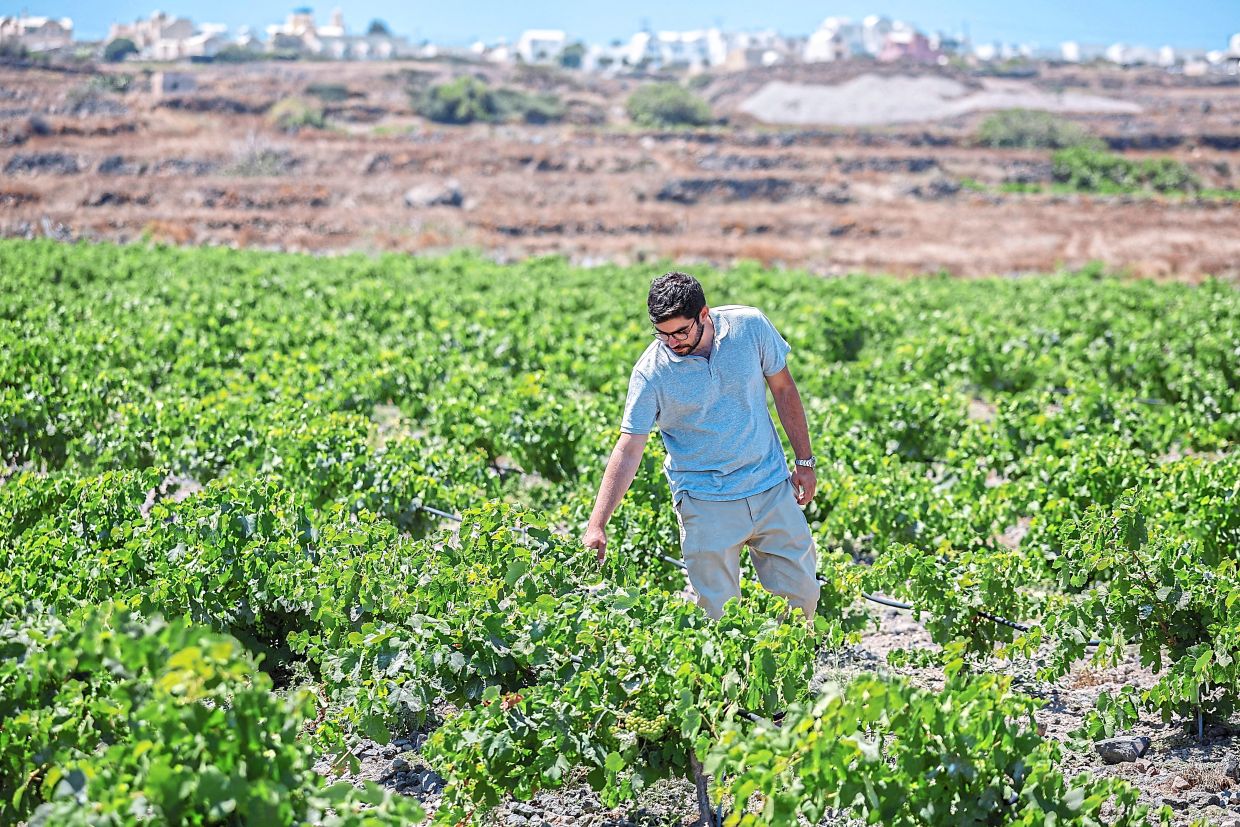
The ancient art of winemaking on the Greek island of Santorini faces an unprecedented reckoning as climate change transforms one of Europe's most celebrated wine regions into an increasingly inhospitable landscape. In terraced vineyards across the sun-scorched volcanic slopes, winemakers are witnessing the death of vines that have endured for nearly a century, unable to withstand the combined assault of minimal rainfall and temperatures that have soared to historic extremes over the past three years. The crisis has become so acute that it is forcing producers to fundamentally reimagine cultivation techniques that have been passed down through generations, challenging the very definition of what it means to produce authentic Santorini wine in an era of climate volatility.
Yiannis Boutaris, a sixth-generation winemaker who oversees Domaine Sigalas winery—now integrated into the Kir-Yianni family of wine estates—has become a face of this transformation. Recently, he stood in his vineyard beside a "kouloura", the distinctive basket-shaped vine training method unique to Santorini, pointing to what was once a thriving 90-year-old plant now rendered lifeless by relentless drought and heat. The death of such venerable vines, whose longevity traditionally symbolized the enduring nature of Santorini's winemaking heritage, underscores the magnitude of environmental pressures bearing down on the island's viticulture. What makes Boutaris's situation particularly emblematic is that his winery sources grapes from multiple vineyards, meaning the crisis affects not only his own land but the broader supply network that supports the island's wine economy.
The consequences of this climatic upheaval extend far beyond individual vineyard losses. Across Santorini between 2023 and 2025, the combination of low rainfall and extreme heat has triggered a cascade of economic disruptions: grape prices have surged substantially, wine production volumes have contracted, and anxieties about future water availability have intensified to crisis levels. The situation reflects a pattern spreading across Greece more broadly, where climate change is fundamentally altering precipitation patterns and temperature regimes, creating an environment increasingly hostile to Mediterranean agriculture. For Santorini specifically, an island with limited freshwater resources and a population swollen by millions of annual tourists, the convergence of agricultural decline and water scarcity represents an existential threat to both economic viability and cultural continuity.
Faced with this reality, Boutaris and his peers are not retreating into nostalgia but instead pursuing aggressive innovation. He is spearheading a pilot initiative developed in collaboration with local authorities and scientific researchers to repurpose wastewater from residential buildings and tourist hotels as irrigation for vineyards. This approach, already established in water-stressed regions like California, promises to deliver both environmental and economic advantages. By recycling water that would otherwise be discharged or require expensive treatment, the system circumvents the need for desalinated water—a resource-intensive and costly alternative that strains both budgets and energy infrastructure. The reuse model thus represents a pragmatic pathway toward sustainability that acknowledges the region's physical constraints while maintaining productive capacity.
Beyond wastewater recycling, Boutaris is experimenting with structural changes to vineyard layout itself. Traditionally, Santorini vines are scattered irregularly across the landscape in patterns refined over centuries. He is now testing the cultivation of vines in organized rows—a departure from convention that dramatically improves irrigation efficiency by enabling systematic water distribution and minimizing waste through runoff. Complementing this shift is an experimental atmospheric water harvesting system that captures ambient moisture using specialized hydrogels, then extracts that moisture as usable water by applying heat generated from solar panels. This technology represents a frontier application in arid agriculture, effectively mining the sky itself for resources rather than depending exclusively on underground reserves or imported supplies.
Stefanos Koundouras, a viticulture specialist at Aristotle University in Thessaloniki, has documented the severity of climatic deterioration with scientific precision. He characterizes 2023 and 2024 as years when Santorini reached "a limit of dramatic conditions", with temperatures registering as the highest in six decades of recorded data. His research indicates that escalating heat and desiccation are not merely challenges for individual islands but portend broader systemic risks to wine production across Europe, particularly in Mediterranean zones where tourism, agriculture, and domestic consumption compete fiercely for scarce water. Koundouras observes that these environmental pressures are already manifesting in measurable declines in wine quality and the distinctive character that has defined regional varieties—suggesting that climate change threatens not only production volume but the fundamental sensory and chemical properties that consumers associate with Santorini wines.
The competitive pressures for water intensify considerably during summer months when tourism peaks. Hotel operators, swimming pool facilities, and agricultural producers all bid for limited freshwater supplies, creating a zero-sum dynamic that frequently disadvantages farmers despite their foundational role in regional identity and economy. This competition starkly illustrates how climate-driven scarcity doesn't simply reduce absolute availability but reshapes power relationships and resource allocation priorities. Unlike northern Greek wine regions where a kilogram of grapes costs merely €0.80 (approximately RM3.70) due to abundant water and cooler conditions, Santorini's grapes command premium prices precisely because of environmental constraints—a situation that paradoxically incentivizes continued cultivation even as sustainability becomes more precarious.
Yiannis Papaeconomou, another Santorini winemaker managing six-year-old vineyards, is similarly embracing the wastewater irrigation pilot program while simultaneously implementing complementary conservation measures. He has installed subsurface irrigation systems that deliver water directly to root zones rather than applying it from above, dramatically reducing evaporative losses in the intense summer heat. He is also restructuring vine trellising configurations to optimize water delivery efficiency and reduce exposure to drying conditions. Papaeconomou's multi-pronged approach reflects an emerging consensus among Santorini producers that survival requires simultaneous adoption of multiple adaptive strategies rather than reliance on any single technological or methodological innovation.
The broader implications of Santorini's crisis extend throughout Southeast Asia and other regions facing similar climate pressures. As global temperatures rise and precipitation becomes increasingly erratic, agricultural communities dependent on traditional water sources and established cultivation methods will confront comparable adaptation imperatives. The pioneering efforts of Greek winemakers—experimenting with wastewater recycling, atmospheric water harvesting, and modified cultivation patterns—generate transferable knowledge for tropical and subtropical producers grappling with drought intensification. Malaysia, with its own vulnerabilities to changing monsoon patterns and water stress in certain regions, may find valuable lessons in Santorini's adaptive strategies as climate projections suggest more frequent dry periods despite the nation's general abundance of precipitation.
Ultimately, the transformation underway in Santorini's vineyards represents neither simple defeat nor triumphant technological salvation, but rather a difficult reckoning with planetary boundaries. Winemakers are consciously abandoning romantic attachments to traditional methods while simultaneously endeavoring to preserve the cultural and gustatory essence of their product. This balance between adaptation and continuity will determine whether Santorini maintains its position as a premium wine region or gradually cedes ground to cooler, wetter areas less immediately threatened by climate volatility. The experiments now underway—wastewater reuse, atmospheric water harvesting, modified cultivation geometries—constitute the first generation of responses to what many climate scientists regard as permanent shifts in Mediterranean climatic regimes. Whether these innovations prove sufficient remains perhaps the central unresolved question haunting Greek agriculture as the coming decades approach.

