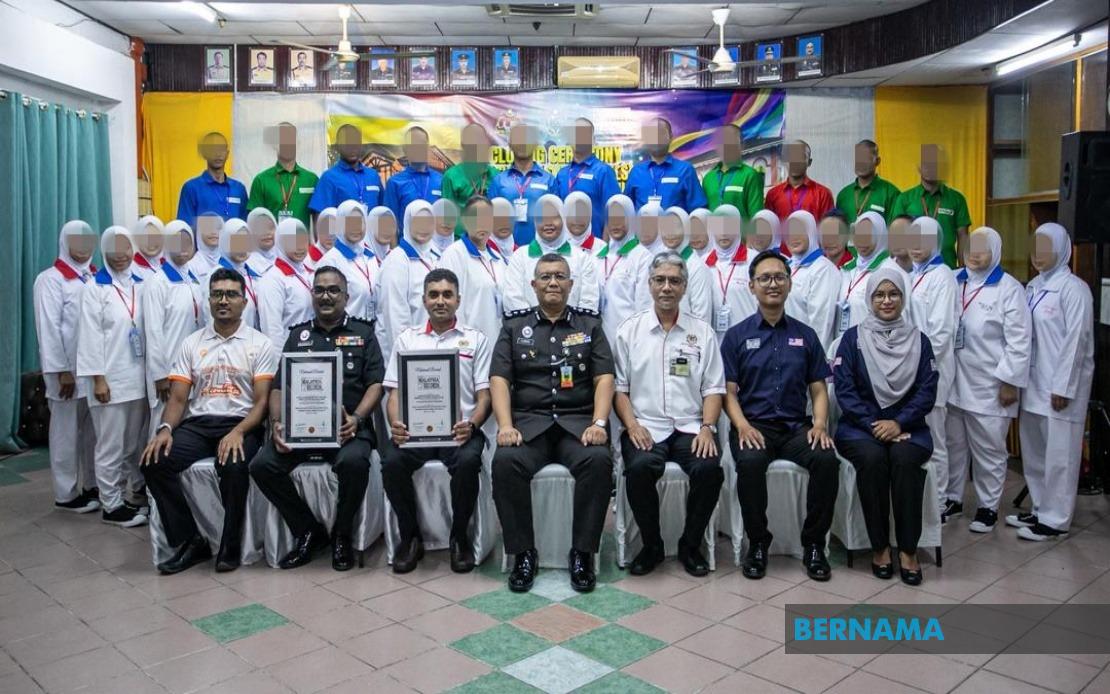
Home Minister Datuk Seri Saifuddin Nasution Ismail has publicly recognised the Malaysian Prisons Department's achievement in earning a Malaysia Book of Records accolade, specifically for the Batu Gajah Correctional Centre's delivery of a comprehensive Basic Life Support and Automated External Defibrillator training programme that engaged 42 inmates. The distinction marks a significant moment for the nation's correctional system, underscoring a fundamental philosophical shift in how institutional leadership approaches the management and development of incarcerated individuals.
The recognition carries deeper meaning beyond the administrative accomplishment of setting a record. Saifuddin's public endorsement signals that Malaysia's correctional framework has moved decisively away from a purely punitive model towards one centred on genuine rehabilitation and skills acquisition. This distinction matters considerably in a region where prison systems have often been criticised for prioritising containment over meaningful transformation. By highlighting this initiative, the minister is actively reshaping public perception of what prisons can and should achieve within the broader criminal justice landscape.
The decision to equip inmates with life-saving medical competencies reflects a strategic understanding that rehabilitation programmes must be tangible, transferable, and immediately valuable. Basic Life Support and defibrillator training represent practical knowledge that participants can carry into civilian life, whether through employment in healthcare, security, or community service sectors. This approach contrasts with purely theoretical educational offerings and demonstrates how correctional institutions can bridge the gap between incarceration and productive reintegration.
Saifuddin's statement emphasises that the programme instils not merely technical competencies but also deeper humanitarian values, personal discipline, responsibility, and self-confidence among participants. These psychological and ethical dimensions address a critical challenge in rehabilitation—many individuals leaving correctional facilities lack the emotional and psychological foundation necessary for successful reintegration. By weaving life-saving training into a framework that develops character alongside skills, the Batu Gajah programme tackles this multifaceted challenge comprehensively.
The philosophical positioning articulated by the minister—that prisons function as rehabilitation institutions offering individuals a genuine second chance—carries particular resonance in Malaysia's context. With prison populations continuing to grow across Southeast Asia, the question of how systems transform rather than perpetuate criminal behaviour remains politically and socially urgent. When senior government figures publicly champion rehabilitation-focused initiatives, they create political space for expanded investment in similar programmes across the broader prison network.
The involvement of 42 inmates in this particular training course, while specific to Batu Gajah, represents a template for replication across other correctional facilities nationwide. If similar programmes were scaled systematically, thousands of individuals could gain marketable qualifications during their sentences, fundamentally altering their prospects upon release. This scalability is crucial—isolated success stories matter less than systemic adoption that creates consistent pathways to reintegration.
From a public health perspective, ensuring that individuals with correctional experience possess emergency medical response capabilities benefits entire communities. Released persons trained in BLS and AED techniques can serve as safety resources in their neighbourhoods, contributing positively to public welfare while simultaneously reinforcing their own sense of purposefulness and community contribution. This mutual benefit dynamic strengthens the case for embedding such programmes across institutional settings.
The Malaysia Book of Records recognition, while symbolic, provides institutional validation that elevates the Batu Gajah initiative beyond routine operational activity. Such external acknowledgment can attract media attention, encourage other facilities to develop comparable programmes, and provide evidence-based support for policy discussions about resource allocation to rehabilitation versus custodial functions. Recognition mechanisms thus serve as practical tools for advancing correctional reform.
Saifuddin's expressed hope that additional high-impact programmes will be implemented signals ministerial commitment to expanding this vision across the prison system. However, such expansion requires sustained funding, staff training, and coordination across multiple correctional facilities operating under varying constraints. The challenge lies in translating ministerial enthusiasm into concrete resource commitments and institutional practices that persist beyond individual leadership tenures.
The broader implication for Malaysia and the region involves recognising that modern correctional administration must balance security, humanity, and functionality. Nations investing strategically in rehabilitation—particularly through practical skills training that creates employment pathways—report measurably lower recidivism rates compared to purely punitive systems. Southeast Asian governments increasingly understand that treating prisons as development institutions rather than merely warehousing facilities generates positive externalities for crime reduction, family stability, and economic productivity.
For Malaysian policymakers, this initiative at Batu Gajah provides a concrete example of how correctional philosophy can be operationalised through concrete, measurable programmes. The question now extends beyond celebrating individual successes to systematically integrating similar approaches throughout the prison network, ensuring that rehabilitation becomes standard practice rather than exceptional occurrence.

