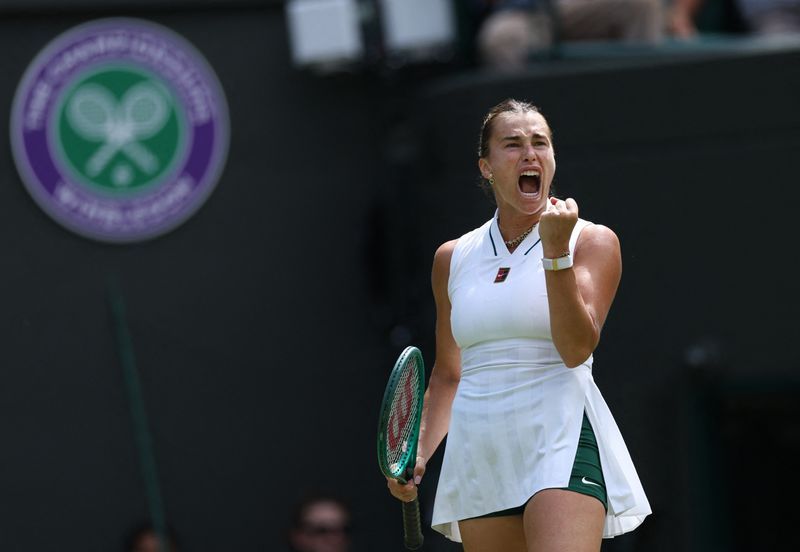
Aryna Sabalenka's temperamental relationship with Wimbledon's notoriously unpredictable grass courts manifested itself once again on Wednesday, as the Belarusian world number one required all her competitive instincts to fend off a spirited American challenger. In a match that swung dramatically from domination to desperation, Sabalenka ultimately prevailed over McCartney Kessler with a 6-1 7-6(9) scoreline at the All England Club, but not before enduring a second-set ordeal that tested both her composure and technical repertoire.
The opening set provided little drama, with Sabalenka dictating play from the baseline and executing her aggressive ground-stroke game with precision across the slippery surface. Yet once Kessler found her rhythm in the second set, launching an onslaught of penetrating forehands and refusing to be intimidated by her higher-ranked opponent, the complexion of the encounter transformed entirely. When Kessler surged to a commanding 5-2 advantage, Sabalenka's frustration boiled over visibly—she repeatedly slapped her own thigh between points, a gesture revealing the internal turmoil that often accompanies her struggles with grass-court tennis.
Kessler's emergence as a genuine threat carried particular significance given her remarkable run through the opening rounds. The American had become the sole competitor in this year's tournament to reach the second stage without surrendering a single game, a statistic that underscored both her current form and the challenge she posed to the tournament favourite. The Philadelphia-based player sensed an opportunity to extend her momentum further, capturing two set points at 5-3 and then mounting successive threats during the tiebreak itself.
What unfolded during these crucial junctures illustrated the gulf in Grand Slam experience and raw power between the two competitors. Sabalenka's superior ability to generate pace from seemingly impossible positions, combined with her nerve in high-pressure moments, proved decisive. When it mattered most, her shot-making transcended technical execution and became almost primal—a demonstration of sheer will through the court. After one hour and 39 minutes of compelling tennis, Sabalenka finally converted her third match point to secure passage through to the next round, exhaling visibly as Kessler's challenge expired.
For Sabalenka, the victory carries significance that extends beyond mere tournament progression. Winning a Grand Slam title on grass courts has long represented an unfulfilled ambition in her career, a gap in her resume that continues to attract scrutiny given her dominance across other surfaces. Her three previous Grand Slam titles have all arrived on hard courts, where her aggressive baseline game functions as an almost unstoppable force. Grass courts, by contrast, demand different tactical approaches and technical adjustments—the reduced bounce and increased pace reward different skills, and Sabalenka's journey to acclimate represents an ongoing process.
The relief etched across Sabalenka's face immediately after the match reflected not just the intensity of the battle she had endured, but the psychological weight of maintaining her quest for Grand Slam success across different surfaces. In her post-match remarks, she acknowledged the examination that Kessler had imposed upon her temperament and technical resilience. The top seed recognised that her opponent had executed a hostile gameplan with considerable effectiveness, particularly through aggressive shot selection and refusal to defer to her ranking or seeding status.
Sabalenka's advancement sets up a third-round encounter against Latvia's Jelena Ostapenko, a former Grand Slam champion who possesses her own formidable grass-court credentials and aggressive playing style. That matchup promises further examination of Sabalenka's ability to impose her game upon the surface while managing the volatility that characterises her performances at Wimbledon.
The broader narrative of Sabalenka's Wimbledon campaign will likely centre on her capacity to sustain the intensity and confidence required to navigate the tournament's later stages. Her first-round dismissal of Petra Marcinchenko proceeded with comparative ease, yet this second-round encounter revealed the vulnerability that can surface when opponents challenge her physical dominance and mental resolve simultaneously. Kessler's near-miss serves as a reminder that even the world's top-ranked player requires periods of adaptation when competing on unfamiliar terrain.
For Malaysian tennis enthusiasts and regional sports observers, Sabalenka's struggles on grass represent a broader lesson in the sport's technical diversity. Southeast Asia's rising tennis talent may find instructive value in observing how even the most talented and physically gifted competitors must consciously work to bridge surface-specific gaps in their games. The systematic approach required to transform grass-court capability from weakness into genuine strength offers a template worth studying for any athlete seeking to achieve consistent excellence across the sport's varied disciplines.

