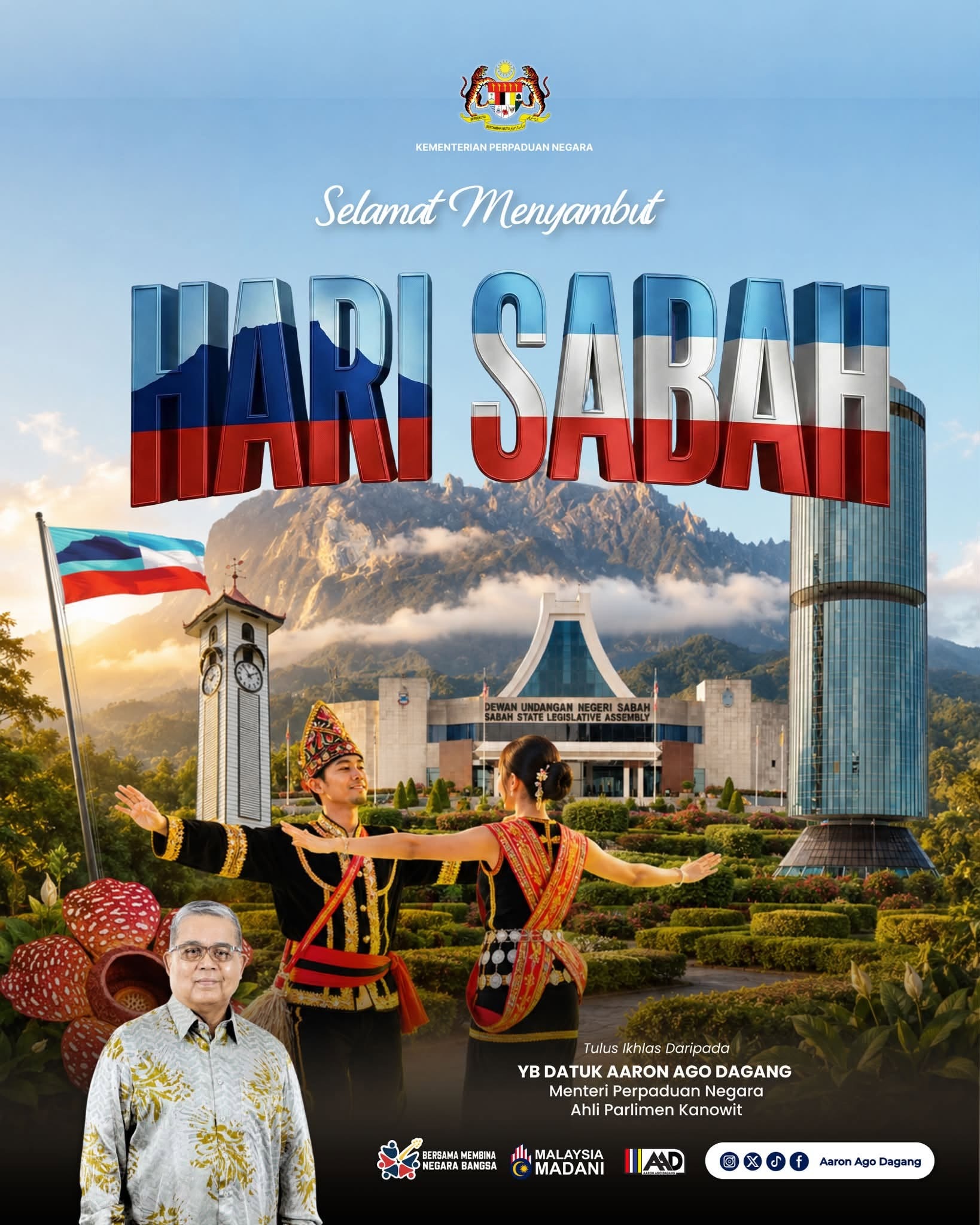
National Unity Minister Datuk Aaron Ago Dagang has highlighted Sabah's remarkable ethnic composition as a defining asset not just for the state but for Malaysia as a whole, underscoring how the region's multicultural character reflects the nation's broader multiracial foundation. Speaking on Sabah Day on August 31, the minister emphasised that the state's strength lies precisely in the coexistence of dozens of distinct communities, each contributing unique cultural threads to the broader national tapestry.
Sabah is home to 35 distinct ethnic groups alongside 217 sub-groups, according to Datuk Aaron's remarks. This extraordinary diversity encompasses well-established communities such as the Kadazan, Dusun, Bajau, Murut, Rungus, Bisaya, Lotud, and Lundayeh peoples, among many others. Each of these communities maintains its own linguistic heritage, customary practices, traditional attire, musical traditions, dance forms, and accumulated cultural knowledge that has developed over generations. Together, these communities have woven the intricate cultural fabric that makes Sabah distinctive within Malaysia and indeed across Southeast Asia.
The minister's framing of diversity as a unifying force rather than a divisive one carries particular significance in the contemporary Malaysian context. Rather than viewing differences in language, religious belief, customary practice, and lifestyle as potential sources of conflict, Datuk Aaron positioned these variations as the foundation upon which meaningful harmony can be constructed. This perspective reflects an understanding that cohesion in multiethnic societies is not achieved through homogenisation but through deliberate cultivation of mutual understanding, respect, and genuine acceptance among communities that maintain their distinct identities.
Sabah's historical journey provides important context for understanding how this diversity has evolved. The region's complex past encompasses the North Borneo colonial period, administration under the British North Borneo Company, the traumatic years of Japanese occupation during World War II, and subsequent British rule. This layered history shaped the social and political foundations upon which Sabah would establish itself as a self-governing entity in 1963. The transition from colonial administration to self-governance represented a pivotal moment when Sabah's diverse communities came together to forge a shared political future.
The formal incorporation of Sabah into the Malaysian federation occurred on September 16, 1963, when the newly independent state joined Peninsular Malaysia, Sarawak, and Singapore to establish the Federation of Malaysia. This union fundamentally altered Sabah's trajectory, positioning it within a larger national framework while preserving significant degrees of state autonomy under the Malaysian federal structure. For many Sabahans, this moment represented the culmination of aspirations for self-determination while simultaneously anchoring the state within a broader multiethnic nation-state project.
Datuk Aaron's message carries an implicit call for remembrance and acknowledgment of those who came before. The minister specifically invoked the contributions made by historical figures and past generations whose labour, intellectual energy, and personal sacrifices laid the groundwork for Sabah's development. Recognising these foundational contributions serves multiple purposes: it validates the experiences of earlier generations, provides historical legitimacy for current national narratives, and establishes a moral framework for understanding contemporary responsibilities.
Central to the minister's address was the transfer of responsibility to the current generation of Sabahans. The framing positions today's younger and working-age populations as stewards charged with advancing the state across multiple dimensions while simultaneously preserving its cultural and historical integrity. This formulation presents a dynamic challenge: to pursue ambitious development goals in education, economic diversification, technological advancement, and infrastructure improvement while maintaining the custodianship of Sabah's distinctive heritage and collective memory.
The designation of August 31 as official Sabah Day represents a relatively recent formal recognition, having been declared by the state government in 2024. This official commemoration provides an annual occasion for public reflection on Sabah's identity, historical significance, and contemporary aspirations. Such commemorative days serve important functions in nation-building processes, creating regular opportunities for citizens to engage with shared narratives and renew collective commitments to common values.
For Malaysian observers beyond Sabah, the minister's articulation of diversity as strength carries implications for broader national discourse on multiculturalism and social cohesion. At a time when plural societies globally face periodic tensions around identity, integration, and belonging, Sabah's demonstrated capacity to maintain stable multiethnic coexistence while celebrating distinct cultural expressions offers a substantive example of how difference can constitute a source of collective enrichment rather than inevitable conflict. The model suggests that intentional cultivation of intercommunal respect, coupled with institutional frameworks that protect minority rights and cultural expression, can generate both social stability and dynamic cultural vibrancy.

