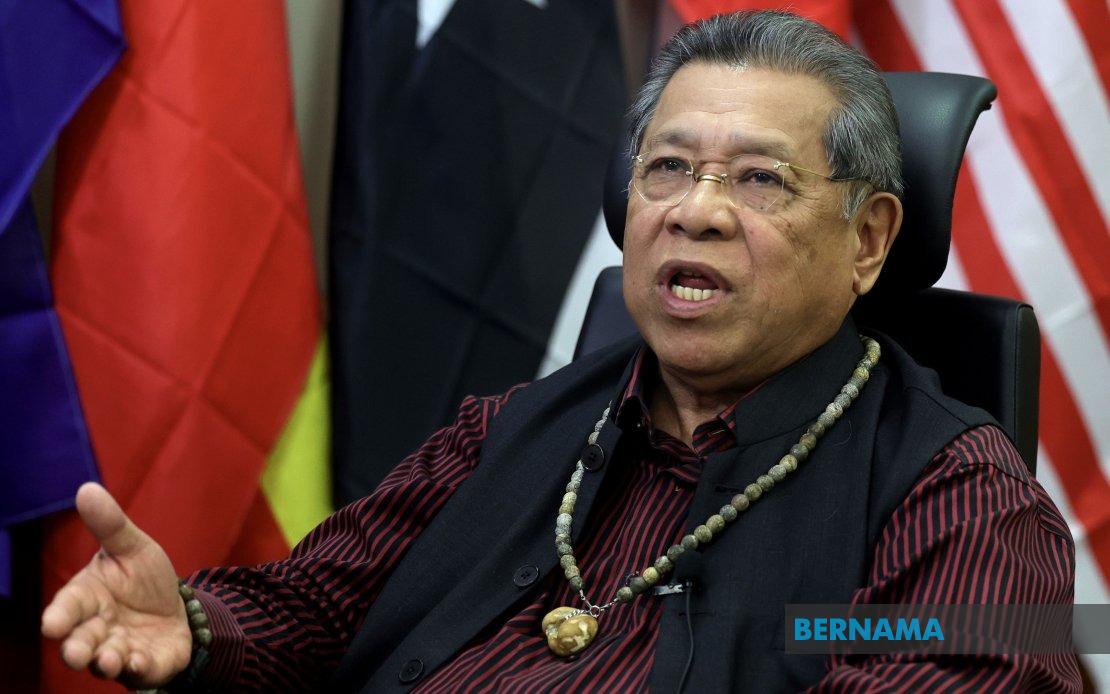
The substantial elevation in federal support directed toward Sabah is positioned to catalyse a wave of infrastructure and development initiatives across the state, according to United Sabah National Organisation (USNO) president Tan Sri Pandikar Amin Mulia. Speaking at the 2026 PKR National Congress held at the Melaka International Trade Centre in Ayer Keroh, Pandikar Amin underscored how the enlarged budget allocation would empower state authorities to undertake more extensive projects benefiting residents. The trajectory of accelerated growth, he noted, extends beyond purely provincial gains, contributing meaningfully to the national economic advancement and competitiveness of Malaysia as a whole.
Prime Minister Datuk Seri Anwar Ibrahim's administration has dramatically expanded its fiscal commitment to the East Malaysian state. The federal allocation has climbed 35 per cent over a four-year span, rising from RM13 billion in 2022 to RM17.6 billion in 2026. This represents a shift in resources that reflects changing political realities in Sabah, where competition for state support has intensified following demographic and electoral shifts. The magnitude of this increase—an additional RM4.6 billion over the baseline four years ago—signals serious governmental intention to address long-standing infrastructure deficits and service delivery gaps that have characterised the resource-rich state.
Sabah's geographic remoteness from the peninsular centre has historically complicated equitable resource distribution. As a major agricultural and energy producer contributing substantially to national output, the state has nonetheless experienced development asymmetries relative to its economic significance. The funding announcement therefore addresses persistent grievances within Sabah's political ecosystem, where concerns about marginalisation have periodically threatened federal coalition stability. By demonstrating tangible financial commitment, the MADANI administration seeks to entrench support among state-based parties and constituencies that remain critical to parliamentary majorities.
Pandikar Amin's public endorsement of Prime Minister Anwar Ibrahim carries particular weight within Sabah's fractious political environment. His assertion that the nation still requires Anwar Ibrahim's stewardship, both domestically and internationally, reflects broader calculations among moderate state leaders who recognise the trade-offs between factional advantage and national governance continuity. The USNO president's positioning suggests that substantive policy delivery—in this case, budgetary allocation—remains the currency through which federal leaders maintain coalition cohesion in competitive electoral states.
The Prime Minister has simultaneously confronted allegations that the MADANI Government dispenses resources inequitably across Malaysia's constituent states. Anwar rejected such contentions, arguing instead that differential allocations reflect divergent development priorities and strategic investments rather than political favouritism or neglect. This framing acknowledges the inevitability of allocation variance while asserting rational governance criteria rather than partisan distribution. The explanation carries weight particularly for states fearing marginalisation under administrations perceived as geographically biased.
For Malaysian federalism, such budgetary announcements encapsulate fundamental tensions between centralised resource command and devolved state authority. Sabah and Sarawak, possessing constitutional status distinct from peninsular states, maintain heightened sensitivities regarding fiscal autonomy and equitable treatment. The 35 per cent increase partially addresses these concerns by demonstrating that major developmental investment can proceed through federal channels while respecting state-level governance structures. This model, if sustained, offers template relevance for managing centre-state relations in Southeast Asian federations confronting comparable pressures.
The timing of this announcement during the PKR National Congress carries strategic significance beyond Sabah specifically. By showcasing substantive achievements in allocating resources, the MADANI administration reinforces its development credentials to party members and the broader electorate ahead of future electoral contests. The PKR, as coalition architect and repository of Anwar Ibrahim's political vision, benefits from demonstrating governance competence and fiscal delivery capacity. This positioning becomes increasingly important as the administration navigates the mid-term recalibration phase when initial policy honeymoon effects typically dissipate.
For Sabah residents, the financial expansion translates into potential employment through construction contracts, expanded public services, and infrastructure projects spanning transportation, education, and healthcare. The magnitude of the increase—roughly RM1.15 billion annually in net new commitments—creates room for meaningful sectoral development that extends beyond symbolic gestures. However, the efficacy of such allocations ultimately depends upon implementation mechanisms, project selection criteria, and accountability frameworks governing expenditure. State capacity constraints and coordination challenges between federal and provincial authorities may limit real-world effectiveness.
Regional implications warrant consideration as well. Neighbouring Indonesian provinces and other Southeast Asian jurisdictions monitor federal spending patterns in Malaysian states as indicators of broader political-economic trends. Generous allocations to Sabah implicitly signal federal commitment to retaining constituent territories, particularly important given historical secessionist movements and cross-border complications. Malaysia's strategic position in the Straits of Malacca and broader maritime Southeast Asia makes stable internal governance a matter of regional significance beyond domestic political cycles.
The announcement also reflects evolving dynamics within Malaysia's coalition politics. The inclusion of USNO alongside traditional peninsular power brokers represents a recalibration of federal consensus-building. By ensuring that Sabah's interests receive visible allocation increases, Anwar Ibrahim demonstrates sensitivity to the political mathematics requiring East Malaysian support. This coalition management represents pragmatic governance rather than ideological commitment, yet proves essential for parliamentary functionality in a system where no single party commands unchallenged majorities.
Moving forward, sustained delivery on these commitments becomes politically necessary. Sabah voters will evaluate the MADANI Government not merely by announced allocations but by visible project completion, service improvement, and economic opportunity generation. The political capital invested in these funding increases can only be recouped through competent implementation. This reality constrains subsequent administrations' flexibility while creating pathways for accountability-based electoral judgment. The precedent of substantial allocation increases establishes baseline expectations that prove difficult to reduce without triggering significant political backlash, particularly among constituencies that view Sabah's development as previously neglected.

