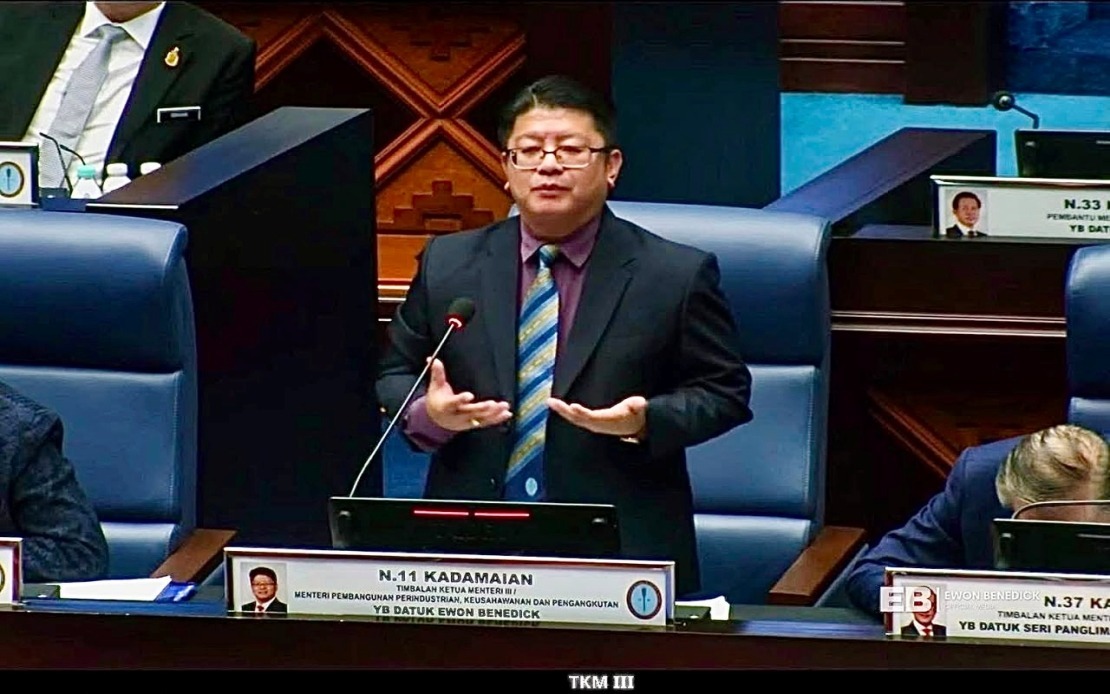
The Sabah state government has moved decisively to resolve a persistent backlog of idle containers clogging Sepanggar Port, with a new fee structure prompting the rapid removal of 103 units that had accumulated for extended periods. Deputy Chief Minister III Datuk Ewon Benedick revealed during state legislative assembly proceedings on July 23 that the action has freed up critical port space, tackling an issue that had created operational inefficiencies and reduced capacity for legitimate cargo handling.
The scale of the container problem had grown severe over time. Some containers had languished at the port for more than 21 days, with certain units remaining idle for as long as 407 days—a situation that represented both wasted infrastructure and lost revenue for the port authority. The prolonged buildup reflected a market failure where the economics of container storage had become distorted, incentivising businesses to leave goods at the port rather than relocating them to commercial warehousing facilities. This dynamic undermined the port's ability to function as a dynamic trade hub.
Ewon, who holds the portfolio of Sabah Minister of Industrial Development, Entrepreneurship and Transport, attributed the previous accumulation to excessively low port tariffs that failed to discourage indefinite storage. By increasing charges, the government introduced a price signal that made extended docking economically unfeasible for container owners. The effectiveness of this market-based approach was immediate—once the new fee structure was announced alongside a clear warning that containers exceeding 21 days could be disposed of under applicable regulations, owners rapidly retrieved their units.
The legislative assembly also passed the Sabah Ports (Privatisation) (Amendment) Bill 2026, which underwent debate before securing approval through majority voice vote. The amendment responds to recent restructuring within the state bureaucracy, transferring port administration from the Ministry of Works and Utilities to the Ministry of Industrial Development, Entrepreneurship and Transport. This portfolio shift necessitated updating legislative definitions to ensure consistent ministerial authority across relevant enactments.
Beyond the administrative realignment, the amendment harmonises terminology within the Sabah Ports (Privatisation) Enactment 1998 with definitions found in the Sabah Ports Authority Enactment 1981, creating clearer legal frameworks for port governance. Such technical amendments, while appearing procedural, enable smoother coordination between regulatory bodies and reduce ambiguity in enforcement. For businesses utilising Sabah's ports, clarity around governance structures reduces uncertainty in compliance requirements.
Conversely, port user associations have raised concerns about the burden imposed by the new charges, prompting calls for review. Ewon indicated the government remains receptive to stakeholder feedback, positioning itself as willing to negotiate terms that balance operational efficiency with commercial viability for users. The ministry has established a task force incorporating representatives from port user associations, shipowners' organisations, and shipping bodies—a structured engagement mechanism designed to facilitate monthly dialogue and consensus-building around pricing structures.
This collaborative governance approach reflects lessons from port management internationally, where unilateral tariff increases often trigger resistance and suboptimal outcomes. By embedding stakeholder representatives in ongoing discussions, the Sabah government creates mechanisms to adjust policy if implementation produces unintended consequences. For Malaysian and Southeast Asian trading enterprises, the inclusion of user voices signals that administrative changes need not be imposed through top-down decree alone.
The parliamentary sitting also advanced other significant legislation. The Sabah Native Affairs Council (Amendment) Bill 2026, presented by Local Government and Housing Minister Datuk Dr Mohd Arifin Mohd Arif, expands the council's mandate to encompass customary education and native customary law preservation. This broadened scope recognises the intersection between economic development—including port infrastructure—and the protection of indigenous heritage and legal traditions in Sabah's multicultural context.
The amendment creates a new post of Native Affairs Officer within the civil service, responsible for receiving complaints, investigating incidents, and managing proceedings involving customary law violations in native courts. This institutional innovation professionalises the adjudication of customary disputes, moving away from informal mechanisms toward documented, accountable processes. Such infrastructure matters particularly for indigenous communities whose land and water rights intersect with development projects like port expansion.
Simultaneously, legislators passed the District Chief, Native Chief and Headman Bill 2026, establishing comprehensive rules governing the appointment, responsibilities, remuneration, and removal of traditional authority figures. The legislation specifies that the responsible minister appoints these officials on District Officer recommendation, with dismissal possible on grounds including incapacity, bankruptcy, criminal or customary offences, misconduct, or relocation outside designated areas. This codification brings previously informal leadership structures within explicit accountability frameworks.
Taken together, these legislative developments reveal Sabah's governing approach: addressing immediate operational inefficiencies like container congestion while simultaneously modernising governance structures and protecting indigenous institutional interests. For port users and the broader business community, the container clearance initiative demonstrates the government's commitment to port functionality. For indigenous communities, concurrent amendments to native affairs legislation signal attention to their institutional preservation amid economic development.
The challenge ahead lies in sustaining balance between the efficiency gains from revised port charges and maintaining commercial confidence among users. Southeast Asian ports compete intensely for regional cargo, and if Sepanggar's fees become uncompetitive relative to alternatives in Peninsular Malaysia or neighbouring countries, traffic may migrate. The monthly consultation mechanism Ewon described will prove critical in monitoring whether the new regime achieves its dual objectives: clearing congestion while sustaining adequate cargo throughput. Success would position Sepanggar as a model for resolving similar infrastructure underutilisation across Malaysian ports.

