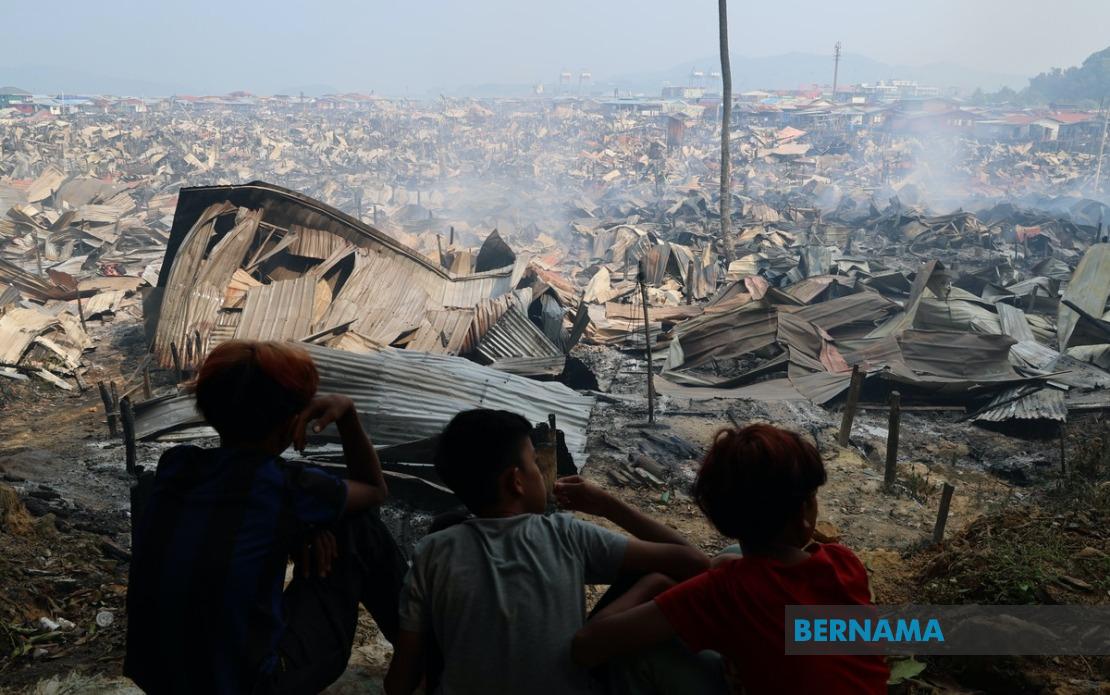
A major fire that swept through Kampung Lok Buta in the Numbak area near Kota Kinabalu has prompted an immediate relief response from the Sabah state government, which announced RM3,000 in financial aid for each Malaysian household head affected by the disaster. The blaze, which erupted shortly before 1.40 am on August 30, razed more than 200 residential structures and left hundreds of residents displaced from their homes. Chief Minister Datuk Seri Hajiji Noor made the aid announcement after visiting the fire victims at a temporary relief centre established at the Likas Multipurpose Hall, where displaced families are currently receiving shelter and basic support.
The RM3,000 assistance package represents a coordinated funding effort involving three entities contributing equally. The state government, federal government, and Yayasan Kebajikan Sabah each pledged RM1,000 towards the relief fund. This tri-level approach demonstrates the shared responsibility across different tiers of governance to address the humanitarian crisis created by the fire. The allocation targets registered Malaysian heads of household, though the government extended humanitarian consideration to non-Malaysian household heads affected by the disaster, offering them RM1,000 in state government aid to ensure no vulnerable population is left without immediate financial assistance.
Beyond the direct cash assistance, the Sabah government has committed to a broader support framework addressing the immediate and longer-term needs of affected families. Authorities are coordinating the provision of essential goods including food supplies and household items to help residents cope with the sudden loss of their possessions and shelter. This immediate humanitarian response aims to ease the shock and disruption caused by the fire, ensuring that basic survival needs are met during the critical initial phase following the disaster.
The state government has also initiated planning for the reconstruction phase, indicating a determination to restore permanent housing for displaced residents. The State Secretary's Office is working in coordination with Majlis Amanah Rakyat (MARA), the federal agency responsible for Bumiputera economic development, to facilitate the rebuilding process. Officials have signalled that decisions regarding reconstruction locations—whether homes will be rebuilt at their original sites in Kampung Lok Buta or relocated to alternative areas—will be made only after careful assessment of site suitability and safety considerations.
The human toll of the fire extends beyond material losses, with three young children losing their lives in the blaze. The deceased included Nana Abdullah, aged four, her six-year-old brother Mohd Asrul, and their eight-year-old cousin Nurfarahdilah Mohd Tajihah. The deaths underscore the severity of the emergency and add a tragic dimension to the displacement crisis facing the community.
For Malaysian readers and the broader Southeast Asian region, the Kampung Lok Buta incident highlights the vulnerability of densely populated residential areas, particularly informal or lower-income settlements that may lack robust fire safety infrastructure and early warning systems. Fires of this scale in residential communities are not uncommon in the region, with similar incidents occurring periodically across Malaysia, Indonesia, and the Philippines. The rapid governmental response in Sabah—with immediate financial assistance and coordination of relief efforts—reflects improving disaster management protocols, though the tragic loss of life raises questions about fire prevention and building safety standards in vulnerable communities.
The fire's destruction of more than 200 homes represents a substantial socioeconomic impact for the affected community. Many residents have lost not only shelter but also personal belongings, documents, and economic assets. The RM3,000 per household allocation, while a meaningful immediate intervention, represents only a partial recovery of losses for families that may have had limited insurance coverage. The reconstruction process will be critical in determining whether affected residents can rebuild their lives in a manner comparable to their pre-disaster circumstances.
The coordination between state and federal authorities, along with the involvement of Yayasan Kebajikan Sabah, demonstrates a structured approach to disaster response in Malaysia. However, the response also raises broader policy questions about disaster preparedness, fire safety enforcement in residential areas, and long-term resilience building in communities prone to such incidents. The integration of MARA into the reconstruction planning is noteworthy, as it positions the rebuilding effort within Malaysia's established institutional framework for supporting affected communities.
For policymakers across Southeast Asia, the Kampung Lok Buta response provides a case study in rapid humanitarian assistance delivery during emergencies. The three-pronged funding approach—combining state, federal, and civil society resources—offers a replicable model for disaster response. Nevertheless, the incident underscores the need for complementary investments in fire prevention, early warning systems, and building code enforcement to reduce the frequency and severity of such disasters in the future, ultimately protecting lives and reducing the burden on government relief systems.

