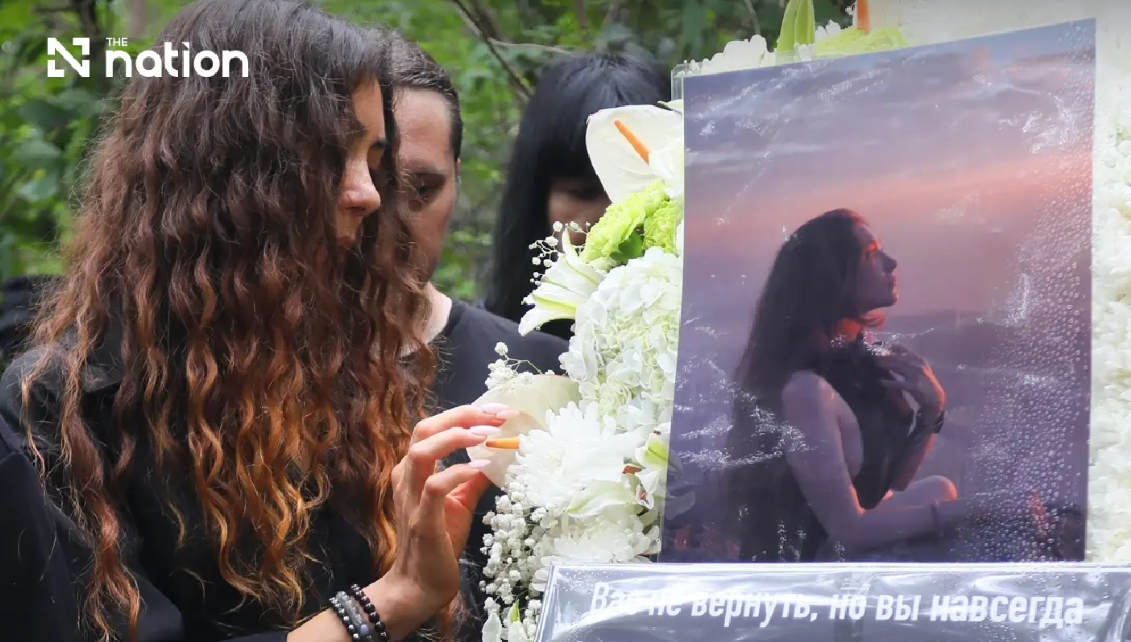
Sharina Nazimova stood before gathered mourners in Chon Buri province on Thursday as monks chanted prayers for her children, siblings Diana and Roman, whose lives were cut short in circumstances that have shaken both the Russian and Thai communities. The memorial service, held at the site in Huai Yai subdistrict where the young Russians were discovered, drew Thai and international attendees alongside provincial officials, law enforcement and civil servants. The ceremony not only honoured the two siblings but also three members of a Thai family, all victims of what authorities believe was orchestrated by the same perpetrators. For Nazimova, who raised both children alone, the gathering represented a powerful moment of connection amid profound loss.
The Buddhist rite unfolded with traditional solemnity, as monks performed merit dedication rituals for all five deceased. Attendees maintained respectful silence, their hands pressed together in prayer as they paid final homage. The atmosphere reflected the gravity of the tragedy while drawing strength from collective mourning—a practice deeply embedded in Thai Buddhist tradition. For the Russian family, unfamiliar perhaps with many Thai customs before their arrival, the embrace of these spiritual observances became a bridge between cultures in grief.
White flowers dominated the memorial landscape—carnations, lilies and roses arranged as tributes to the dead. The choice of white blooms held particular symbolism across both Buddhist and Western traditions, representing purity, reverence and peaceful transition. Yet among these formal floral arrangements lay a detail that captured the intimacy of family loss: a cup of coffee positioned at the memorial. Diana's favourite beverage became more than a drink; it was a tangible connection to the person she had been, a small insistence that the deceased should be remembered not merely as victims but as individuals with everyday preferences and habits. That simple gesture elicited emotional responses from those standing vigil, anchoring abstract grief to concrete, lived experience.
Nazimova's tears flowed throughout the ceremony as relatives and friends steadied her through the proceedings. Her public expression of sorrow seemed to unlock similar emotions in others present, creating a collective space where sadness could be witnessed and validated. She spoke directly to those gathered, extending gratitude to the Thai nation for its response to her family's catastrophe. Her words acknowledged not only government institutions and police but also ordinary Thai citizens who had followed the case, expressed concern, and offered practical and emotional support. In an era when international incidents can degenerate into blame and recrimination, Nazimova's measured appreciation suggested a different path forward.
The circumstances that brought so many together were grim. Police arrested Thana "Pong" Kerdthong, 43, and Thongchai "Thong" Srinil, 39, on July 31 in Wang Sombun district of Sa Kaeo province following an intensive manhunt. Investigators established that the suspects allegedly posed as police officers when they encountered Diana and Roman beside a roadway, restraining them before transporting them to a wooded location. The apparent motive centred on theft—specifically, the siblings' motorcycle. The callousness suggested by this motivation contrasts sharply with the reverence being paid at the memorial.
Investigative processes remain ongoing despite the arrests and initial confessions. The suspects have provided differing accounts of the events surrounding the deaths, accounts that police have not yet fully accepted pending verification against forensic evidence and other investigative materials. This ongoing scrutiny reflects professional law enforcement protocol, yet it also prolongs uncertainty for grieving families awaiting closure. After their apprehension, the two men guided authorities to burial sites, leading to the discovery not only of Diana and Roman but also the remains of three Thai family members in adjacent graves—victims of what appears to be a killing spree rather than an isolated incident.
For Malaysian and broader Southeast Asian readers, this tragedy underscores vulnerabilities that travellers across the region face. While Thailand remains a predominantly safe destination for millions of visitors annually, isolated violent crimes remind travellers of the importance of situational awareness and caution. The incident involved alleged impersonation of police, a technique that exploits the trust citizens and visitors naturally place in law enforcement. Young travellers particularly should understand that legitimate Thai police would not detain individuals roadside in the manner described without proper identification verification and transparent procedure.
The response from Thai institutional and civil society has been notably measured and respectful. Rather than defensiveness about crime, authorities engaged transparently with international media and the victim's family. Chon Buri officials attended the memorial; police continued investigative work; volunteers mobilised to assist. This institutional grace extended toward the grieving family demonstrated that professional responsibility need not be incompatible with human compassion. For Thailand, managing the international dimensions of crime—maintaining tourist confidence while acknowledging legitimate tragedies—requires precisely this balance.
Nazimova's statement of appreciation also reflected her faith commitment. The family practises Buddhism, a choice that may have eased their navigation of Thai spiritual traditions during this ordeal. The decision to honour her children through Buddhist ceremony, rather than insisting on Russian Orthodox rites, suggested an openness to Thai culture that transcended the horrific circumstances of their visit. For cross-cultural engagement, such flexibility, born not from weakness but from genuine spiritual conviction, offers models for how communities can grieve together across difference.
The broader question animating the memorial service concerned justice. Attendees expressed hope that the legal process would proceed decisively against those found culpable and deliver accountability for all five victims and their families. In Thailand's legal system, such cases proceed through investigation, prosecution and trial—processes that can extend months or years. For Nazimova and other bereaved relatives, patience becomes another burden alongside grief, as legal proceedings unfold in languages and institutional contexts different from their own. The vigil in Chon Buri therefore represented not conclusion but a checkpoint in longer journeys toward justice and healing.

