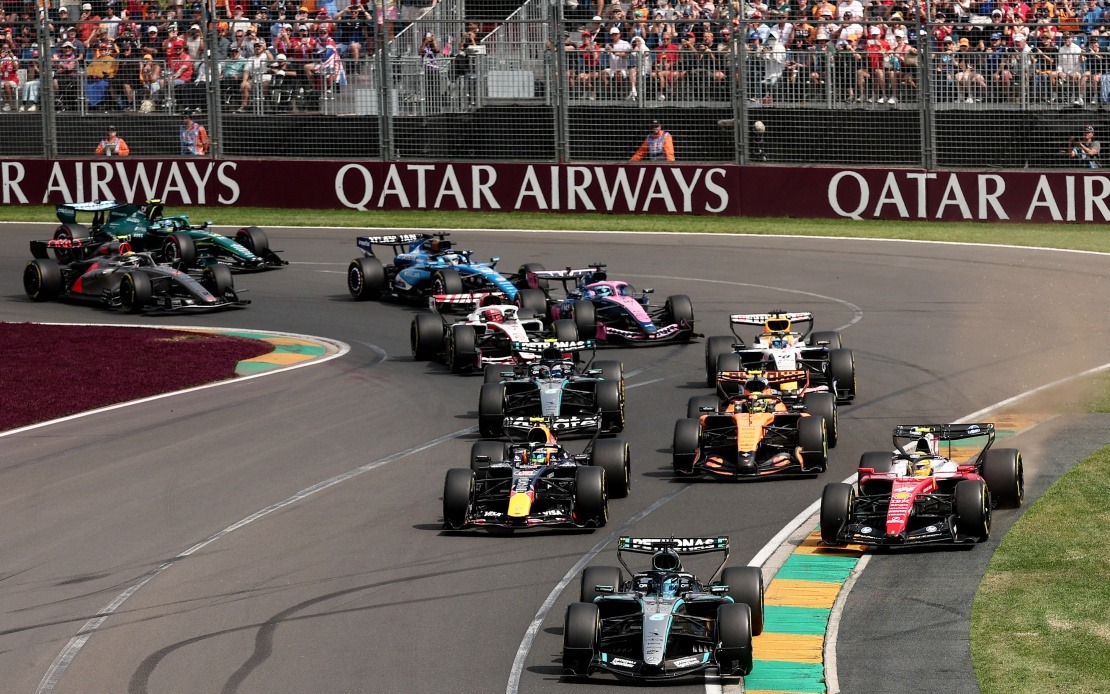
George Russell's championship aspirations took another severe blow at Spa-Francorchamps on Sunday when a collision with teammate Lewis Hamilton ended his Belgian Grand Prix after technical problems had already compromised his race from the opening lap. The British driver's frustration boiled over on the radio, unleashing a profanity-laden outburst that captured his mounting desperation as he trails Antonelli, the teenage Italian sensation, by 50 points with just over half the season remaining.
Russell's race unravelled following an engine deployment malfunction that left him vulnerable to the chasing field from the start. The glitch in his Mercedes power unit created a cascading series of misfortunes, beginning with a qualifying session where he finished half a second adrift of Antonelli and culminating in the collision that ended his afternoon. The recovery from such a deficit in the championship now appears increasingly remote, particularly given that Antonelli has already claimed six victories from ten rounds, establishing a commanding advantage that reflects the raw speed differential between the two drivers this season.
The technical issue proved especially galling because it had been initially misdiagnosed by the team's engineers, who initially attributed the problem to Russell's driving technique. This misunderstanding delayed identification of the actual fault, compounding the driver's sense of helplessness. Only after further investigation did the Mercedes technical group isolate an engine-related anomaly, though by then substantial damage to Russell's championship position had already accumulated. His radio transmission, captured but not aired during the race broadcast, revealed a driver stretched to his emotional limit: questioning why his state of battery charge had depleted during the straights and declaring the situation categorically unacceptable.
What makes Russell's predicament particularly acute for the Mercedes organization is the broader pattern of mechanical failures that has characterized his campaign. Rather than isolated incidents, these problems appear symptomatic of deeper reliability concerns within the team's new power unit specification. Russell indicated that he is now approaching each race weekend with diminished expectation, describing himself as "numb to disappointment" following the relentless parade of technical gremlins. This psychological toll on a world-class driver raises questions about Mercedes' technical direction and whether the new regulations have exposed fundamental weaknesses in their engineering approach.
The upcoming Hungarian Grand Prix, scheduled for the following weekend and marking the final round before the summer break, represents both a crucial opportunity and a potential last chance for Russell to salvage momentum before the season's midpoint reset. Russell has openly stated he is "praying" that his team can isolate and rectify whatever remains unresolved with his power unit before arriving at the Budapest circuit. The pressure mounting on the Mercedes technical division has intensified correspondingly, with the organization acutely aware that consecutive races featuring the same driver experiencing similar failures would suggest systematic rather than random problems.
Toto Wolff, the Mercedes team principal, responded to Russell's outburst with a measured tone that acknowledged both the driver's emotional state and his elite status within Formula One. Wolff's comments reflected an understanding that world championship aspirants are entitled to compete without equipment failures derailing their campaigns, whilst simultaneously defending the team's efforts to address the underlying reliability issues. He drew parallels to other challenging periods experienced by accomplished drivers, framing Russell's current struggles as a temporary setback rather than a reflection of his capabilities or Mercedes' long-term competitiveness.
Wolff provided technical insight into the specific nature of Russell's Belgian problem, explaining that the power unit had failed to deliver adequate energy deployment capacity heading into turn 18, a corner where efficient energy management is critical for competitive lap times. The team principal indicated that while the fault had been identified, its discovery in Belgium carried an unintended silver lining: the straightline-dependent circuit had made the problem apparent, whereas a different track configuration might have masked the underlying malfunction for longer. However, this technical consolation offered little comfort to Russell, who had already surrendered valuable championship points and momentum through no fault of his own.
Wolff's acknowledgement that the identified engine issue likely accounted for roughly half of Russell's qualifying deficit to Antonelli underscores how marginal the performance gaps have become in contemporary Formula One. In an era where hundredths of seconds separate competitive positions, a technical problem costing half a second represents the difference between championship contention and fighting for points. The Mercedes team principal's analysis suggests that without the engine malfunction, Russell might have qualified significantly closer to his teammate, potentially altering the entire trajectory of his weekend and preserving his title chances.
The reliability problems plaguing Russell this season reflect broader challenges facing Mercedes under the new technical regulations that have introduced unprecedented complexity into power unit design and energy management systems. The interaction between driver inputs, battery state management, and energy deployment requires meticulous calibration, and even marginal errors in setup or software tuning can manifest as significant performance deficits. Wolff's comments acknowledged this complexity whilst emphasizing the team's commitment to solving the problems, though his tone suggested neither complacency nor confidence that solutions would arrive instantaneously.
Russell's deteriorating championship position relative to Antonelli also highlights the rapid emergence of a generational talent capable of immediately challenging established competitors. The teenager's six victories demonstrate pace that transcends any single driver's temporary struggles, establishing him as a formidable rival who is capitalizing on every opportunity. For Russell, the task ahead involves not merely recovering lost ground but doing so whilst competing against a teammate operating at the peak of his capabilities and unladen by the mechanical misfortunes that have compromised the British driver's season.
Looking toward Hungary and beyond, Mercedes faces mounting pressure to demonstrate that Russell's problems represent isolated incidents rather than systemic failures endemic to their power unit specification. The team's ability to rebuild Russell's confidence and restore his championship prospects will depend substantially on whether the technical corrections implemented before Budapest prove durable and effective. Should similar failures resurface, questions about Mercedes' technical competence and commitment to providing equal equipment to both drivers would inevitably intensify, threatening the organizational harmony essential for championship campaigns.
Russell's emotional honesty during and after the Belgian Grand Prix, whilst raw and unfiltered, illuminated the psychological toll that mechanical failures exact on elite competitors. The prospect of another technical failure in Hungary looms large in his mind, adding psychological weight to an already demanding weekend. For Malaysian and Southeast Asian Formula One enthusiasts, Russell's struggles provide a cautionary reminder that even the most talented drivers cannot overcome systematic equipment deficiencies, and that championship outcomes ultimately depend on the collective engineering excellence of entire organizations rather than individual driver brilliance alone.

