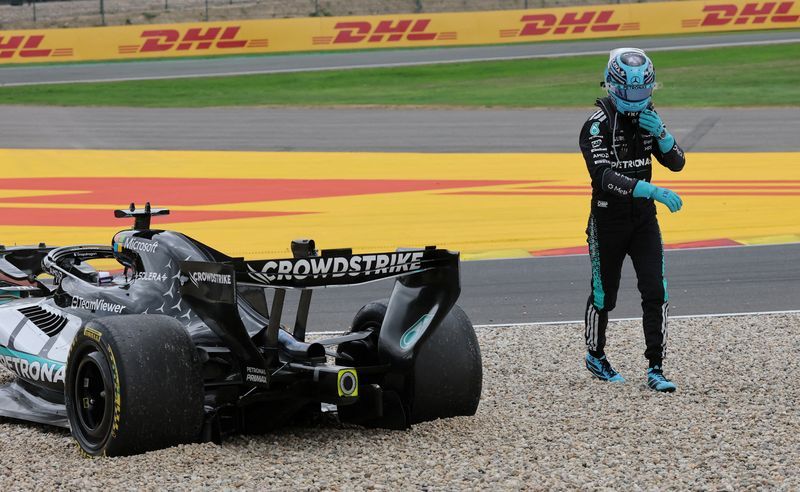
George Russell's weekend at Spa-Francorchamps unraveled within moments of the Belgian Grand Prix getting underway on Sunday, with the Mercedes driver describing himself as emotionally detached from yet another setback in what has become a frustrating campaign for the team. Starting third on the grid, Russell collided with his former Ferrari teammate Lewis Hamilton during the chaos of the first lap and slid into the gravel, putting him out of contention entirely. The incident marked another scoring drought for Russell, extending his winless streak to three consecutive races as his battle for the Formula One championship faces mounting complications.
The collision itself appeared almost inevitable given the circumstances Russell encountered in the opening moments. After making strong progress through the opening corner and positioning himself directly behind Red Bull's Max Verstappen, the Mercedes driver suddenly found himself at a severe disadvantage when his vehicle's battery management system failed to recharge properly through Turn One. This mechanical failure left Russell exiting the first corner with only 35 percent battery capacity available, a deficit that proved impossible to overcome as the car continued struggling with charging issues through the following sequence of corners. By the time he reached Eau Rouge, Russell had essentially no electrical power remaining, leaving him defenceless against the wave of competitors who swept past him.
The power deficit effectively erased Russell's qualifying advantage within seconds, forcing him into a desperate and ultimately unsuccessful fight to recover lost positions. Recognizing his precarious situation, Russell attempted to overtake Hamilton as they approached the upper sections of the circuit, pulling alongside the seven-time world champion in an aggressive but necessary move to minimize further position losses. However, their cars made contact as they negotiated the narrow section, and Russell's bid to maintain track position ended with a spin that deposited him in the gravel trap. Hamilton received a five-second penalty from race stewards for causing the collision, though Russell himself acknowledged that both drivers bore some responsibility for the incident, viewing it as a natural consequence of the impossible position in which his mechanical failure had placed him.
Russell's philosophical response to the drama revealed the emotional toll of repeated mechanical failures and disappointing results. When discussing the retirement afterwards, he emphasized feeling disconnected from the disappointment, suggesting that the frequency of such setbacks had created a numbing effect on his emotional response. His comments reflected genuine frustration not at Hamilton's driving but at the situation his own car's malfunction had created, distinguishing between the legitimate racing incident and the underlying technical failure that necessitated it. This mental state provided insight into the psychological challenges modern Formula One drivers face when contending with unreliable machinery, particularly when individual brilliance becomes secondary to equipment reliability.
The battery malfunction Russell experienced represents a concerning pattern of technical difficulties that have plagued Mercedes throughout the early season rounds. The German manufacturer had already identified problems with power delivery on straight sections during Saturday's qualifying, and Russell's race-day experience confirmed that these issues remained unresolved heading into Sunday. Such mechanical inconsistencies directly impact championship positioning, as the gap between points-scoring and retirement often proves decisive by season's end. For a driver fighting at the sharp end of the championship battle, equipment failure transforms qualifying position advantage into irrelevance within moments.
The championship landscape heading into the mid-season break now sees Kimi Antonelli extending his commanding advantage over Russell's teammate in the standings. Antonelli maintained pole position at Spa-Francorchamps and was chasing his sixth victory of the campaign, capitalizing on the misfortunes affecting Mercedes' broader team performance. With nine of twenty-two rounds completed, Antonelli's twenty-five-point lead provides substantial cushioning against the inconsistent results currently being produced by the silver arrows, though the season's considerable length means championship mathematics remain fluid. Russell's continued struggles in extracting points from recent rounds have allowed rival drivers to consolidate their positions and build leads that may prove difficult to overcome.
For Malaysian and Southeast Asian Formula One enthusiasts, Russell's frustrations illustrate how championship fortunes in the sport depend upon far more than driver skill and racecraft alone. The reliability of complex hybrid power units, battery management systems, and energy recovery mechanisms can prove decisive in individual races and ultimately across entire seasons. The incident at Spa demonstrated that mechanical failure during critical race moments can instantly negate months of development work and strategic planning by engineering teams. Russell's acknowledgement that he was in no position to challenge for victory once power delivery failed highlights the reality that even the finest drivers cannot overcome fundamental equipment inadequacy.
The stewards' decision to penalize Hamilton rather than Russell demonstrated official recognition that the contact resulted primarily from Russell's compromised situation rather than recklessness. This nuanced interpretation provided some vindication for Russell's own assessment of the incident, though vindication offers little consolation when a driver walks away from the car without championship points. The penalty imposed on Hamilton effectively transferred blame for the accident, yet both drivers' races had ended in disappointment, with Hamilton managing to continue and Russell relegated to the spectators' perspective for the remainder of the afternoon. The situation exemplified how mechanical failures create cascading consequences that affect multiple competitors and complicate stewards' investigative responsibilities.
Moving forward, Mercedes faces urgent questions about rectifying the power delivery issues that transformed Russell's promising grid position into a race-ending malfunction. The engineering team must diagnose whether the problem stems from battery management software, physical charging systems, or some combination of factors. Russell's detailed technical description of the malfunction sequence should provide valuable diagnostic information for the Mercedes engineering department as they prepare for subsequent races. Without resolution to these reliability concerns, even excellent qualifying performances and strong racecraft cannot deliver the consistent points accumulation necessary for mounting serious championship challenges.
Russell's mental resilience in acknowledging the racing incident with Hamilton without deflection or blame-shifting demonstrated mature perspective amid genuine frustration. His distinction between condemning mechanical failure while accepting racing reality provided context for observers seeking to understand his emotional state. This balanced assessment suggested a driver determined to move beyond the setback rather than dwelling on it, though the cumulative effect of three consecutive non-scoring results undoubtedly weighs heavily on championship ambitions. As the Formula One season approaches its halfway point, Russell's ability to recover from current difficulties will test both his adaptability as a competitor and Mercedes' capacity to resolve outstanding technical challenges.

