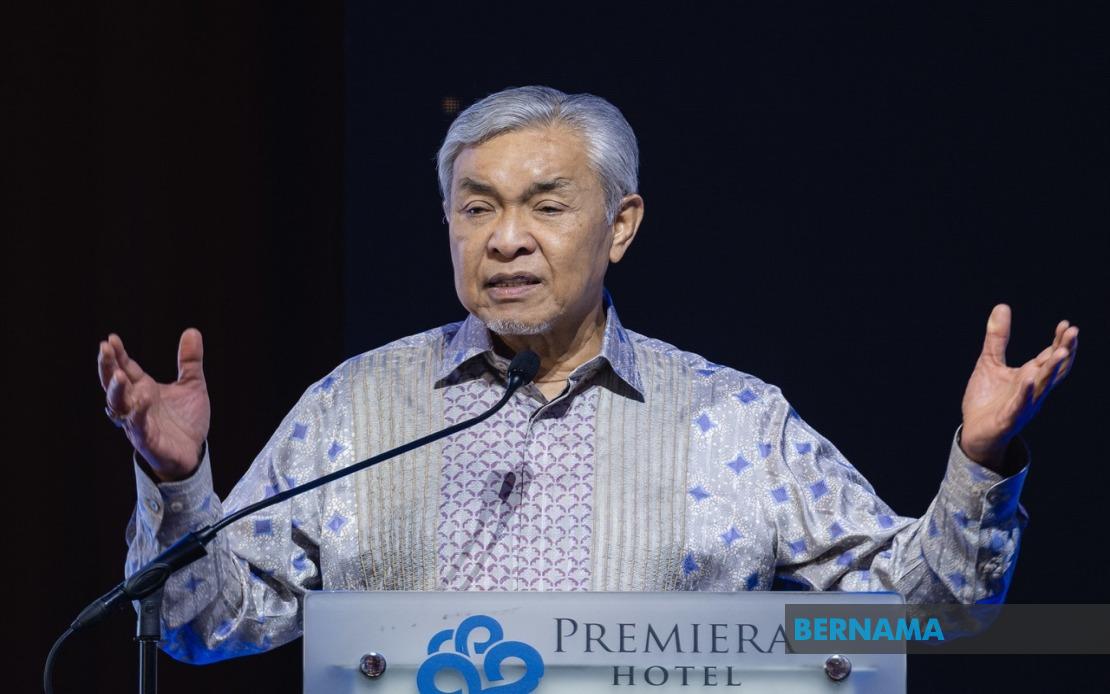
Deputy Prime Minister Datuk Seri Dr Ahmad Zahid Hamidi has signalled openness to funding new rural road infrastructure in Sabah and Sarawak through the 2027 budget cycle, provided that such projects address genuine connectivity gaps between isolated settlements and established urban centres. Speaking after a ceremony honouring excellence within the Ministry of Rural and Regional Development, Ahmad Zahid underscored that his ministry remains committed to improving transport accessibility as a core mandate, with rural road construction explicitly identified as part of its institutional responsibility.
The pathway forward for these infrastructure initiatives will require scrutiny and approval from the finance and public works authorities, Ahmad Zahid cautioned, emphasizing that budgetary inclusion alone does not guarantee immediate implementation. The Ministry of Rural and Regional Development must complete consultation with stakeholders before submitting detailed proposals, a process that will determine which projects advance to the funding stage. This procedural requirement reflects the complex interagency coordination needed when allocating national resources across Malaysia's most geographically challenging regions, where terrain and population density create distinct engineering and economic considerations.
Ahmad Zahid's announcement arrives amid broader pressures on the government to demonstrate tangible development benefits across East Malaysia, where infrastructure deficits have long constrained economic participation and social mobility. Road connectivity serves as foundational infrastructure enabling downstream investments in agriculture, commerce, and services, making rural road development a politically resonant issue in both Sabah and Sarawak. The Deputy Prime Minister's acknowledgment of outstanding requests suggests accumulated demand from local communities and elected representatives seeking to address transport bottlenecks that isolate productive regions from regional and national markets.
Critically, Ahmad Zahid outlined a philosophical shift in how the Ministry of Rural and Regional Development should approach its mandate, moving beyond infrastructure construction toward comprehensive economic development. During the awards ceremony, he challenged the ministry to adopt what he termed a "new discipline," encouraging staff to evaluate programmes based on demonstrable impact rather than continuation by institutional inertia. This framing positions rural road investment not merely as engineering projects but as instruments for generating employment and income streams, reflecting acknowledgment that infrastructure alone cannot reverse structural disadvantages in rural economies without complementary productivity initiatives.
The Deputy Prime Minister's call for selective programme termination and acceleration of effective initiatives signals an intention to redirect resources from underperforming interventions toward higher-impact activities. In the context of rural development, this could imply prioritizing road projects that connect communities to viable economic opportunities, such as agricultural processing zones or market centres, over roads serving primarily administrative or ceremonial functions. This results-oriented approach represents a departure from traditional spending patterns and reflects evolving expectations among senior policymakers regarding accountability for development expenditures.
Ahmad Zahid stressed that transformation within the ministry extends beyond technological modernization, requiring instead a fundamental reorientation of institutional culture toward decisiveness and adaptability. He emphasized that public service reform demands more than digitization; it requires officials to embrace continuous learning, exercise independent judgment, and maintain ethical standards under pressure. This messaging appears aimed at institutionalizing a performance culture within the rural development apparatus, potentially addressing long-standing criticisms regarding implementation delays and inconsistent project quality across different states and localities.
The emphasis on innovation and lifelong learning carries particular significance given the scale of challenges confronting rural development administrators in Malaysia's most remote regions. Officials working on infrastructure projects in Sabah and Sarawak must navigate geographical complexity, environmental constraints, and limited local economic capacity, requiring technical sophistication and adaptive management. Ahmad Zahid's exhortation to foster innovation suggests receptiveness to unconventional solutions, whether through construction methodology, maintenance approaches, or community engagement models that differ from established urban-centric practices.
For East Malaysian communities awaiting road improvements, the 2027 budget timeline provides both opportunity and uncertainty. While Ahmad Zahid's indication of openness represents progress, the multi-stage approval process means that funding confirmation remains contingent on finance ministry decisions and public works department assessment. Communities and state governments must now formulate compelling proposals that demonstrate how specific road projects align with economic development objectives and meet technical feasibility standards, transforming political intention into budgetary reality.
The announcement also reflects evolving dynamics between federal and state governments regarding infrastructure funding, particularly relevant in Sabah and Sarawak where political relationships have shifted markedly in recent years. State-level requests for rural road investment carry increased weight given these changed political alignments, potentially explaining Ahmad Zahid's receptive positioning. Ensuring equitable development outcomes across the federation remains a persistent challenge, and rural road connectivity represents a tangible means of addressing regional disparities that have accumulated over decades of uneven investment.
Moving forward, stakeholders in Sabah and Sarawak should recognize that advancing specific road projects requires translating the Deputy Prime Minister's general commitment into detailed proposals meeting finance ministry standards. This involves documenting baseline connectivity conditions, projecting economic benefits, estimating construction costs, and demonstrating community support. The consultation process Ahmad Zahid referenced will likely involve technical agencies, state governments, and potentially international development partners, extending the timeline before final budgetary decisions emerge.
The broader implications of Ahmad Zahid's remarks extend to how Malaysia frames rural development in the current budgetary cycle. By explicitly linking infrastructure investment to employment generation and income creation, the Deputy Prime Minister signals that rural road projects will be evaluated not merely as infrastructure necessities but as economic development instruments. This conceptual reframing could strengthen the business case for projects in Sabah and Sarawak, where demonstrable linkages to livelihood improvement may prove decisive in competitive budget allocations.
For observers monitoring Malaysia's commitment to inclusive development, the 2027 budget process will indicate whether rhetorical emphasis on East Malaysian infrastructure translates into sustained funding increases. The scale of resource allocation decisions made during this cycle will shape infrastructure conditions and economic prospects for remote communities across Sabah and Sarawak for years beyond, making the current budgetary deliberations consequential for regional equity and social cohesion across the federation.

