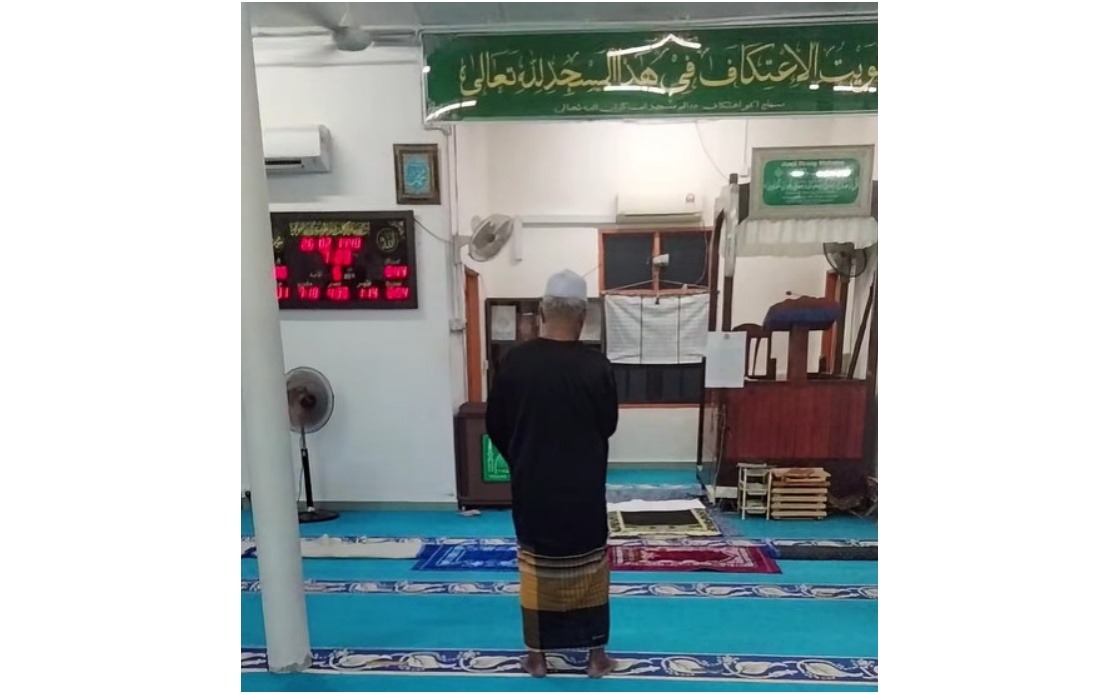
A brief clip circulating across social media platforms has drawn attention to the operational realities of Masjid Tanjung Resang in Mersing, a rural settlement in Johor, with the 15-second video depicting a solitary worshipper performing prayers while simultaneously fulfilling multiple roles at the mosque. The footage, which spread rapidly on Facebook and WhatsApp in recent weeks, prompted questions about the institution's viability and the level of community engagement it maintains in what appears to be an increasingly depopulated area.
Mersing's Member of Parliament Muhammad Islahuddin Abas, who resides in the village himself, has attributed the attendance challenges primarily to demographic shifts rather than any failing in mosque management or religious activity. He explained that whilst the surrounding locality contains numerous residential structures, the actual number of permanent residents has declined substantially as individuals have migrated to urban centres for employment opportunities or relocated to other regions entirely. This pattern reflects broader trends occurring across rural Malaysia, where younger and working-age populations have progressively moved toward cities in search of economic advancement, leaving behind ageing populations and intermittent seasonal residents.
Despite these demographic pressures, Muhammad Islahuddin emphasised that the mosque maintains its regular programming schedule without interruption. The institution continues to organise religious lectures, Quranic recitation sessions known as Yasin gatherings, and spiritual talks that serve the resident community. The consistency of these activities underscores the commitment of mosque officials to sustain religious functions even when confronted with the practical constraints imposed by a smaller congregation base.
The Member of Parliament acknowledged his own initial surprise upon receiving screenshots of the viral content through a personal messaging application. A friend in Kuala Lumpur had forwarded the material, bringing to his attention the way the incident had gained traction among distant observers. However, rather than viewing the situation solely negatively, Muhammad Islahuddin identified an unexpected benefit: the viral attention had inadvertently expanded awareness of the mosque's existence among people outside Mersing.
The mosque's geographical positioning presents a significant challenge to its visibility and accessibility. Located away from the main thoroughfare, the facility remains unknown to many potential visitors, including some residents within Mersing district itself. This relative obscurity had previously limited the institution's profile and the flow of visitors to its premises. Muhammad Islahuddin highlighted that the mosque operates with considerable openness to visitors, including individuals who do not follow Islam, and serves as a convenient facility for hikers ascending Gunung Arong, providing amenities and comfort for those undertaking the outdoor pursuit.
Abdul Syamil Abdul Fadzil, the mosque's chairman, provided further context regarding the viral video's interpretation. He confirmed that representatives from the Johor Islamic Religious Affairs Department (JAINJ) had contacted him about the circulating content, and he had clarified the actual circumstances to departmental officials. According to his account, the footage had captured a mosque assistant engaged in voluntary devotional prayer rather than depicting a crisis in congregational attendance or operational dysfunction.
Abdul Syamil stressed that the video content fundamentally misrepresents the day-to-day reality of the institution's functioning. The mosque maintains an active calendar of religious programming and educational activities that operate on a regular basis throughout the year. This consistent engagement demonstrates that the facility continues to fulfill its core religious and community purposes notwithstanding the smaller number of congregants physically present at any given time.
The incident illustrates broader challenges facing rural religious institutions across Southeast Asia, where demographic transitions and urbanisation have reshaped congregation sizes without necessarily reflecting diminished religious commitment or institutional abandonment. Many mosques, temples, and other places of worship in less densely populated areas face similar attendance fluctuations driven by economic migration rather than declining religiosity among the community. The case of Masjid Tanjung Resang demonstrates how social media can amplify isolated moments and present potentially misleading impressions of institutional health.
For Malaysian policymakers and religious administrators, the episode highlights the importance of contextualising rural religious infrastructure within contemporary migration patterns. Rather than viewing small congregations as inherent failures, there may be value in recognising how these institutions serve residual communities whilst maintaining potential to welcome external visitors and accommodate broader functions such as educational or cultural programming. The Mersing mosque's role as a waypoint for hikers and open community space suggests multiple pathways through which rural religious buildings can sustain relevance and utility.
The response from local leadership, both political and religious, has been measured and focused on clarification rather than defensiveness. This approach reflects an understanding that social media narratives, whilst sometimes misleading, can also serve constructive purposes by raising awareness. The unexpected publicity may ultimately strengthen the mosque's position within the broader Mersing community and among those researching rural religious life in Malaysia.

