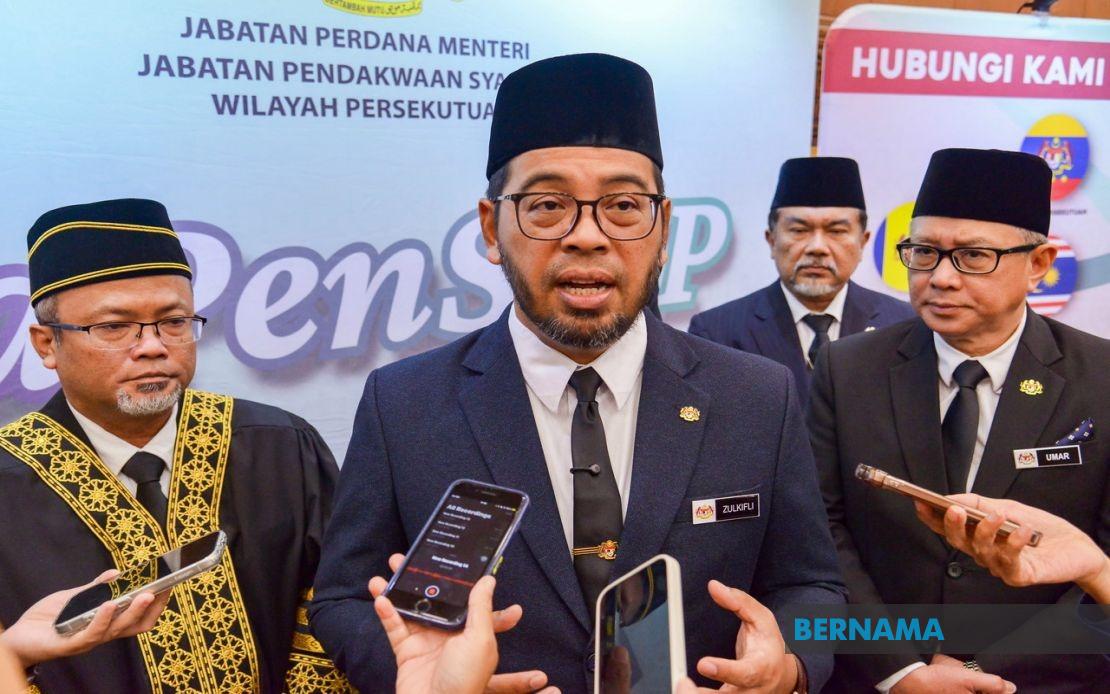
The Prime Minister's Department (Religious Affairs) has launched an investigation into social media claims that an official Department of Islamic Development Malaysia identification number was cited as authorisation for marriage recognition documents distributed by the Malaysia Rohingya Ulama Council. Religious Affairs Minister Dr Zulkifli Hasan disclosed the enquiry at a media briefing in Putrajaya on July 15, noting that his office had not yet assembled comprehensive details to fully assess the allegations.
The controversy centres on a marriage declaration letter that gained traction across social media platforms, bearing what appeared to be an authorised JAKIM reference code: "JAKIM.PERH/LN.800-7(5)". The presence of this identifier raised immediate concerns about potential institutional endorsement or misappropriation of JAKIM's official designation, prompting questions about the document's legitimacy and the extent of any connection to Malaysia's primary Islamic religious authority.
Local authorities have already expressed reservations about the document's validity. The Perak Islamic Religious Department stated that the marriage declaration letter cannot be treated as an officially recognised instrument within its jurisdiction. State religious bodies nationwide have also signalled that matrimonial matters involving the Rohingya community cannot proceed through standard registration channels, as such cases remain subject to ongoing policy deliberations at the state level across Malaysia.
The situation reflects broader complexities surrounding Rohingya communities in Malaysia. Numbering around 180,000 individuals, Rohingya refugees have sought stability and recognition within Malaysia's legal and social frameworks. However, their status remains contested—they are neither citizens nor fully integrated into Malaysia's formal administrative systems. Marriage recognition, central to personal status law throughout Southeast Asia, touches upon citizenship implications, inheritance rights, and children's legal standing, making it a matter of considerable sensitivity for state governments.
Beyond the immediate marriage documentation controversy, Dr Zulkifli highlighted a related concern: the proliferation of religious lectures and teachings circulated via social media without proper accreditation. This phenomenon has grown substantially as digital platforms democratise religious discourse, yet simultaneously create enforcement challenges for authorities tasked with ensuring theological legitimacy and accuracy. The minister acknowledged that the government was actively reviewing strategies to address unaccredited religious content distributed online, though he stressed that regulatory authority ultimately resides with state religious departments rather than federal institutions.
The jurisdictional complexity here is significant for Southeast Asian policymakers. Malaysia's federal structure designates Islam as a state matter, meaning each of the thirteen state governments holds primary responsibility for determining Islamic religious teaching standards, accreditation protocols, and the qualifications required for individuals delivering religious instruction. This constitutional arrangement, while protecting state autonomy, sometimes creates coordination challenges when transnational or cross-state issues emerge, as evidenced by inconsistent approaches to Rohingya-related matters.
Dr Zulkifli indicated that the Prime Minister's Department would work alongside state authorities to establish consistent frameworks, though enforcement remains complicated by the speed of digital dissemination and the difficulty of identifying original publishers. The federal government is examining what legal instruments might be deployed to address unaccredited religious content on digital platforms, a task requiring careful calibration to balance religious oversight against free expression considerations.
In his address to the second Malaysian Syariah Prosecutors Conference, Dr Zulkifli emphasised that Malaysia's Islamic legal system must adapt to contemporary challenges, particularly those involving cyber-related offences. He stressed the necessity for closer coordination between Syariah prosecutors and secular law enforcement agencies, specifically the Malaysian Communications and Multimedia Commission, the Royal Malaysia Police, and the Attorney General's Chambers. This multi-agency approach reflects international best practice in countering religiously-motivated digital crimes.
The minister underscored that Syariah prosecutors require enhanced capabilities in digital forensics, data analysis, and technological literacy to effectively investigate and prosecute increasingly sophisticated offences committed through electronic means. This capability-building initiative extends beyond traditional Islamic jurisprudence into forensic science and cybercrime investigation—domains that Islamic legal professionals historically have not required expertise in. The shift indicates Malaysia's acknowledgement that modern religious crimes operate across digital-physical boundaries.
The investigation into the Rohingya marriage document claims occurs against a backdrop of rising concern about document fraud and the misappropriation of government institutional identifiers across Southeast Asia. Counterfeit or fraudulently-labelled certificates and declarations have become increasingly common as sophisticated actors exploit bureaucratic legitimacy. Malaysia's investigation thus carries implications beyond the immediate case, potentially establishing precedents for how federal authorities address document authenticity claims affecting vulnerable populations lacking full legal status.
For the Rohingya communities themselves, clarity regarding marriage recognition remains urgent. Without formalised marriage registration, Rohingya couples and their children face legal uncertainty affecting inheritance, custody, and succession rights. The delay in establishing coherent state-level policies on this matter leaves thousands in liminal status, neither fully recognised nor completely excluded from Malaysia's formal legal order. Regional stability may depend on resolving such issues, as unresolved legal status can become a vector for grievance and instability.
The broader pattern evident here—document fraud allegations, unaccredited religious teaching proliferation, and jurisdictional coordination challenges—suggests that Malaysia's Islamic governance systems are experiencing growing pains as digital technologies and transnational populations challenge established frameworks. How authorities respond to these challenges will shape not only Malaysian policy but potentially influence approaches across other Muslim-majority Southeast Asian nations grappling with similar tensions between institutional legitimacy, technological change, and inclusive governance of diverse religious communities.

