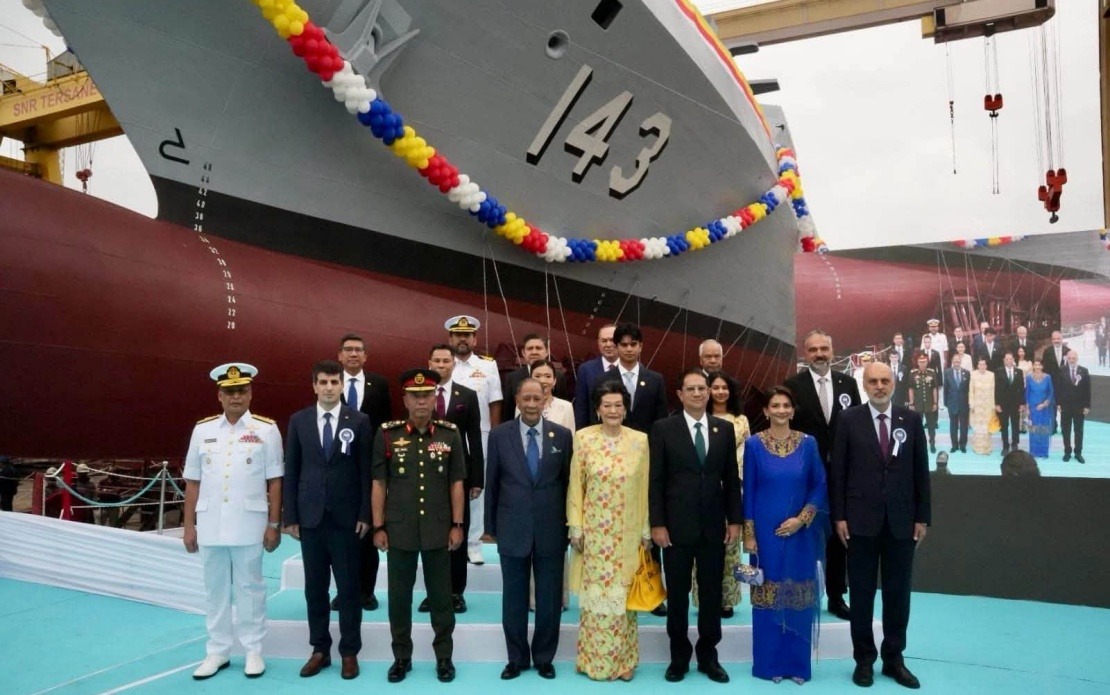
The Royal Malaysian Navy requires continuous investment in modern and capable maritime platforms to navigate an increasingly complex security environment, according to Defence Minister Datuk Seri Mohamed Khaled Nordin. His remarks coincided with the official naming and launching of Tunku Osman Jewa, the third and final vessel in the Littoral Mission Ship Batch 2 (LMSB2) series, underscoring the government's commitment to strengthening the nation's naval defences and protecting Malaysia's maritime sovereignty.
Mohamed Khaled articulated the government's strategic position that equipping the RMN with state-of-the-art assets forms a critical pillar of national defence policy. The minister's emphasis reflects broader regional concerns about maritime security, particularly given Southeast Asia's significant commercial shipping lanes and the strategic importance of waters around Malaysia. The RMN's modernisation directly supports Malaysia's ability to project power, conduct maritime law enforcement, and respond to emerging threats ranging from piracy to territorial disputes.
The newly commissioned Tunku Osman Jewa carries symbolic significance beyond its operational capabilities. Named after General Tan Sri Tunku Osman Tunku Mohammad Jewa, a former Armed Forces chief and member of the Kedah royal family, the vessel honours Malaysia's military heritage whilst serving contemporary defence objectives. The presence of the Sultan of Kedah, Al Aminul Karim Sultan Sallehuddin Sultan Badlishah, and Sultanah Maliha Tengku Ariff at the ceremony highlighted the formal recognition of this naval milestone at the highest state level.
Completion of the three-ship LMSB2 series represents a watershed moment in Malaysian naval procurement. Each vessel represents substantial investment in operational capability, designed to address littoral and coastal security requirements where Malaysia faces its most pressing maritime challenges. The Littoral Mission Ship platform itself represents a contemporary approach to naval design, balancing offensive and defensive capabilities within a relatively compact hull that maintains manoeuvrability in the shallow and confined waters characteristic of Malaysian territorial seas.
Perhaps most significantly, the LMSB2 programme embodies Malaysia's first direct Government-to-Government warship procurement collaboration with Turkiye. This partnership extends beyond simple vessel acquisition, establishing technological transfer pathways and industrial cooperation mechanisms that strengthen Malaysia's domestic maritime-industrial base. Turkish naval expertise and shipbuilding capacity have created opportunities for knowledge sharing and future engagement in regional defence cooperation, positioning Malaysia advantageously within ASEAN's evolving security architecture.
The delivery schedule outlined by Mohamed Khaled indicates all three LMSB2 vessels will enter RMN service by end-2027. This timeline integrates into the broader 15-to-5 Transformation Plan, an ambitious RMN modernisation initiative aimed at creating a more capable, technologically advanced fleet capable of addressing twenty-first-century maritime threats. The transformation plan reflects recognition that naval capabilities require systematic renewal rather than incremental improvement, with particular emphasis on platforms suited to Malaysia's geographic circumstances and operational requirements.
From a strategic perspective, the LMSB2 acquisition addresses capability gaps in Malaysia's current fleet composition. Littoral combat vessels fill an important niche between larger conventional frigates and smaller patrol craft, providing sustained offshore presence whilst maintaining cost-efficiency. This class of ship proves particularly valuable in contested maritime environments where nations require flexible platforms capable of conducting multiple mission types—from anti-piracy operations to exclusive economic zone surveillance—without deploying larger, more expensive capital ships.
Regionally, Malaysia's naval modernisation signals confidence in maritime security frameworks and demonstrates commitment to maintaining credible deterrent capabilities. Within ASEAN, the move contributes to regional navies developing more interoperable and advanced platforms, enhancing collective security responses to transnational maritime challenges. The emphasis on modern assets reflects wider recognition across Southeast Asia that traditional territorial disputes and emerging maritime threats—including environmental crime and terrorism—demand sophisticated naval responses.
The RMN's equipment requirements must be understood within Malaysia's geographic reality and strategic position. As custodian of extensive maritime territories and significant portions of crucial international shipping lanes, the Navy bears responsibility for coastal defence, resource protection, and maritime order maintenance across vast distances. Modern assets enable the RMN to operate more efficiently, deploying smaller crews over extended periods whilst maintaining operational effectiveness—critical advantages given budgetary constraints and personnel availability challenges facing many regional navies.
Mohamed Khaled's statement underscores how maritime security connects to broader national development objectives. Secure waters enable commercial shipping, fisheries, offshore energy production, and tourism—all essential to Malaysia's economic prosperity. Naval modernisation thus represents investment in economic security as much as military capability, protecting the maritime domain upon which significant portions of regional commerce depend. The government's commitment to equipping the RMN reflects understanding that maritime strength underpins national resilience.
Looking forward, the completion of the LMSB2 programme opens possibilities for additional naval acquisitions and technological upgrades. The successful Turkey partnership may serve as template for future defence collaborations, particularly if Malaysia identifies additional capability requirements or seeks to expand its submarine fleet or air-defence systems. Sustained investment in naval modernisation requires commitment across political cycles and budget allocation priorities, demanding the kind of strategic consistency Mohamed Khaled's statements appear designed to communicate.
The RMN's transformation journey remains far from complete. Beyond platform acquisition, modernisation encompasses crew training, maintenance infrastructure, logistics networks, and tactical doctrine development. The three LMSB2 vessels represent important progress, yet comprehensive naval modernisation requires sustained effort across multiple defence sectors. Malaysia's demonstrated commitment through this procurement programme, however, signals that maritime security remains a government priority, with corresponding resource allocation supporting stated strategic objectives.

