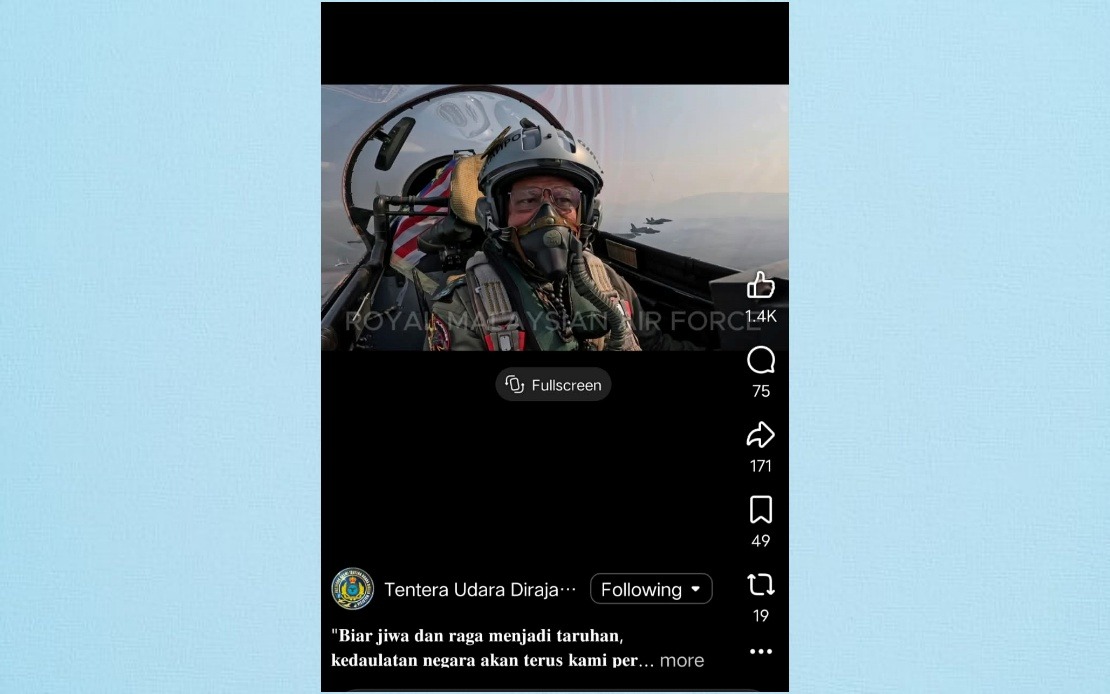
The skies above Malaysia's federal administrative centre erupted in a symphony of jet engines and aeronautical precision on August 31 as the Royal Malaysian Air Force orchestrated an elaborate aerial performance that captivated thousands gathered at Dataran Putrajaya for the nation's 69th independence commemoration. Spearheading the spectacle was General Tan Sri Muhamad Norazlan Aris, the RMAF's commanding officer, who personally piloted a Sukhoi Su-30MKM through the meticulously choreographed display—a distinction the air force chief has now claimed for the second consecutive year, underscoring both his operational credentials and the symbolic weight placed on the nation's military leadership during key national occasions.
The carefully orchestrated demonstration, which commenced at 9.30 am and extended for precisely ten minutes, deployed a formidable inventory of Malaysia's air defence assets to communicate to both domestic audiences and regional observers the breadth and sophistication of the country's military aviation capabilities. The initial segment featured eleven frontline combat aircraft: four Su-30MKM fighters, which represent the cornerstone of Malaysia's air superiority platform and are considered among the region's most advanced fourth-generation aircraft; four F/A-18D Hornets, which provide multi-role strike and air defence functionality across the RMAF's operational spectrum; and three BAE Hawk 208 trainers, which, despite their primary instructional role, possess combat-capable configurations suitable for light attack missions and are frequently highlighted during national displays as symbols of the air force's developmental pipeline.
The choreography executed by these combat platforms demonstrated the tactical proficiency expected of operational fighter units, with pilots guiding their aircraft through a sequence of specially designed formations that balanced visual drama with aeronautical authenticity. The formations employed—designated as Kite, Diamond, Delta and Victory Combine configurations—represent standardized precision flying manoeuvres that demand exceptional pilot skill and inter-aircraft coordination. These formations simultaneously serve a practical purpose in military operations, where such tight formations facilitate communication and tactical flexibility, and a representational function during public displays, where the visual spectacle of perfectly aligned aircraft conveys messages about military readiness and unity of command.
Enhancing the public engagement dimension of the display were live commentaries delivered by Major Patrick Dinnesh, Major Neny Suhaida Ab Suki and Captain Muhammad Iqbal Nasrudin, whose role transcended simple narration to provide technical and strategic context about the aircraft types, their capabilities and the significance of their manoeuvres. This educational component transforms what might otherwise remain an impressive but abstract spectacle into a more comprehensible demonstration of specific military assets and doctrinal approaches. For Malaysian citizens watching the display, such detailed explanations help bridge the gap between abstract notions of national defence and concrete understanding of how taxpayer investment in defence infrastructure translates into operational capability.
Following the combat aircraft segment, the display transitioned to showcasing the RMAF's significant but often less celebrated airlift and logistical capacities through the appearance of multiple transport aircraft platforms. The C-130H Hercules, a workhorse transport platform that has served Malaysian military and humanitarian missions for decades, performed alongside the more contemporary A400M Atlas, representing the air force's modernisation trajectory in strategic airlift capability. The CN235, a medium-range transport aircraft, rounded out this segment by demonstrating the RMAF's capacity to operate across diverse operational environments and terrains. These aircraft, while not inherently dramatic performers, carry substantial implications for Malaysia's ability to project power within the region, conduct humanitarian assistance and disaster relief operations, and sustain distant military deployments—capabilities that increasingly define how modern air forces contribute to national strategic objectives beyond conventional air defence.
The demonstration subsequently incorporated rotary-wing platforms, specifically EC725 and AW139 helicopters operated by the RMAF, which performed coordinated flights alongside assets representing the broader Malaysian security apparatus. This interservice dimension proved particularly significant, as the display featured participation from the Malaysian Army, Royal Malaysian Navy, Fire and Rescue Department of Malaysia and Royal Malaysia Police, reflecting the contemporary emphasis on integrated security operations that transcend service-specific boundaries. Such multi-agency participation during national celebrations carries symbolic resonance in emphasising cohesion across Malaysia's security establishment, an important messaging component in a nation where civil-military relations and cross-sector coordination remain topics of continuing national conversation.
The response from the assembled crowd—described as thousands of spectators maintaining fixed attention on the aerial displays—suggests successful engagement with the intended audience across demographic lines. National Day celebrations in Malaysia function as occasions where political messaging, historical commemoration and public entertainment intersect, with military displays occupying a traditional and valued position within this ceremonial framework. The sustained attention and evident enthusiasm indicated by reports of audience members being captivated throughout the performance suggests that the RMAF's investment in staging a sophisticated display achieved its objectives of entertainment, civic engagement and implicit messaging about Malaysia's military competence and modernisation.
The broader strategic context framing such displays merits consideration for regional observers and Malaysian defence analysts. Southeast Asia has experienced intensifying focus on military modernisation and capability demonstration as several nations, including Malaysia, navigate complex geopolitical environments characterised by great power competition, maritime security challenges and evolving regional power dynamics. Public displays of military capability serve multiple functions beyond domestic entertainment: they communicate to both allies and potential adversaries assessments of operational capacity, they signal sustained commitment to defence investment and modernisation, and they provide domestic constituencies with tangible evidence of security force readiness.
For Malaysia specifically, maintaining demonstrable air force capabilities holds particular significance given the nation's maritime geography, its strategic position astride crucial sea lanes, and its participation in regional security architecture spanning ASEAN frameworks, bilateral partnerships and multilateral forums. The prominence given to the RMAF in National Day celebrations, evidenced by staging a full combat aircraft display and securing the air force chief's personal participation, reflects recognition of aviation's centrality to contemporary military strategy in the region. The inclusion of diverse aircraft types—from air superiority fighters through transport platforms to support helicopters—communicates a message of comprehensive military capability rather than narrowly focused specialisation, an important positioning for a nation seeking to project balanced defence competence across multiple operational domains.
The logistical achievement of orchestrating such a display, coordinating multiple aircraft types and pilots, and executing precisely choreographed manoeuvres over a populated urban area represents significant operational competence in its own right. The successful execution without reported incidents demonstrates both pilot proficiency and air traffic management capability—factors that regional observers and defence analysts monitor as indicators of broader institutional military competence. For Malaysia's defence establishment, particularly the air force branch seeking to justify continued modernisation budgets and acquisition plans, such high-profile successful demonstrations provide valuable opportunities to demonstrate return on investment and operational credibility to both civilian oversight bodies and international partners.
As Malaysia continues navigating complex security environments and competing development priorities, public demonstrations of defence capability serve functions extending beyond immediate ceremonial purposes. They contribute to ongoing national conversations about security requirements, they reinforce professional identity and institutional pride within the military services themselves, and they provide ordinary citizens with accessible engagement with defence matters that typically remain distant from everyday civilian experience. The 69th National Day air display, through the RMAF chief's personal participation and the coordinated showcase of diverse military aviation assets, accomplished these purposes while simultaneously maintaining the traditional ceremonial and entertainment functions expected of such national occasions.

