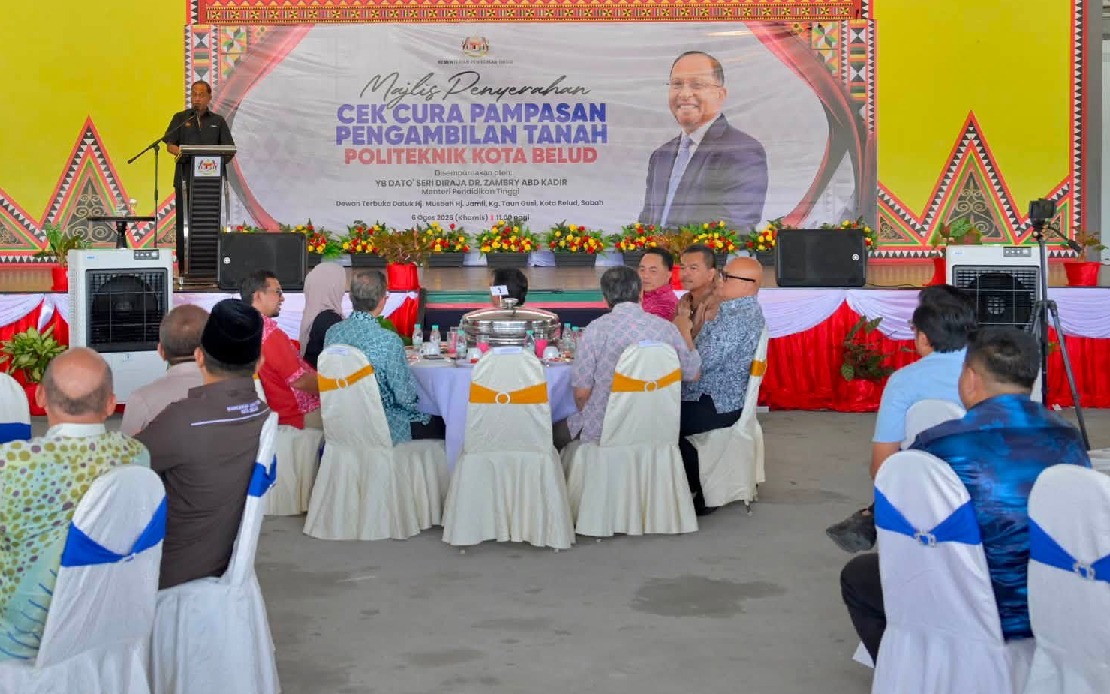
Malaysia's ambitious RM250 million Politeknik Kota Belud has officially entered its construction phase following the completion of land acquisition procedures, marking a significant milestone for higher education development in Sabah. The project, which was formally acknowledged through a mock cheque presentation to affected landowners in Kota Belud on Tuesday, now sits poised to transform the eastern state's vocational training landscape by 2030.
Higher Education Minister Datuk Seri Zambry Abd Kadir emphasised that the compensation disbursements represent far more than a financial transaction—they signal the true commencement of physical construction activities. The institution will progress through its design and detailed planning phase immediately, with full-scale development anticipated to roll out from next year under the Third Rolling Plan component of the 13th Malaysia Plan. Zambry outlined an aggressive timeline, indicating that all developmental aspects should be operationalised within the next seven years, contingent upon successful project management and funding allocation.
The genesis of this educational venture traces back to 2017, when then-Member of Parliament for Kota Belud Datuk Seri Abdul Rahman Dahlan proposed the establishment of a specialised polytechnic facility in the constituency. The lengthy planning period reflects the complexity involved in securing land, conducting feasibility studies, and obtaining the necessary approvals within Malaysia's governmental framework. What began as a forward-thinking proposal has matured into a concrete development agenda, demonstrating how regional advocacy can translate into substantial infrastructure commitments.
The polytechnic's curriculum framework reflects contemporary economic realities and emerging sectoral opportunities within Sabah and the broader Southeast Asian region. Zambry articulated that educational programmes will concentrate on domains including green energy, artificial intelligence, computer science, and smart technology-based agriculture—sectors identified as critical for workforce competitiveness in the coming decade. This strategic alignment between academic provision and industry demand represents a departure from traditional vocational training models, positioning Kota Belud's institution as a centre for advanced technical skills development rather than conventional trades-focused learning.
The enrolment strategy reveals a phased approach to institutional growth. The polytechnic is projected to accommodate approximately 500 students during its inaugural intake, a modest figure designed to ensure educational quality and manageable resource allocation. However, the institution's masterplan incorporates substantial scalability, with capacity targeted to expand between 1,000 and 1,500 students as facilities mature and programmes stabilise. This incremental expansion model permits operational refinement and curriculum validation before pursuing aggressive growth trajectories.
For Malaysian policymakers and education stakeholders, this development signals sustained commitment to geographic diversification of higher learning facilities. Historically, polytechnic and technical institutions have concentrated in peninsular Malaysia, leaving Sabah and Sarawak comparatively underserved in terms of specialised vocational provision. The Kota Belud project addresses this disparity, potentially catalysing improved retention of local talent within the state and reducing migration to peninsula-based institutions. From an equity perspective, enhanced local access to technology-focused education may narrow regional disparities in human capital development.
The project's emphasis on green energy and agricultural technology carries particular resonance given Sabah's economic foundation and environmental considerations. The state possesses substantial palm oil, cocoa, and timber industries—sectors increasingly pressured to adopt sustainable practices and digital innovations. A polytechnic graduating specialists in smart agriculture and renewable energy could meaningfully accelerate these transitions, enabling local producers to meet evolving international standards whilst maintaining competitiveness. Simultaneously, green energy training addresses Malaysia's broader decarbonisation objectives outlined in national sustainability commitments.
Artificial intelligence and computer science components acknowledge the digital economy's pervasive influence across all productive sectors. Rather than concentrating advanced IT education in major metropolitan areas, dispersing such programmes to Sabah democratises access to cutting-edge technical knowledge. This distribution strategy potentially enables smaller towns and rural communities to benefit from emerging digital opportunities, bridging the technology adoption gap that frequently disadvantages peripheral regions.
The construction timeline through 2030 situates the polytechnic within Malaysia's broader educational modernisation agenda. Concurrent developments across the country in skills training, curriculum reform, and institutional expansion reflect systemic efforts to prepare successive generations for rapidly transforming labour markets. The Kota Belud project's progression will serve as a barometer for implementation effectiveness, offering lessons applicable to analogous facilities planned elsewhere across Malaysia's territorial landscape.
Beyond immediate educational outcomes, the polytechnic represents substantial economic stimulus for Kota Belud itself. Construction spending, permanent staffing requirements, student-related commercial activity, and residential accommodation demand will generate multiplier effects throughout the local economy. The institution may catalyse complementary infrastructure development, including improved transportation links and accommodation facilities, benefiting the broader community regardless of direct polytechnic involvement.
The successful navigation of land acquisition processes—historically contentious in Malaysian development projects—demonstrates improved coordination between state and federal authorities, and between government and affected populations. The compensation ceremony itself reinforces stakeholder confidence in project legitimacy and management competence, crucial psychological factors influencing community acceptance of ongoing development activities.
As construction commences, critical attention will focus on budget management, timeline adherence, and educational quality assurance mechanisms. The RM250 million investment demands rigorous oversight to prevent cost escalation and schedule slippage common in Malaysian infrastructure projects. Simultaneously, curriculum development and faculty recruitment must proceed in parallel with physical construction to ensure the institution delivers genuine workforce relevance rather than merely occupying impressive buildings.
The Politeknik Kota Belud ultimately exemplifies how strategic planning, sustained political commitment, and targeted educational investment can address regional development disparities. Its 2030 completion will materially alter Sabah's technical training landscape, potentially positioning the state as a regional hub for technology-focused vocational education and positioning graduates for meaningful participation in Malaysia's increasingly sophisticated economy.

