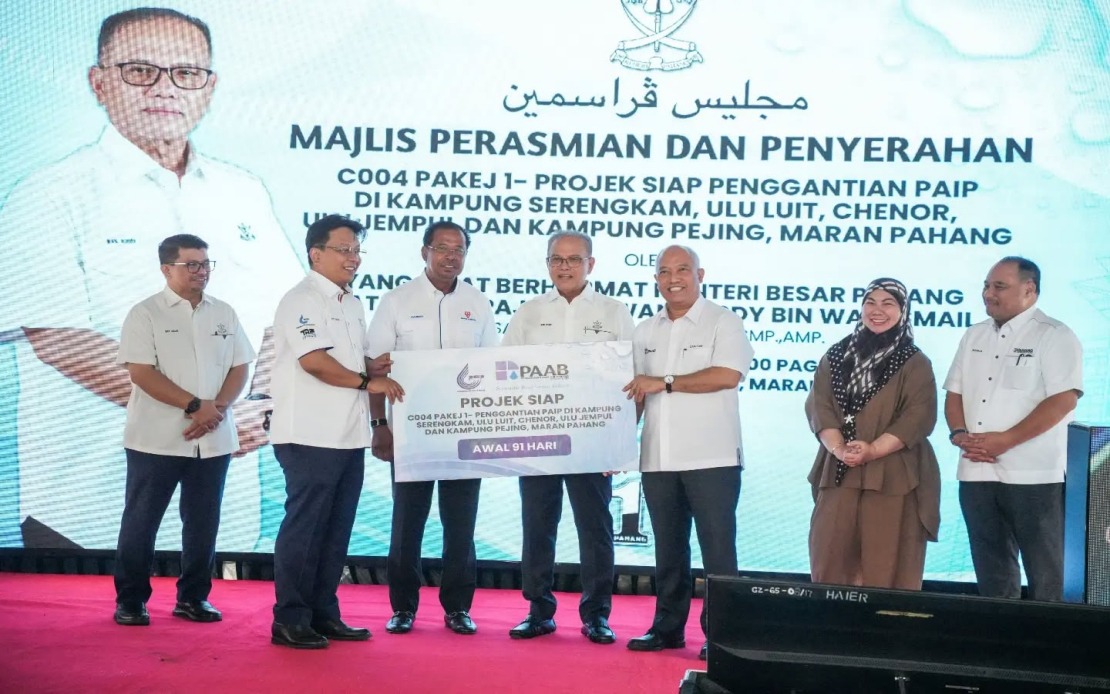
The chronic water supply problems plaguing Maran district in Pahang have finally been tackled through an ambitious infrastructure renewal programme, with Pengurusan Aset Air Berhad (PAAB) investing RM11.19 million to overhaul the ageing pipe network that has frustrated residents for nearly twenty years. The project, which achieved completion three months ahead of its original timeline, represents a significant step forward in addressing one of Pahang's most persistent utility challenges and demonstrates renewed federal commitment to upgrading water infrastructure across the state.
The scope of the project proved substantial, with engineering teams replacing 29.6 kilometres of deteriorating pipes across five key residential areas. The affected communities—Kampung Serengkam, Ulu Luit, Pejing, Ulu Jempul and Chenor—had endured repeated burst pipes, erratic water pressure, and frequent supply interruptions, particularly during the dry season and festive periods when demand surged. The Chenor sub-district bore the brunt of these disruptions, where residents had grown accustomed to water rationing and unpredictable service despite living in a state with significant water resources.
PAIB framed the investment as central to a broader strategic vision of ensuring reliable access to clean water across Pahang. The replacement of corroded and ageing infrastructure directly addresses two critical technical problems: the recurring pipe failures that necessitated expensive emergency repairs, and the high non-revenue water (NRW) losses resulting from leakage across the deteriorating network. By stabilising water pressure and reducing system losses, the project simultaneously improves service reliability whilst enhancing the efficiency of water distribution—a dual benefit that water authorities across Malaysia continue to grapple with.
Nearly 10,000 residents in Maran now benefit directly from the completed work, a population that encompasses not only household users but also small businesses and community institutions dependent on consistent water supply. The improved service reliability is expected to generate tangible socioeconomic effects, reducing the productivity losses and health risks associated with inadequate water access. This benefit extends beyond immediate convenience; consistent water supply is fundamental to attracting economic investment and supporting agricultural activities in rural areas, making infrastructure reliability a development enabler.
The project handover ceremony, held at the Chenor Water Treatment Plant, drew prominent attendance from Pahang Menteri Besar Datuk Seri Wan Rosdy Wan Ismail alongside federal representation from Deputy Energy Transition and Water Transformation Minister Datuk Seri Abdul Rahman Mohamad and Deputy Economy Minister Datuk Mohd Shahar Abdullah. This high-level engagement signals that water infrastructure has become a priority within the federal government's broader water sector transformation agenda, moving beyond routine maintenance into strategic investment.
Beyond Maran, PAAB has articulated an ambitious three-year roadmap in partnership with Pengurusan Air Pahang Berhad (PAIP) to systematise water infrastructure development across multiple Pahang districts. One concurrent initiative focuses on upgrading electrical systems at the Jengka Utama Water Treatment Plant's clean water pumping station, specifically targeting chronic supply disruptions affecting communities around the Felda Jengka settlement. This targeted approach addresses infrastructure bottlenecks at the generation and pumping stage rather than purely at the distribution level.
Two additional major projects underscore the scale of Pahang's water infrastructure deficit and PAAB's response. A RM35.7 million undertaking will replace 76.2 kilometres of deteriorating pipes in Jerantut and Lipis, serving areas around Pulau Tawar and Kuala Tahan—regions dependent on the Terengganu River system. Simultaneously, a RM13 million project in Felda Keratong will overhaul 11 kilometres of pipes to improve distribution efficiency in Rompin. These projects collectively address infrastructure challenges across Pahang's geographically dispersed settlements, many in semi-rural areas where infrastructure maintenance has historically been neglected.
The financial scale of PAAB's broader Pahang commitment demonstrates genuine investment depth. As of July 2024, PAAB had allocated RM1.17 billion toward water supply infrastructure across the state, with RM69.79 million already spent on completed projects, RM66.94 million committed to ongoing construction, and a substantial RM981.04 million earmarked for projects in planning and design phases. This pipeline suggests that water infrastructure development will remain a significant ongoing investment focus across Pahang over the coming years, with implications for household bills and service improvements.
For Malaysian readers and regional observers, the Maran project illustrates both the urgency of water infrastructure renewal across Southeast Asia and the complexity of modernising systems inherited from earlier development eras. Pahang, like many Malaysian states, contains pockets of urban sophistication alongside rural communities whose infrastructure has aged without timely reinvestment. The PAAB intervention in Maran tacitly acknowledges that decentralised water supply management in less urbanised areas requires targeted federal support to prevent widening service disparities.
PAIB itself, established in 2006 under the Water Services Industry Act 2006, operates as the federal government's primary instrument for implementing the National Water Services Industry Restructuring Plan. Wholly owned by the Minister of Finance Incorporated and regulated by the Ministry of Energy Transition and Water Transformation (PETRA), the agency functions as a specialised development finance institution focused on water infrastructure. Its ability to fully fund the Maran project without requiring local cost-sharing reflects a policy choice to treat water security as a national priority warranting direct federal investment.
The partnership between PAIB and PAIP, formalised through Pahang's 2020 State Water Supply Services Restructuring Agreement, exemplifies the layered institutional arrangements now characterising Malaysian water governance. Rather than centralised monopolistic control, the system involves federal specialist agencies coordinating with state-level operators, creating potential for both efficiency gains through specialisation and coordination challenges at the interface between state and federal entities.
Looking forward, the three-year strategic planning cycle that PAIB and PAIP have commenced suggests that Pahang's water infrastructure gap is being approached systematically rather than through ad-hoc crisis response. This marks a shift toward anticipatory maintenance and planned renewal rather than reactive emergency interventions. For other Malaysian states confronting similar ageing infrastructure, the Maran model—combining federal technical expertise, dedicated funding mechanisms, and multi-year implementation frameworks—offers a replicable template for addressing persistent water supply deficits that have become increasingly untenable as populations grow and urbanisation accelerates.

