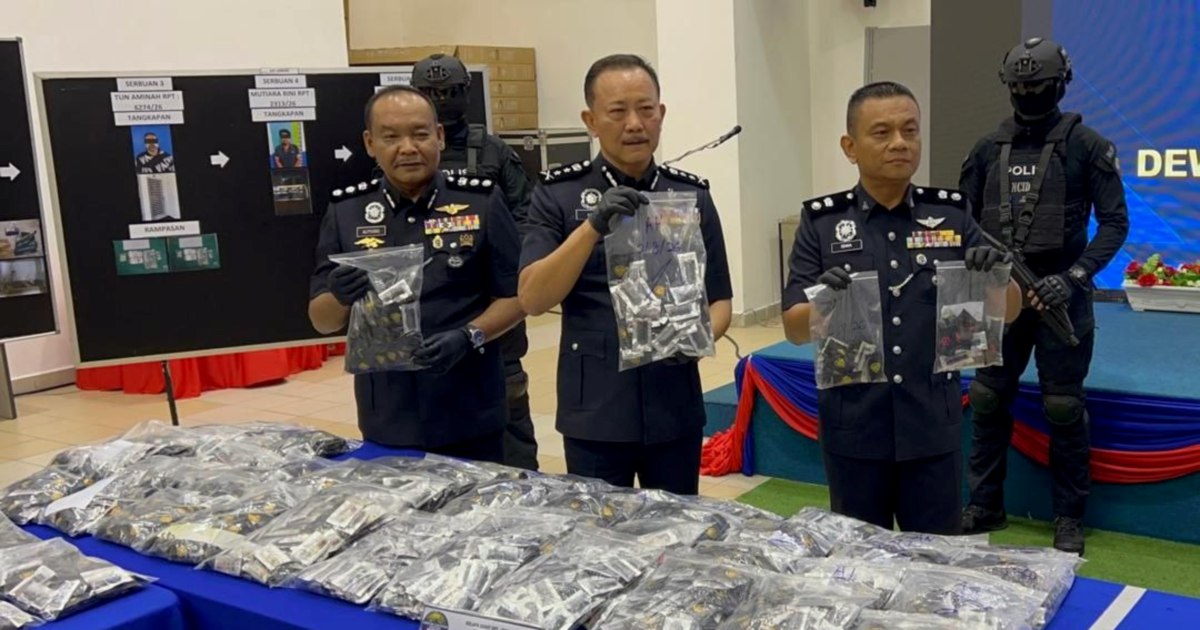
Authorities have successfully broken up a major drug trafficking network specializing in the processing and distribution of vape cartridges laced with controlled substances, following coordinated enforcement action across Johor on Sunday. The operation, which spanned five locations across the state simultaneously, resulted in the apprehension of seven individuals connected to what appears to be a well-organized distribution system. The confiscated contraband carries an estimated street value of RM10.68 million, representing one of the significant busts targeting the evolving illicit narcotics market in the region.
The parallel raids demonstrate the increasing sophistication of enforcement strategies employed by Malaysian police in combating drug trafficking networks that exploit modern consumption methods. The deliberate timing of multiple simultaneous operations reflects a tactical approach designed to prevent suspects from alerting associates or destroying evidence. This synchronized approach has become increasingly common as authorities recognize that traditional sequential enforcement efforts often fail to disrupt the entire supply chain, allowing key operatives to evade capture or relocate operations.
The targeting of drug-infused vape products represents a significant shift in how trafficking syndicates are adapting their business models. Vaping devices have become normalized in many communities, offering traffickers a relatively inconspicuous method of distributing controlled substances compared to traditional forms. The cartridge format allows for easier concealment, transportation, and distribution through conventional retail channels, making detection more difficult for authorities. This particular avenue of drug distribution is particularly concerning because it leverages technology and changing social norms around vaping to circumvent traditional enforcement mechanisms.
For Malaysian readers, this bust carries implications beyond the immediate disruption of supply chains. The scale of the operation, valued at over RM10 million, indicates that narcotics trafficking organizations view the domestic market as sufficiently profitable to justify significant investment in processing infrastructure and distribution networks. The presence of processing facilities suggests that the syndicate was not merely importing finished products but was engaged in manufacturing activities within Malaysian territory, indicating a deeper entrenchment of trafficking operations within the country's economy.
The seven arrests represent varying levels within the organizational hierarchy, though authorities have not detailed the specific roles of each suspect. In typical drug trafficking networks, such operations involve multiple tiers ranging from street-level distributors to supervisors managing logistics and supply chain coordination. Understanding this hierarchical structure is essential for law enforcement to effectively dismantle operations, as removing only lower-level operatives often results in rapid organizational adaptation and replacement of personnel.
Johor's prominence in this enforcement action reflects broader patterns of trafficking activity in southern Peninsular Malaysia. The state's geographic proximity to Singapore, a major consumption hub with higher population density and purchasing power, creates natural incentives for traffickers to establish supply chains through Johor. Additionally, Johor's extensive port infrastructure and road networks provide multiple transit routes for moving contraband, making it an attractive operational base for criminal enterprises.
The vape-based delivery method raises public health concerns distinct from traditional drug consumption patterns. Vaping products are often perceived as less harmful than conventional smoking or other drug delivery methods, potentially lowering barriers to experimentation, particularly among younger demographics. Young users may be unaware that their vape cartridges contain controlled substances, making them unwitting consumers of illicit drugs. This deception represents a particularly insidious dimension of the trafficking enterprise, as it exploits misplaced consumer trust in what appears to be a legitimate commercial product.
The enforcement success also highlights the operational challenges law enforcement agencies face when confronting transnational criminal networks. Drug trafficking organizations often operate across multiple jurisdictions, utilizing different territories for distinct functions such as manufacturing, warehousing, and distribution. The coordination required to simultaneously execute raids across five locations demonstrates institutional capacity, though it also reveals that such capacity-intensive operations may only be possible at irregular intervals, allowing syndicates to resume activities between major enforcement actions.
The financial dimensions of this bust warrant particular attention. A RM10.68 million operation suggests substantial capital investment in processing equipment, precursor chemicals, cartridge components, and distribution infrastructure. The syndicate's ability to command such resources indicates access to funding mechanisms, whether derived from domestic criminal proceeds or international trafficking networks. Understanding these financial flows is crucial for authorities seeking to disrupt not merely the supply chain but the economic foundations that enable such operations to function.
For the broader Southeast Asian context, this operation reflects a region-wide phenomenon of narcotics trafficking organizations rapidly adapting to exploit technological changes and evolving consumer preferences. The vape cartridge model represents a transnational innovation in drug distribution, likely already adopted by criminal enterprises across multiple countries. The sharing of enforcement intelligence and best practices between regional law enforcement agencies becomes increasingly vital in disrupting these networks before they become established across the entire region.
Authorities have indicated that investigations remain ongoing, with possibilities for additional arrests and the identification of international connections. Such continued investigation is essential for understanding the full scope of the operation and identifying upstream suppliers and downstream distribution partners. The intelligence gathered from this operation will likely inform enforcement strategies targeting similar syndicates elsewhere in Malaysia and potentially throughout Southeast Asia.

