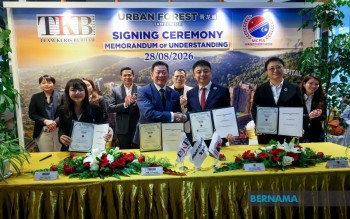
An ambitious RM1 billion urban forest project in Tambun, Ipoh, marks a significant shift in Perak's tourism ambitions, signalling the state's determination to transition from a domestic travel destination to an international player. The 84-acre development by Team Keris Bhd, expected to reach completion within three years, represents one of the most substantial integrated tourism investments in the state in recent years. Rather than pursuing incremental growth, stakeholders involved in the project are framing it as a catalyst for comprehensive economic diversification across tourism, hospitality, food and beverage, retail and commercial sectors.
The partnership structure underscores the multi-stakeholder approach driving the initiative. Team Keris Bhd has signed formal agreements with RJJ Hotels and the Malaysian Chinese Restaurant Association, creating a framework where accommodation, dining and cultural experiences interlock to create what proponents describe as a complete visitor journey. This strategic bundling of services aims to address a persistent challenge for Perak tourism: despite possessing attractions like the Lost World of Tambun and a rich culinary heritage, the state has struggled to extend visitor stays and increase spending compared to more established destinations like Penang or Kuala Lumpur. By anchoring hospitality and food within a curated urban environment, developers hope to shift visitor behaviour from quick day trips to extended stays that generate significantly higher economic impact.
Peак's tourism committee chairman Loh Sze Yee articulated an explicit strategy to elevate international perception of the state's offerings. The framework being pursued involves standardising service quality to match international expectations while simultaneously preserving and promoting distinctive local culinary and cultural identity. This balancing act is critical because regional competitors including Thailand, Vietnam and Indonesia have successfully marketed authentic local experiences to affluent international tourists. Perak's challenge lies in professionalising its tourism delivery without diminishing the authentic character that distinguishes it from generic international hospitality chains. The urban forest concept attempts to bridge this gap by functioning as a controlled environment where quality control meets cultural authenticity.
The food and beverage component reveals particularly nuanced thinking about market positioning. The proposed composition—40 percent Malaysian Chinese Restaurant Association-affiliated operators alongside 60 percent other Malaysian F&B businesses—reflects deliberate market segmentation. Rather than importing international cuisine franchises, the development prioritises showcasing Malaysia's indigenous food culture to visitors from primary source markets including Australia, Britain and the United States. This approach aligns with broader Southeast Asian trends where culinary tourism has become a significant draw, with countries like Thailand and Vietnam successfully leveraging food heritage as economic differentiators. Team Keris Bhd group executive chairman Datuk Lee Seng Hee emphasised that food serves as a cross-border attraction mechanism, capable of driving visitation decisions independently of conventional hotel or activity marketing.
Muslim-friendly dining represents another strategic consideration embedded within the project. By ensuring 30 percent of F&B offerings accommodate halal requirements and Muslim dietary preferences—including innovations like halal dim sum—the development broadens its appeal to markets including the Middle East, Indonesia and Bangladesh. This positioning acknowledges demographic shifts in global tourism where Muslim-majority populations represent increasingly affluent traveller segments. Malaysia's established halal certification framework, recognised internationally, provides competitive advantage in packaging these offerings for export markets. The integration of halal considerations into the urban forest concept avoids the perception of religious accommodation as afterthought, instead positioning it as core to the destination brand.
RJJ Hotels' involvement introduces crucial international distribution capability. The company's affiliation with Jin Jiang Hotels, commanding over 200 million members across 50 countries and operating more than 40 hotel brands globally, provides immediate access to established travel channels. Rather than requiring Ipoh to build awareness from scratch in distant markets, RJJ leverages existing networks to package Perak experiences within broader Asia-Pacific travel itineraries. RJJ Hotels chief executive officer Yap Lip Seng articulated the competitive advantage this creates: international tourists can book comprehensive packages covering accommodation, dining and transportation without logistical uncertainty, a critical consideration for travellers unfamiliar with accessing smaller regional destinations. This connectivity model resembles how established tourism destinations in Thailand and Vietnam have successfully integrated peripheral regions into primary market circuits through hotel network intermediation.
The supply chain development articulated by Malaysian Chinese Restaurant Association president Gao Houyun suggests ambitions extending beyond visitor attraction. By encouraging condiment and ingredient manufacturers to establish Perak-based facilities, the project aims to create sustainable employment and develop export ecosystems. Perak's established status as an agricultural and manufacturing hub positions it favourably for this value-chain approach. If realised, ingredient producers could service not only the urban forest's internal F&B ecosystem but broader Southeast Asian markets, creating multiplier effects across manufacturing, logistics and distribution sectors. The emphasis on leveraging Malaysia's halal certification for regional market penetration indicates recognition that certification represents tradeable asset capable of generating export revenues beyond tourism contexts.
The development's positioning within Tambun's existing commercial landscape reflects strategic clustering logic. Lost World of Tambun and surrounding hospitality infrastructure have established the area's leisure credentials, reducing project risk by building upon existing visitor flows. Rather than competing with established attractions, the urban forest functions as complementary ecosystem designed to extend average visitor spending and length of stay. This collaborative rather than competitive posture distinguishes the project from zero-sum destination rivalries that sometimes characterise regional tourism development. By increasing Tambun's attractiveness, the urban forest potentially elevates the entire district's tourism economy through visitor multiplication and spending concentration effects.
The three-year completion timeline suggests significant capital deployment and construction activity will commence immediately. For Perak's broader economy, the project offers employment generation through construction phases and operational staffing once facilities open. Skills development initiatives mentioned by MCRA officials suggest recognition that service quality ultimately determines visitor satisfaction and repeat visitation. Training infrastructure targeting local restaurant workers and hospitality staff represents investment in human capital that extends beyond the urban forest itself, potentially elevating service standards across Perak's broader tourism sector. This positive externality creation distinguishes development projects contributing to systematic competitiveness improvements from isolated commercial ventures.
The implicit challenge confronting the urban forest lies in executing a development ambitious in scope while remaining focused on visitor experience quality. Large integrated projects frequently encounter cost overruns, operational inefficiencies and market challenges once operational. Perak's success in this instance depends upon whether the partnership maintains strategic coherence through construction completion, effectively recruits and trains operational personnel, and successfully attracts the anticipated visitor volumes. Competition from other Southeast Asian destinations continues intensifying, meaning the urban forest must not merely open but consistently deliver experiences justifying premium pricing positioning. International market familiarity with Perak remains limited compared to Thailand or Indonesia, requiring sustained marketing investment beyond project completion.
For Malaysian policymakers and regional observers, the urban forest represents significant experimentation in tourism destination development strategy. Rather than pursuing casino-based gaming tourism or mass beach resort models adopted elsewhere in Southeast Asia, Perak is emphasising culinary heritage, hospitality excellence and cultural authenticity. If successful, the model offers template for other secondary Malaysian cities seeking international tourism elevation without sacrificing local character. The project's emphasis on supply chain development and skills training additionally suggests recognition that sustainable tourism development requires investment in enabling infrastructure and human capital, not merely visitor attraction facilities. The coming three years will determine whether Perak's ambitious vision for international recognition can withstand execution challenges and translate strategic intent into operational reality.

