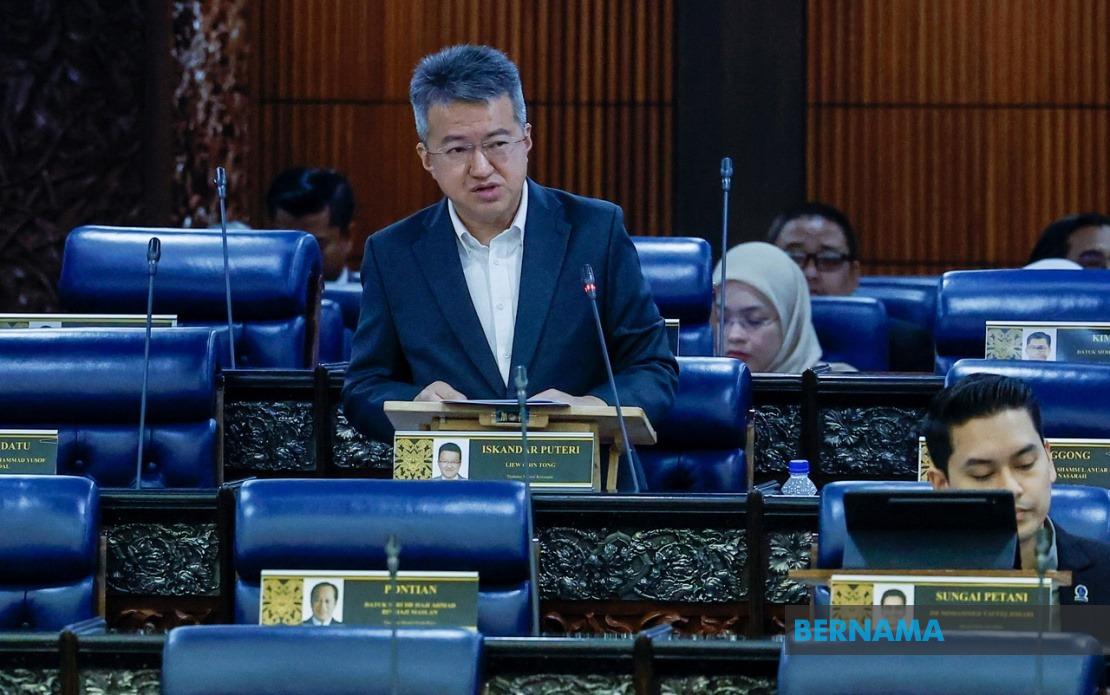
The federal government has moved to reassure Sabah that the RM1.5 billion increase in the state's interim special grant will remain separate from and not encroach upon existing development spending commitments. Deputy Finance Minister Liew Chin Tong made this clarification during parliamentary proceedings on July 14, directly addressing concerns raised by a lawmaker from WARISAN regarding the mechanism and constitutional basis of the additional grant.
The announcement of the interim grant increase, made by Prime Minister Datuk Seri Anwar Ibrahim in May, has been structured to complement rather than substitute for Sabah's regular development budget. According to Liew, the state's development allocation has expanded from RM6.7 billion to RM6.9 billion for the current fiscal year, representing a concrete improvement in infrastructure investment capacity. This year-on-year growth demonstrates the federal government's stated commitment to raising capital expenditure in the state beyond the baseline funding typically allocated through constitutional revenue-sharing arrangements.
Sabah's development portfolio spans an expansive range of initiatives critical to the state's infrastructure backbone. The Pan Borneo Highway project continues as a flagship undertaking, while concurrently the federal government is directing funds toward rural road networks that connect peripheral communities to economic centres. Rural electrification and water supply expansion programmes remain priority areas, particularly for settlements where access to these basic utilities remains inconsistent. Simultaneously, the federal government is allocating resources toward construction and renovation of medical facilities, from major hospitals to primary clinics, as well as addressing the accumulated maintenance backlog in the state's school infrastructure and law enforcement buildings.
Liew highlighted that the federal commitment to Sabah extends beyond capital projects into recurring operational expenditure. Notably, the federal government will continue subsidising electricity supply to the state even after regulatory authority over the power sector transitioned to Sabah's administration in 2024. This ongoing subsidy arrangement, projected to reach RM880 million in 2026, underscores the federal acknowledgement that Sabah's electricity cost structure requires long-term support to maintain affordability for residents and competitiveness for businesses.
Water infrastructure funding has experienced notable expansion, with allocations for rural water supply climbing from RM103.5 million in 2025 to RM143 million in the current year. This 38 percent increase signals heightened federal attention to water security in rural Sabah, where piped supply networks often face technical challenges and population density variations that complicate cost recovery. The magnitude of this boost reflects recognition that water infrastructure is foundational to human development and economic activity in remote areas.
Beyond capital and sectoral spending, the federal government is channelling assistance through cash transfer schemes designed to ease household budgets. The Sumbangan Tunai Rahmah and Sumbangan Asas Rahmah programmes are expected to distribute approximately RM1.2 billion across Sabah households during the period under discussion. These targeted assistance schemes represent a form of demand-side intervention that complements supply-side infrastructure investment, allowing lower-income households to sustain consumption levels and participate more fully in the economy.
The constitutional framework governing Sabah's special grants has emerged as a significant area of federal-state negotiation. Liew reiterated that the federal government respects the constitutional foundation for these grants, specifically Article 112C of the Federal Constitution, which enshrines Sabah's entitlement to special financial arrangements reflecting its unique constitutional position within Malaysia. However, the government has filed an appeal against certain aspects of a Kota Kinabalu High Court judgment on the matter, indicating that disputes over interpretation and implementation modality persist despite broad acceptance of the principle.
The procedural framework for disbursing the additional grant mirrors mechanisms established in previous years, requiring coordinated action between federal and state governments under Article 112D of the Federal Constitution. This parallel process requirement means that while the federal government has committed the funds, the actual transfer and allocation depend on achieving agreement between Kuala Lumpur and Kota Kinabalu on implementation procedures. The federal government's invocation of past precedent from 2022, 2023, and 2025 suggests that established processes have provided a workable template, though the constitutional ambiguities that prompted the court challenge remain unresolved.
Looking forward, Liew indicated that the federal government intends to engage in sustained negotiations with the Sabah state government to devise a new mechanism for determining future special grant amounts. This prospective institutional reform would operate within the framework of Articles 112C and 112D, suggesting that the goal is not to diminish Sabah's entitlements but to establish a more transparent and predictable formula for calculating grants. Such institutional clarity could reduce future disputes and enable Sabah's government to engage in more reliable long-term planning based on predictable revenue streams.
For Malaysian policymakers and observers, the Sabah grant arrangement carries broader significance for federal-state fiscal relations. Sabah's constitutional position differs from other states, carrying forward protections negotiated at the time of Malaysia's formation in 1963. How effectively the federal government manages these constitutionally-mandated special arrangements sets a precedent for honouring federal-state compacts and for navigating tensions between central resource control and state development prerogatives. The willingness to increase interim grants while simultaneously contesting court interpretations of grant formulae suggests a government attempting to balance fiscal generosity with institutional control—a balance that will require ongoing calibration as both economies evolve.

