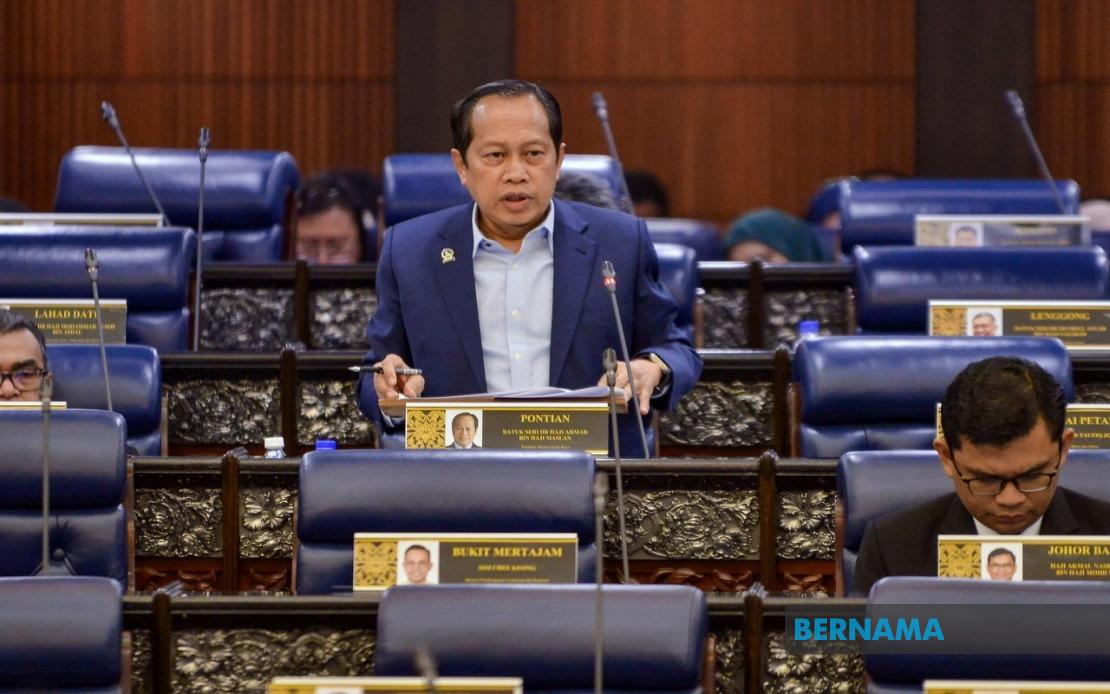
The federal government has channelled RM1.2 billion towards compensating landowners affected by the Sabah Pan Borneo Highway Phase 1 Project, Deputy Minister of Works Datuk Seri Ahmad Maslan revealed during parliamentary questioning on July 14. The commitment reflects Putrajaya's stated policy of ensuring affected parties do not bear financial burdens resulting from the major infrastructure development, with the government absorbing all compensation, losses, and related administrative expenses. In Sarawak, land acquisition costs for the parallel PBH initiative have reached RM737 million, underscoring the substantial financial implications of corridor development across Malaysian Borneo.
The disclosure emerged during an exchange in the Dewan Rakyat when WARISAN member Isnaraissah Munirah Majilis queried the dramatic escalation in project costs. The Sabah Phase 1 initiative has ballooned to RM24.889 billion from an original 2015 estimate of RM12.86 billion—nearly doubling the initial projection and raising questions about cost management and project oversight. This near-doubling represents one of Malaysia's most significant infrastructure cost overruns in recent years, warranting closer examination of the factors driving expenditure increases and their implications for future mega-projects across the nation.
Ahmad attributed the substantial cost elevation primarily to the transition from the Project Delivery Partner model to direct federal conventional contracting. The PDP structure, which had guided the project's initial years, was terminated in 2019 following considerations of national interest. This shift necessitated comprehensive reassessment of all remaining construction phases and deliverables, effectively requiring fresh technical and financial analysis five years into the original planning framework. Such pivotal changes in procurement methodology inevitably trigger cost recalculations, as contractors adjust pricing, timelines, and resource allocation under different operational and contractual parameters.
Technical factors comprise a substantial component of the cost increases. Ahmad highlighted modifications to project scope and engineering design, along with unanticipated geotechnical challenges requiring specialized soil treatment interventions. Additionally, large-scale utility relocation—involving telecommunications, water, electricity, and gas infrastructure—has demanded extensive coordination and remedial construction work. These technical complications, often revealed only during detailed design phases or initial ground works, are characteristic of major corridor projects traversing diverse terrain and developed areas requiring protection of existing services.
The Sabah Phase 1 project encompasses two distinct implementation packages with divergent cost profiles. Phase 1A comprises 16 work packages totalling RM10.9 billion, while Phase 1B incorporates 19 packages valued at RM13.989 billion. This structural division allows phased delivery and separate contractor engagement, though it also multiplies coordination complexities and potential cost pressures at interface points between contract segments. The differential pricing between phases suggests varying terrain difficulty, population density, and utility complexity across the highway corridor.
Beyond technical considerations, broader macroeconomic forces have substantially amplified construction expenses. Global and domestic inflation, particularly in commodity-dependent sectors, has inflated material costs dramatically. Iron, cement, and bitumen—three critical highway construction inputs—have experienced sustained price pressures over the past decade, reflecting global supply chain dynamics and demand from regional development initiatives. Malaysian contractors face additional headwinds from elevated machinery rental costs and intensifying labour market tightness, particularly for skilled workers with highway construction expertise. These market-driven factors operate beyond governmental control, though they significantly impact any long-duration infrastructure project.
The RM1.2 billion land compensation figure itself merits contextual analysis. For a corridor spanning hundreds of kilometres through Sabah's diverse geography, this represents considerable acquisition costs, reflecting both the extent of privately held land intersecting the alignment and prevailing land valuations across Borneo's interior and coastal zones. Compensation methodology—whether market-rate assessment, negotiated settlement, or statutory valuation—directly influences aggregate expenses. The government's stated commitment to bearing full compensation costs, without cost-sharing with project beneficiaries or developers, places the entire burden on federal budgets, with implications for resource allocation across competing priorities.
The Pan Borneo Highway initiative constitutes a transformative infrastructure undertaking for Malaysian Borneo, intended to enhance regional connectivity, facilitate economic integration, and improve access to previously remote communities. Phase 1 represents merely the opening segment of the broader vision. However, the dramatic cost trajectory evident in Sabah's experience raises significant questions about financial planning methodology for comparable megaprojects. If similar cost multiplication occurs during subsequent phases or parallel Sarawak expansion, the total programme expenditure could escalate well beyond current projections, potentially reaching RM40 billion or higher across all scheduled phases.
For Malaysian policymakers and development practitioners, the Sabah PBH experience offers cautionary lessons regarding infrastructure cost estimation and project governance. The necessity to abandon the PDP model and revert to conventional contracting suggests that innovative procurement frameworks, while theoretically promising, can encounter practical implementation challenges requiring mid-project course correction. Retrospective technical reassessment following contract termination often reveals that initial planning assumptions were insufficiently conservative or inadequately addressed risk factors. Future megaprojects should incorporate more substantial contingency provisions and phased gate reviews rather than advancing on fixed initial estimates.
The political dimensions warrant consideration as well. In parliament, WARISAN—Sabah's principal opposition alliance partner—raised the cost escalation issue, reflecting constituent concerns about value-for-money in regional development spending. For a state government perspective, receiving infrastructure investment carries both benefits and costs; while connectivity improvements offer economic promise, the magnitude of federal resource commitment raises questions about whether alternative regional priorities might have yielded greater immediate social impact. The compensation payments, while substantial, represent merely one cost component within the project's broader financial framework.
Moving forward, monitoring of Phase 1 completion timelines and cost containment will prove critical. If the first phase experiences further delays or expense increases, subsequent phases may encounter escalated contingency expectations or funding constraints. The RM1.2 billion in compensation payments already distributed represents irreversible expenditure; ensuring that the physical infrastructure eventually delivered provides commensurate regional benefits becomes essential for justifying the total investment. Malaysian infrastructure development credibility, particularly in Borneo contexts where remoteness and technical challenges multiply cost pressures, depends upon demonstrating that even dramatically expanded budgets ultimately translate into functional, durable transportation networks serving their intended development purposes.

