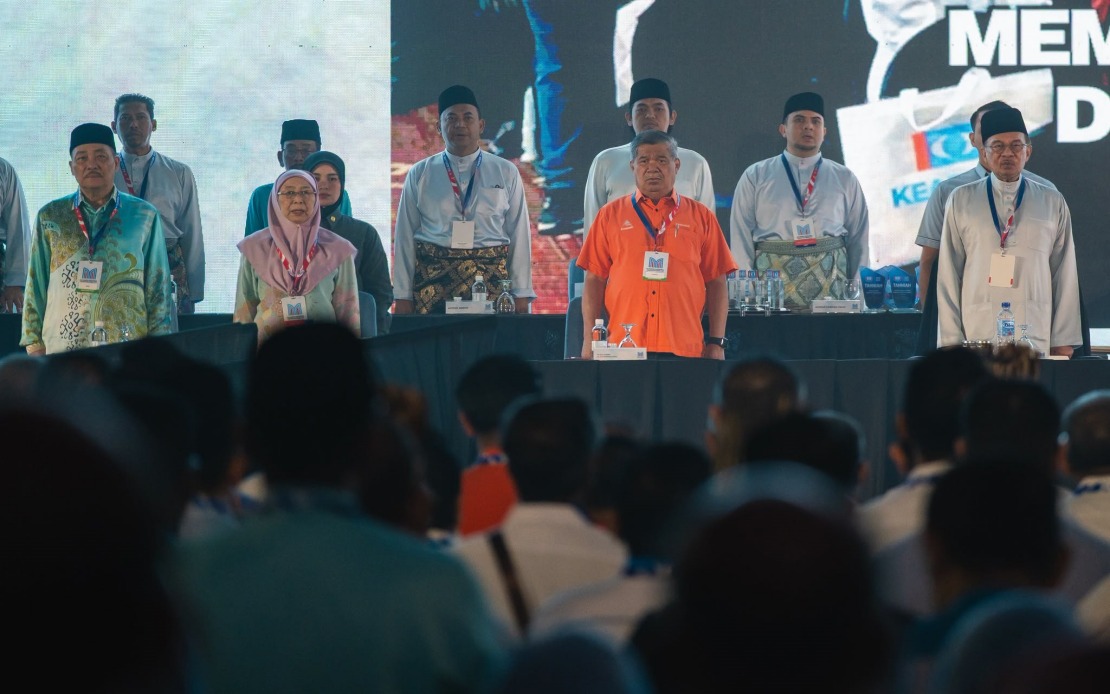
The reform mandate entrusted to the government by Malaysian voters must translate into sustained action and measurable outcomes, according to Parti Amanah Negara (Amanah) president Datuk Seri Mohamad Sabu, who delivered his message at the Melaka International Trade Centre in Ayer Keroh during the 2026 Parti Keadilan Rakyat (PKR) National Congress. Speaking through a Facebook post, Sabu stressed that institutional transformation cannot be treated as a temporary political campaign slogan but rather as an enduring commitment that extends well beyond the initial transition to power.
Sabu, who currently serves as Agriculture and Food Security Minister, emphasised that the administration's credibility ultimately depends on demonstrable action rather than rhetoric. He articulated a clear positioning against corruption at all levels, stating unequivocally that individuals who misappropriate public funds would face consequences regardless of their political affiliation or official standing. This pronouncement carries particular weight in Malaysia's political landscape, where concerns about governance accountability have remained central to public discourse following previous administrations marred by high-profile corruption scandals. The minister's willingness to name this commitment publicly signals an attempt to distinguish the current coalition government from predecessors accused of tolerating financial malfeasance within their own ranks.
The broader context of Sabu's remarks reflects an ongoing tension within Malaysia's ruling coalition between achieving short-term political consolidation and pursuing structural reforms that could ultimately weaken entrenched patronage networks. By attending and acknowledging PKR president Datuk Seri Anwar Ibrahim's address on reform continuity, Sabu positioned Amanah alongside the larger coalition partner in championing institutional renewal. This alignment becomes strategically significant given that reform commitments formed a cornerstone of the campaign messaging that brought the current coalition to power, and any perceived abandonment of these pledges could undermine coalition cohesion and voter confidence alike.
Regarding economic stewardship, Sabu articulated a nuanced perspective on development metrics that suggests awareness of public frustration with growth statistics that fail to translate into improved household circumstances. While acknowledging that economic expansion remains important, he prioritised the lived experience of ordinary Malaysians, emphasising that statistical growth means little if wages stagnate, employment remains precarious, or essential goods become increasingly unaffordable. This messaging directly addresses cost-of-living pressures that have dominated public grievances across Southeast Asia in recent years, particularly affecting middle and lower-income households confronting persistent inflation in food, energy, and housing costs.
The minister also reaffirmed the government's commitment to implementing the Malaysia Agreement 1963 (MA63), which governs the constitutional relationship between Peninsular Malaysia and the East Malaysian states of Sabah and Sarawak. This emphasis reflects ongoing sensitivities regarding federal-state relations and resource distribution that have periodically threatened coalition stability. By positioning MA63 implementation as a priority alongside reform and economic management, Sabu signalled awareness that the coalition's long-term viability depends partly on satisfying the political demands of East Malaysian coalition partners who have historically used their pivotal parliamentary numbers as leverage for greater autonomy and revenue sharing.
Particularly noteworthy was Sabu's welcome of the government's announcement to repeal the Universities and University Colleges Act 1971 (AUKU), which had long restricted student political expression and assembly rights. Characterising the repeal as expanding freedom and opportunities for campus-based civic engagement, Sabu positioned the measure as emblematic of the broader reform agenda. The AUKU repeal carries symbolic importance beyond its immediate operational scope, signifying governmental willingness to loosen restrictions on political participation and public discourse that had been maintained across multiple administrations. For younger voters and civil society organisations, this gesture demonstrates commitment to opening democratic space, though implementation challenges remain substantial.
The linkage between anti-corruption efforts, economic inclusivity, federalism, and civil liberties that Sabu articulated reflects an understanding that Malaysia's governance challenges operate as interconnected systems rather than discrete policy domains. Corruption that depletes public resources inevitably constrains the fiscal space available for programmes addressing cost-of-living concerns; restrictions on student activism can discourage youth political engagement and reduce accountability pressure on institutions; and grievances regarding federal-state relations can destabilise coalition governments if left unaddressed. By positioning reform as multifaceted and continuous, Sabu attempted to frame Amanah and the broader coalition as committed to systematic institutional renovation rather than merely tinkering at the margins.
However, sustaining such a comprehensive reform agenda poses genuine challenges that Sabu's rhetoric does not explicitly address. Corruption investigations targeting individuals from within the coalition or its allies risk generating internal factional conflicts and potentially destabilising the government itself. Economic restructuring designed to improve living standards may require difficult trade-offs involving subsidy rationalisation or tax increases that alienate voter constituencies. Expanding civil liberties can create political complications if student activism mobilises criticism of government policies. These tensions suggest that reform continuity will ultimately depend on whether coalition leaders can maintain unity around shared commitments despite the pressures that typically accompany governing power in any complex democracy.
The timing of Sabu's intervention during the PKR National Congress also warrants consideration. By publicly aligning Amanah with Anwar Ibrahim's reform messaging, Sabu engaged in coalition management as much as policy articulation. This positioning potentially strengthens Amanah's standing within the coalition partnership by demonstrating ideological consistency with the larger PKR faction while simultaneously establishing a distinct identity based on principled commitment to governance standards. Such positioning matters particularly for a mid-sized coalition member seeking to justify its political relevance and secure meaningful portfolio allocations in any future cabinet reconfiguration.
For Malaysian voters and observers of regional politics more broadly, Sabu's message encapsulates the broader challenge confronting democratic governments across Southeast Asia: reconciling ambitious reform agendas with the practical realities of coalition politics, fiscal constraints, and entrenched institutional interests. Whether the Malaysian government can sustain its reform commitments beyond the current political cycle will likely influence not only its own electoral prospects but also broader regional patterns of democratic governance and public expectations regarding state accountability.

