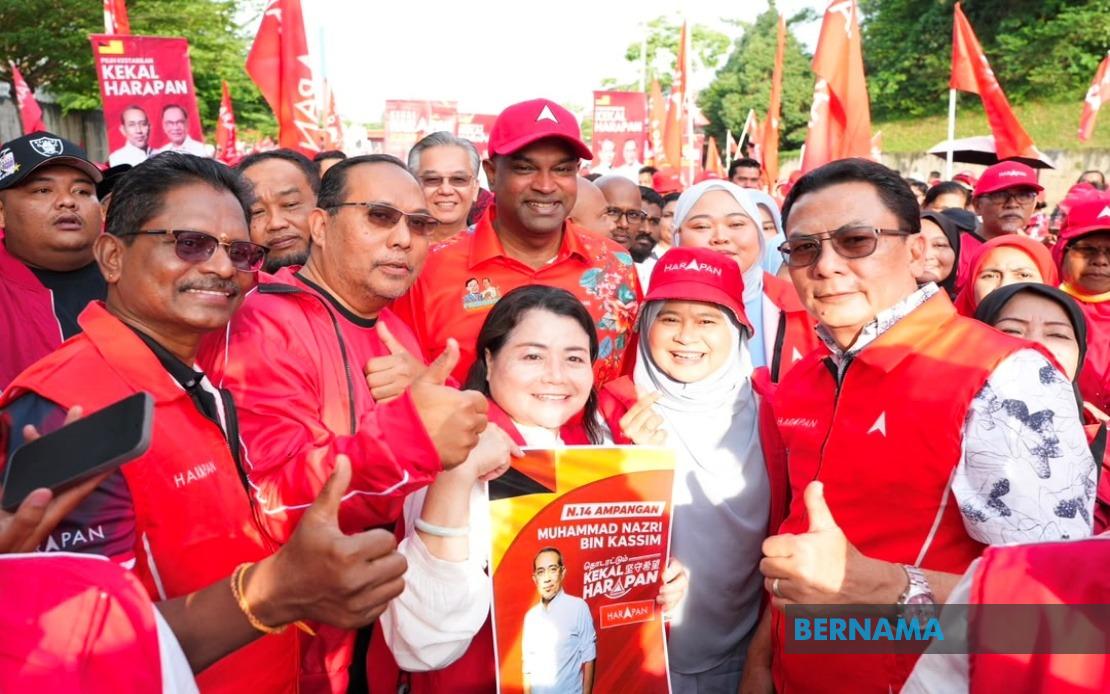
Senior Pakatan Harapan figures descended on Seremban this week to bolster campaign efforts for six coalition candidates contesting the 16th Negeri Sembilan state election, signalling the intensity of mobilisation efforts as Malaysia's smallest state heads toward the ballot box. Datuk Seri R. Ramanan, the Sungai Buloh Member of Parliament and vice-president of Parti Keadilan Rakyat, appeared at the Nomination Centre at Wisma Majlis Bandaraya Seremban alongside DAP deputy secretary-general Steven Sim to throw their weight behind candidates seeking seats across six constituencies.
The pair lent their organisational firepower to Nor Azman Mohamad in Sikamat, Datuk Muhammad Nazri Kassim in Ampangan, Zarinna Abu Zarin in Lenggeng, Chew Seh Yong in Lobak, J. Arul Kumar in Nilai, and Ho Weng Wah in Temiang. The appearance of such heavyweight personalities reflects the high stakes nature of a contest that will determine which coalition steers Negeri Sembilan's development agenda for the next five years. Ramanan's presence as a senior PKR figure underscores the ruling coalition's determination to maintain its grip on a state where it has faced stiffening electoral headwinds in recent years.
Ramanan characterised the scene at the nomination centre as evidence of grassroots energy within the coalition. He emphasised that the visible presence of party machinery and ordinary supporters demonstrated the depth of commitment flowing through PH ranks ahead of the formal campaign period. His observation carries weight in Malaysian electoral politics, where the capacity to mobilise ground-level party workers often predicts electoral outcomes more accurately than polling data or media coverage. The nomination process having concluded on the day of his visit, the campaign proper commenced immediately, giving all contending candidates precisely two weeks to make their case to voters.
The electoral timeline is compressed but consequential. Voters will cast ballots on August 1, with early voting scheduled for July 28, meaning the campaign window spans merely thirteen days. This truncated timeframe demands ruthless efficiency in resource deployment and messaging discipline across all competing parties. For Pakatan Harapan, particularly PKR and the DAP who dominate within the coalition's Negeri Sembilan footprint, the nomination centre visit represented a statement that the machinery remains operational and committed despite the party-political turbulence that has occasionally distracted federal-level politics.
Negeri Sembilan presents an intriguing microcosm of Malaysian electoral dynamics. With only thirty-six seats available across the entire state legislature, each contest carries disproportionate weight compared to larger states where single-seat swings can be absorbed into broader victory margins. The dissolution of the previous assembly on June 5 triggered the election process, culminating in the current cycle. The state's relatively compact size means that individual personalities and local knowledge often outweigh national campaigns, potentially favouring candidates with deep community roots and long-standing networks.
The coalition's selection of six candidates to receive explicit backing from national-level figures suggests strategic prioritisation. These constituencies likely represent either highly marginal seats where the coalition believes incumbent performances can be improved, or safe territory where visible high-level support might boost turnout among coalition voters. The choice to concentrate attention on these specific races while leaving other PH-endorsed candidates to conduct their own campaigns demonstrates sophisticated electoral calculus about where external help provides maximum advantage.
For Malaysian observers, the Negeri Sembilan contest offers insights into broader coalition dynamics at a time when Pakatan Harapan has been navigating complex negotiations with other political entities in pursuit of the two-thirds parliamentary majority necessary for constitutional changes. The performance in this state election will inevitably be scrutinised as a barometer of public sentiment regarding PH governance and its capacity to execute policies effectively. Any significant losses could embolden opposition voices and complicate internal coalition management, whilst decisive victories would strengthen the hands of PH negotiators in ongoing political discussions.
Steven Sim's participation alongside Ramanan carries particular significance given DAP's role as Pakatan Harapan's largest component party by parliamentary representation. The DAP has traditionally performed strongly in Negeri Sembilan's more urbanised constituencies, where the party's focus on economic competence and anti-corruption messaging resonates with Chinese-majority and urban middle-class voters. The deputy secretary-general's appearance signals that DAP leadership takes the state contest seriously rather than viewing it as subsidiary to larger political contests elsewhere.
The broader context of Malaysian state elections has shifted considerably since Pakatan Harapan's 2018 federal victory. Voters have demonstrated increasing willingness to split mandates, returning different coalitions to power at state and federal levels. This pattern suggests that national-level sentiment regarding PH performance in federal government may significantly influence voter behaviour in Negeri Sembilan, regardless of local factors. If federal approval ratings have shifted since the last state election, the campaign narratives crafted by both PH and opposition parties will necessarily address this changed landscape.
Regionally, Negeri Sembilan's election outcome may carry implications for broader Southeast Asian political trends. Malaysia's handling of coalition governance, management of political competition, and electoral integrity continue to attract international attention as a touchstone for how Westminster-influenced systems function in the contemporary era. The smooth conduct of elections and the acceptance of results by all parties remains crucial for demonstrating Malaysia's institutional robustness in an era of concerning democratic backsliding elsewhere in the region.
For Ramanan and Sim's supporters, and for the six candidates they backed, the next fortnight represents the culmination of months of preparation and positioning. The formal campaign period commencing with the completion of nominations reflects a critical juncture where abstract organisational preparation transforms into direct voter engagement. Ramanan's statement about continuing to engage with constituents and maintaining campaign momentum articulates the familiar refrain of Malaysian election campaigns, yet the substance beneath such rhetoric—the actual capacity to mobilise voters, communicate compelling visions of governance, and overcome opposition critiques—will determine which candidates emerge victorious on August 1.

