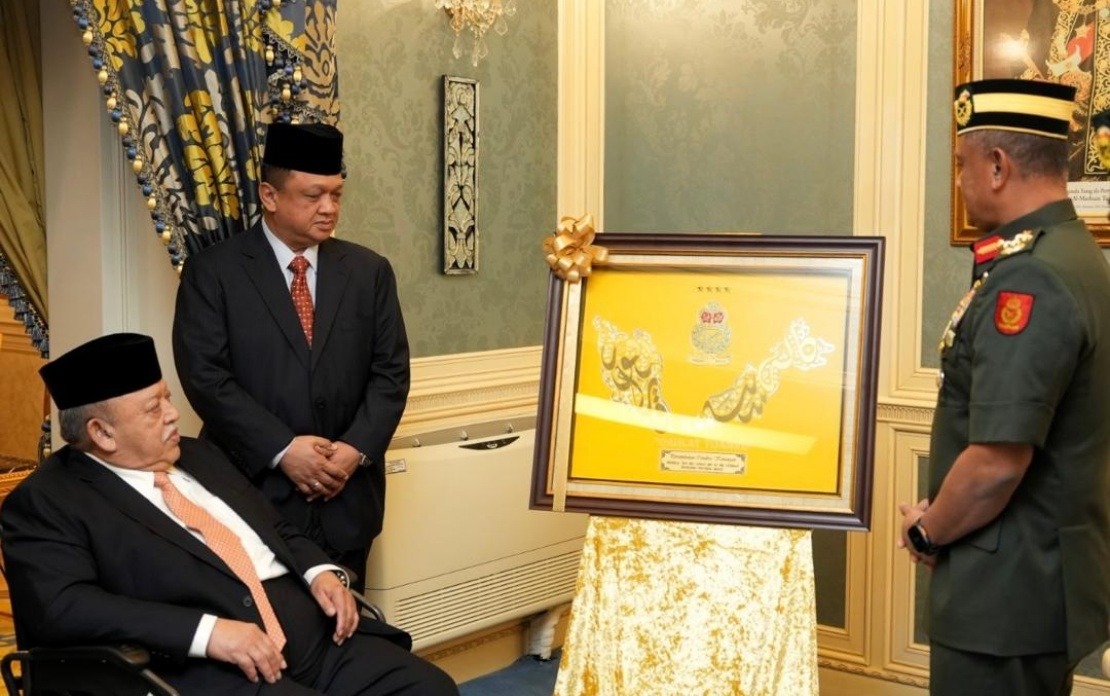
The Raja of Perlis, Tuanku Syed Sirajuddin Jamalullail, received Malaysia's army chief General Tan Sri Azhan Md Othman in a formal audience held at Balai Menghadap Biru, the ceremonial chamber at Istana Arau in Arau on July 29. The occasion demonstrated the continuing protocol and ceremonial importance placed on high-level engagements between the state's royal institution and the country's defence establishment, underscoring the constitutional and practical significance of the monarchy's role in military affairs.
The Raja Muda of Perlis, Brigadier General Tuanku Syed Faizuddin Putra Jamalullail, was present alongside the Raja during the meeting. The Raja Muda holds the significant position of Commander of the 504th Territorial Army Regiment, which is stationed at Kem Bukit Keteri near Padang Besar. This dual role—bridging the royal household and the military command structure—exemplifies how senior royalty in Malaysian states maintain active involvement in defence matters, a tradition reflecting the constitutional relationship between rulers and the armed forces.
According to a statement released by Istana Arau, the primary objective of the audience was to deepen the established relationship between Perlis's royal institution and the Malaysian armed forces. Such formal exchanges serve multiple diplomatic and institutional purposes beyond mere ceremonial protocol. They provide structured opportunities for state leadership and national defence authorities to align on security priorities, resource allocation, and collaborative initiatives that directly affect the state's wellbeing and its contribution to broader national security objectives.
The palace emphasised that the audience reflected appreciation for the army's ongoing dedication to protecting Malaysia's territorial integrity and ensuring public safety. This acknowledgement carries particular weight in the context of Perlis's geographical location along the Thai-Malaysian border, where security challenges and cross-border cooperation with both national and regional stakeholders remain ongoing concerns. The state's proximity to international borders makes its security interests particularly aligned with the broader strategic priorities of the Malaysian armed forces.
Tuanku Syed Sirajuddin Jamalullail holds additional military-ceremonial positions that enhance the significance of such interactions. He serves as Colonel-in-Chief of both the Royal Ranger Regiment (RRD) and the Royal Military Police Corps (KPTD), titles that represent more than honorary designations. These roles vest the Raja with symbolic authority and institutional connection to specific military units, creating pathways for substantive engagement on operational, welfare, and strategic matters affecting those formations.
The palace statement identified several substantive areas of focus for the meeting. Discussion encompassed security matters affecting the state and nation, programmes relating to public welfare and quality of life, and initiatives supporting national development. These three pillars—defence, social wellbeing, and economic progress—reflect how contemporary governance in Malaysian states integrates defence policy with broader developmental objectives. The army's potential involvement in disaster relief, infrastructure projects, and community engagement programmes means high-level dialogue between rulers and military leadership directly influences resource deployment across multiple sectors.
The audience also served as a platform to strengthen what the palace described as strategic cooperation and closer ties between army leadership and Perlis state administration. This language suggests concrete operational coordination mechanisms beyond ceremonial encounters. Military units stationed within a state require working relationships with state governments on matters ranging from land use and infrastructure access to community relations and emergency response protocols. Regular high-level engagement facilitates smoother institutional coordination on these practical matters.
The palace highlighted the shared commitment between the royal institution and the defence establishment to preserving national peace, stability, and prosperity. This shared language reflects the convergence of interests between Malaysia's monarchy—whose constitutional role includes serving as head of state and symbol of national unity—and the armed forces, whose organisational mandate centres on national security. Regular dialogue between these institutions helps ensure coordinated approaches to emerging challenges and maintains institutional alignment on fundamental priorities.
For Malaysian observers and regional analysts, such formal audiences underscore the continuing relevance of the constitutional monarchy within Malaysia's defence and security architecture. Unlike purely ceremonial roles in some democracies, the Malaysian monarchy maintains substantive institutional connections to the armed forces. The audience also demonstrates how state-level royal institutions remain engaged with national security matters, ensuring that local perspectives and concerns inform defence policy discussions at the highest levels.
The emphasis on strengthening cooperation between Perlis's royal leadership and the national defence establishment carries implications for regional security dynamics as well. Perlis, as a border state, sits at the intersection of Malaysian and Thai security interests. When the Raja meets with Malaysia's army chief, these discussions implicitly address transnational security challenges, bilateral military cooperation frameworks, and the state's role in Malaysia's broader strategic posture within Southeast Asia. Such engagements thus extend beyond state-level governance to touch upon regional security relationships and Malaysia's positioning within the wider Indo-Pacific strategic landscape.

