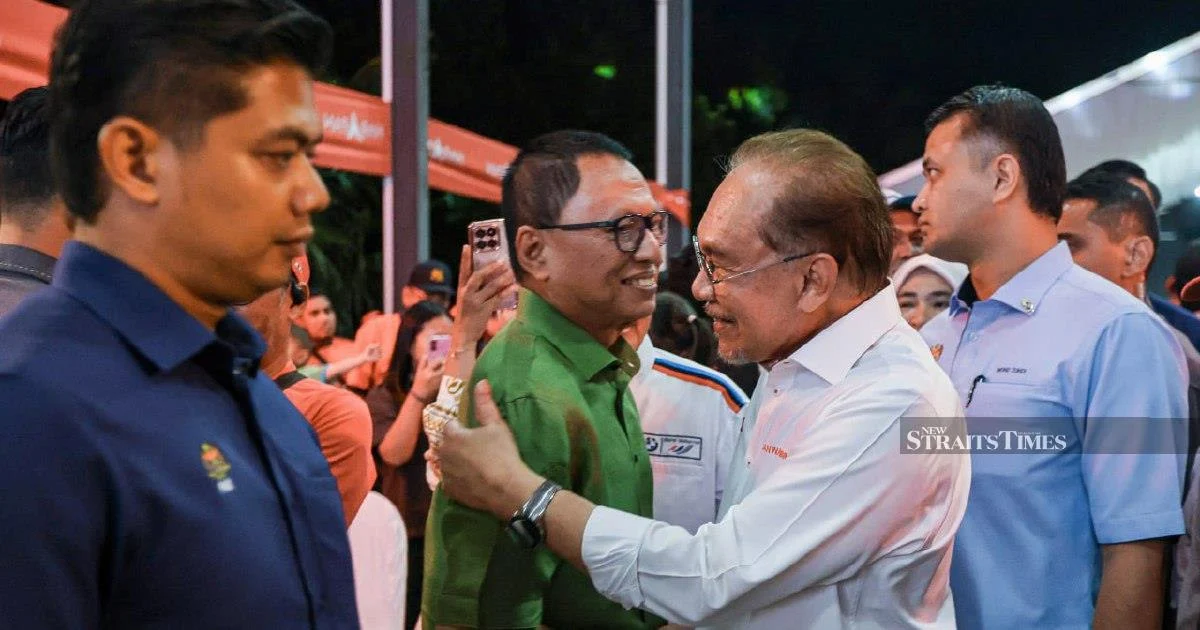
Political theatre in Malaysia took an amusing turn on Saturday when Bersama leader Datuk Seri Rafizi Ramli offered a tongue-in-cheek commentary on the apparent shift in fortunes of Datuk Dr Mohd Puad Zarkashi following a notably affectionate public exchange with Prime Minister Anwar Ibrahim.
The quip represents more than mere parliamentary banter. It touches on a broader narrative of political realignment that has characterised Malaysian politics since the 2022 general election, when Anwar's coalition secured its improbable majority. The visual of Puad receiving a warm embrace from the prime minister—captured in plain sight during a public event—carries symbolic weight in a political landscape where gestures and proximity to power communicate as loudly as policy statements.
Rafizi's observation, delivered with characteristic wit, highlights the precarious positioning of figures who occupy liminal spaces within Malaysia's fractured political ecosystem. Puad, despite his long association with Umno and traditional power structures, found himself in a position of apparent favour with the ruling administration. The Bersama leader's jest suggests that such visibility and warmth from the prime minister effectively constitutes a form of political repositioning, whether or not formal party-hopping has occurred.
This dynamic reflects a critical feature of contemporary Malaysian governance: the fluid nature of political alliances and the importance of individual relationships across traditional party lines. Under the Anwar administration, coalition politics has become increasingly personalised, with individual lawmakers and leaders enjoying varying degrees of access and influence based on their utility to the government's legislative agenda. Puad's apparent standing illustrates how relevance in Malaysian politics no longer depends solely on formal party affiliation but on demonstrated support for the government's programmes.
The embracing moment itself, witnessed publicly, departed from the traditional reserve that often characterises interactions between political figures from ostensibly different camps. Such overt displays of warmth carry implications for factional dynamics within Umno, which has struggled to maintain cohesion as members pursue individual political interests. For a senior figure like Puad to be visibly embraced by the prime minister sends unmistakable signals about his standing and the government's confidence in his support.
Rafizi's jibe also underscores the competitive dynamics within the ruling coalition. Bersama, though a component party, operates within a complex power structure where PKR holds significant sway through Anwar's position as prime minister. The comment may be interpreted as a reminder that political capital and ministerial favour remain hotly contested commodities. If Puad is receiving such public recognition from the prime minister, the implication for coalition partners is that the distribution of such attention and resources warrants attention.
The Malaysian political landscape has witnessed numerous instances of figures making unexpected transitions, though Puad's situation differs in that no formal defection has been announced. What appears to have occurred instead is a recalibration of his political positioning through enhanced relationship with the incumbent administration. This approach allows flexibility without the formal party-switching that would trigger legal consequences under anti-hopping legislation.
For Malaysian voters and political observers, the exchange illustrates the informal nature of much political negotiation in the country. Coalition politics at the federal level often operates through interpersonal relationships and individual accommodations rather than through rigid party discipline. Puad's apparent elevation in the government's regard suggests that such informal mechanisms remain integral to how governance actually functions, distinct from the formal structures outlined in legislation and party charters.
Rafizi's quip gained traction precisely because it articulated what many observers had noticed: a shift in Puad's political trajectory and standing. The warmth extended by Anwar suggested trust and a desire to cultivate the relationship, whether for legislative support, communal outreach, or broader coalition-building purposes. In Malaysian politics, such moments communicate intentions and shift perceptions about an individual's future trajectory and influence.
The wider implications of this playful exchange deserve consideration. It highlights how Malaysian political figures continue to navigate complex webs of loyalty, ambition, and pragmatism. Puad's position as someone receiving favour from the prime minister while retaining formal Umno ties exemplifies the pragmatism that defines contemporary coalition politics. Rather than burning bridges through formal party defection, political figures increasingly opt for strategic positioning that preserves options while enjoying tangible benefits from proximity to power.
For the Anwar administration, demonstrating warmth toward figures like Puad serves multiple purposes: it signals willingness to work across traditional divides, it provides an incentive for Umno members to support government initiatives, and it keeps options open for potential realignment should political circumstances shift. This approach has proven more durable than attempting to enforce party discipline across ideologically fractious coalitions.
As Malaysian politics continues evolving in the post-2022 election period, episodes like Puad's embrace by Anwar will likely proliferate. The challenge for established parties like Umno lies in maintaining member loyalty when individuals can achieve influence and recognition through alternative channels. Rafizi's joke, though seemingly light, captures a genuine tension in Malaysian politics: the gap between formal party structures and the fluid reality of personal political positioning.

