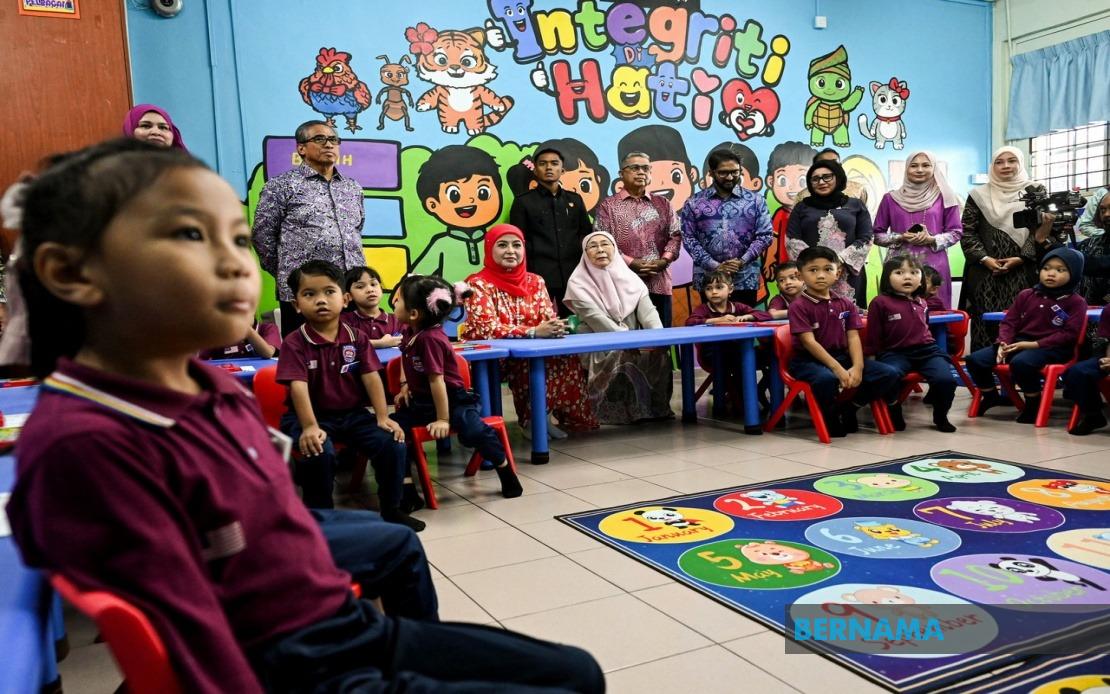
Malaysia's push to build ethical foundations from childhood received royal endorsement on Tuesday when Her Majesty Raja Zarith Sofiah, Queen of Malaysia, officially launched the Children's Integrity Module (MIKa) at Tabika Perpaduan Taman Bukit Cheras in Kuala Lumpur. The initiative represents a comprehensive strategy to embed integrity and moral principles into the nation's earliest learners, reflecting growing governmental recognition that character formation begins long before formal schooling. The Queen's presence underscored the symbolic importance of the programme, signalling institutional commitment to this educational frontier.
The programme's formal unveiling drew several senior government figures, including National Unity Minister Datuk Aaron Ago Dagang, Chief Secretary to the Government Tan Sri Shamsul Azri Abu Bakar who chairs the Malaysian Institute of Integrity (IIM), and Bandar Tun Razak Member of Parliament Datuk Seri Dr Wan Azizah Wan Ismail. During her visit at 9.45 am, the Queen participated in classroom demonstrations and engaged directly with preschool children experiencing MIKa's learning methodology. This hands-on interaction underscored the practical, ground-level nature of the initiative beyond ceremonial formality.
The Malaysian Institute of Integrity developed MIKa specifically to introduce and reinforce integrity values among the nation's youngest population cohorts. The module targets children between ages two and six, a developmental window when foundational attitudes and behavioural patterns crystallise. This age group focus reflects contemporary educational psychology understanding that moral habits and ethical reasoning develop most effectively when introduced during early childhood, making preschool and childcare environments critical intervention points for shaping long-term national character.
The ambitions underlying MIKa extend considerably beyond initial rollout. Government officials articulated plans to achieve implementation across Malaysia's entire early childhood education ecosystem by 2030. This encompasses more than 31,000 childcare centres, kindergartens and preschools functioning nationwide, representing one of the most extensive institutional coordination efforts in the sector. Achieving this coverage would constitute transformative reach, potentially influencing millions of Malaysian children's foundational understanding of ethical behaviour and societal responsibility during their formative years.
Development of MIKa involved substantial preparatory groundwork spanning since 2024. The Malaysian Institute of Integrity collaborated with thirty-five early childhood education specialists, drawing on their cumulative expertise to design pedagogically appropriate content and delivery mechanisms. Beyond academic experts, the module received backing from multiple government ministries, relevant agencies, higher education institutions and organisations active in early childhood development. This multi-stakeholder engagement ensured the programme integrated diverse perspectives and practical implementation knowledge across the sector.
Chief Secretary Tan Sri Shamsul Azri Abu Bakar articulated the philosophical underpinning motivating MIKa during the launch proceedings. He emphasised that integrity cannot emerge solely through legal frameworks or regulatory mandates; instead, it requires deliberate cultivation during early childhood so ethical conduct transforms into automatic habit. His remarks reflected a sophisticated understanding that abstract legal obligations prove insufficient for shaping sustained moral behaviour. By contrast, embedding integrity values during formative years when children's cognitive frameworks remain malleable enables ethical principles to develop as internalized guides rather than externally imposed restrictions.
This developmental approach carries particular resonance in Malaysia's governance context. The nation has grappled with intermittent corruption concerns across various sectors, making preventive education addressing ethical foundations strategically important. Building generations whose instinctive responses favour transparency, trustworthiness and principled conduct offers potential long-term solutions complementing enforcement mechanisms and institutional reforms. Early childhood programming thus functions as preventive investment in the nation's institutional integrity infrastructure.
Shamsul Azri's statements highlighted that sustained integrity requires trustworthiness functioning as an operational guiding principle rather than occasional aspiration, and that beneficial conduct must become routine practice woven through daily behaviours. These framings emphasise transforming integrity from abstract concept into embodied practice. Children internalising these values during preschool years develop neurological and psychological patterns supporting ethical decision-making throughout life, potentially generating compounding benefits across subsequent decades.
The Chief Secretary also positioned MIKa's launch as inaugurating broader generational efforts producing a Malaysian populace characterised by honesty, trustworthiness, responsibility and principled conduct. This encompasses not merely individual virtue but collective cultural transformation. Simultaneously, government messaging acknowledged parents' central role as moral exemplars whose behaviour substantially influences children's ethical development. This recognition balanced institutional educational provision with family responsibility, acknowledging that preschool programming functions most effectively when reinforced through consistent parental modelling and household environments prioritising ethical values.
MIKa's design reflects evolving understanding of childhood development and institutional capacity for character formation. Rather than treating integrity as abstract concept taught through rote instruction, the module employs interactive learning simulations enabling hands-on experiential understanding. The Queen's observation of classroom simulations during the launch exemplified this pedagogy, demonstrating how young children engaged with age-appropriate scenarios developing ethical reasoning and decision-making capacities. This methodology aligns with contemporary early childhood education best practices emphasising experiential learning over passive knowledge transmission.
For Malaysian stakeholders across education, governance and social development sectors, MIKa represents significant strategic commitment to preventive moral education. The thirty-thousand-plus institution coverage target indicates substantial resource allocation and coordinated institutional effort. Success requires sustained funding, consistent teacher training, quality curriculum implementation, and parental engagement across diverse communities and socioeconomic contexts. The initiative also carries implicit messaging that integrity development constitutes legitimate government responsibility, not peripheral educational concern.
Southeast Asian observers may recognise MIKa as part of broader regional trends prioritising early childhood development and character education within national development strategies. As regional economies increasingly emphasise institutional quality and governance credibility competing for investment and international confidence, cultivating integrity foundations during childhood offers potentially distinctive competitive advantages. Malaysia's systematic approach through the Malaysian Institute of Integrity and coordinated institutional implementation may establish templates informing similar regional initiatives addressing ethical development and institutional character across the Association of Southeast Asian Nations community.

