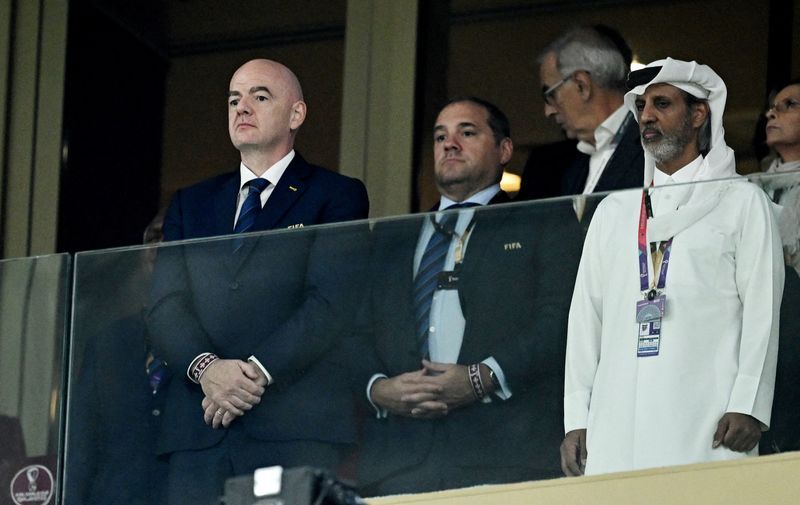
The Qatar Football Association has escalated tensions with the Asian Football Confederation in an unusually public dispute over governance and consultation procedures, casting doubt on the AFC leadership's authority to represent its 47 member associations. In a third letter within a rapidly unfolding correspondence, QFA President Hamad bin Khalifa Al-Thani has reiterated that the AFC's latest response fails to address a fundamental procedural question: whether Asian football's members were properly consulted before their confederation joined UEFA and CONCACAF in issuing a strongly worded statement against FIFA President Gianni Infantino.
The underlying trigger for this extraordinary exchange stems from Infantino's proposed FIFA Forward Enterprise initiative, which sought to bring private investment into World Cup tournaments. When the proposal faced widespread resistance from football confederations globally, Infantino encountered unexpected opposition from senior figures within his usual base of support. The AFC's public letter critiquing both the proposal's development process and Infantino's leadership approach marked a significant break from Asia's traditional deference toward FIFA's president, who is preparing to seek reelection in 2025.
Qatar's response—and its willingness to pursue the complaint in writing—reveals deeper fractures within Asian football governance that extend beyond the immediate Infantino dispute. Al-Thani's most recent missive amounts to a constitutional challenge against AFC President Sheikh Salman bin Ebrahim Al-Khalifa's authority to commit the confederation to international positions without explicit member authorization. The Qatari leader argues that Sheikh Salman's powers, while allowing him to act decisively in emergencies affecting Asian football's interests, do not extend to making unilateral policy pronouncements on matters outside the AFC's direct institutional remit.
What makes this escalation particularly significant is its public nature. The AFC, like most continental football bodies, traditionally conducts its internal disagreements behind closed doors, preserving institutional unity in dealings with FIFA. The fact that letters between senior confederation figures are being circulated openly suggests that normal diplomatic channels have broken down and that both parties believe they have compelling reasons to make their positions part of the public record.
Qatar itself occupies an interesting position in this dispute. As host of the 2022 World Cup and a pivotal member of Asian football, Qatar has maintained close ties to Infantino and was among six AFC members who declared early support for the FIFA president when the FFE crisis erupted. This context makes Qatar's procedural objections—rather than substantive disagreements with the AFC's criticism of Infantino—appear strategic. By focusing on whether proper consultation occurred rather than defending the FIFA chief's conduct, Al-Thani has positioned Qatar as defending foundational principles of federation governance, a position with broader appeal across Asia's football community.
Sheikh Salman's counter-argument, articulated in his own pointed response, draws on precedent and necessity. He contends that AFC presidents have historically issued public statements on matters of significance to Asian football, citing the confederation's prior collective backing of Qatar as World Cup host despite international controversy. Sheikh Salman suggests that his decision to sign the joint letter with UEFA and CONCACAF falls within this established precedent and represents a responsible exercise of his authority to defend Asian football's institutional interests.
However, Al-Thani's distinction between those historical statements and the Infantino letter is analytically sound. He argues that previous AFC pronouncements, even when politically charged, reflected the confederation's own organizational interests—ensuring that a World Cup in Asia proceeded successfully, for instance. By contrast, the letter criticizing Infantino and the FFE proposal addressed FIFA's internal governance and the FIFA president's conduct, areas where individual AFC member associations might hold divergent views not necessarily aligned with collective institutional positioning.
The Malaysian football community and other Southeast Asian federations watching this dispute face implications for how their voices will be heard within Asian football decision-making structures. The question of whether continental confederations can commit member associations to positions without explicit authorization cuts to the heart of representative governance in sport. If Sheikh Salman's interpretation prevails, individual associations effectively cede some authority over international football policy to the AFC leadership. Conversely, if Al-Thani's stricter reading of constitutional authority is vindicated, the AFC may find itself less able to mount coordinated regional responses to FIFA initiatives.
The irony of the dispute centers on the very issue that triggered Infantino's FFE proposal controversy: insufficient consultation with stakeholders before imposing decisions. The criticism leveled against the FIFA president—that he developed his investment proposal without adequately consulting continental confederations—mirrors the procedural complaint Qatar now directs at Sheikh Salman. Both controversies essentially pit the practical necessity for executive action against the legitimacy conferred by inclusive decision-making processes.
Neither party has signaled willingness to compromise or clarify the contested procedures through established AFC governance channels, suggesting that this matter may eventually require intervention by the AFC's broader membership or its executive committee. The longer this dispute persists as public correspondence between senior leaders, the more it undermines the AFC's credibility as a unified continental voice and raises questions about Sheikh Salman's leadership approach.
For Asian football's development and standing within global football governance, the timing of this internal conflict is problematic. As FIFA prepares for its presidential election and as major tournaments approach, continental confederations should ideally present unified positions on governance issues. Instead, the AFC finds itself consumed by a debate over its own procedural legitimacy, weakening its capacity to shape the broader global football agenda. Whether Al-Thani's procedural objections represent principled governance concerns or tactical positioning, they have succeeded in placing the AFC's internal authority structures under public scrutiny at a moment when external unity appears strategically valuable.

