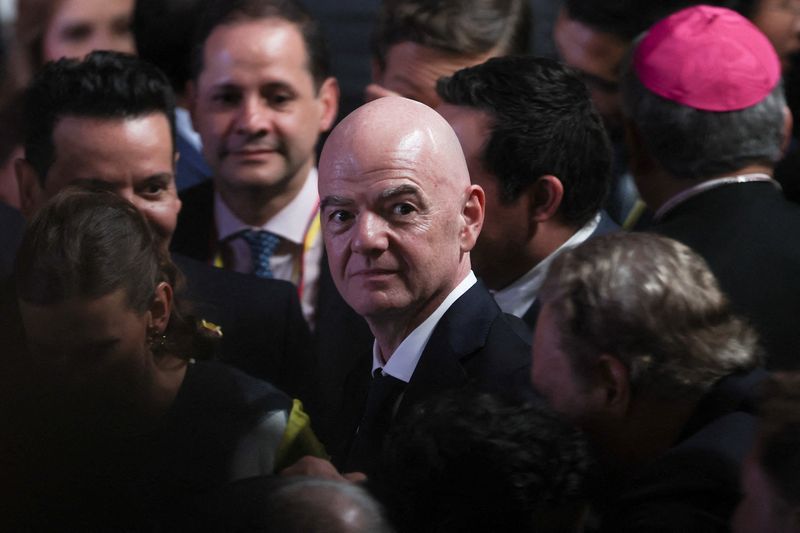
A schism has opened within Asian football governance as Qatar directly challenged the Asian Football Confederation's right to coordinate with European and North American bodies in launching a coordinated assault on FIFA President Gianni Infantino's leadership. The intervention by Qatar's football hierarchy marks an unusual moment of internal dissent within the AFC, coinciding with escalating tensions between global football's power brokers over the direction of the sport's commercial future.
Qatar Football Association President Hamad bin Khalifa Al-Thani sent a formal letter to AFC President Sheikh Salman bin Ibrahim Al Khalifa questioning the federation's authority to issue a sweeping public statement in the name of its 47 member associations without securing their agreement beforehand. The letter, which surfaced on August 14, contends that neither Al-Thani nor the QFA received any advance notice, consultation, or opportunity to comment on the content of the joint statement released by UEFA, the AFC, and CONCACAF on Monday targeting Infantino's conduct and his abandoned proposal to privatize World Cup commercial rights.
The timing of Qatar's challenge reveals fundamental disagreements about how Asian football should navigate the current crisis engulfing FIFA's leadership. Just days before the AFC issued its attack on Infantino, six Arab national football association heads—including Qatar and Morocco, joint hosts of the 2030 World Cup—publicly expressed support for the FIFA president. Four of these signatories hold simultaneous positions on FIFA's Council, granting them significant institutional authority within global football's governance structure. Their endorsement of Infantino explicitly praised his efforts to expand opportunities across regions and strengthen football's community role, positioning them in direct opposition to the confederations' coordinated criticism.
Al-Thani's letter employs careful but pointed language to challenge the AFC's procedural legitimacy. He argues that "a collective view must first be ascertained; it cannot be presumed, and it cannot be brought into existence by declaration." This formulation strikes at the heart of how the AFC leadership conducted itself—essentially questioning whether issuing a statement purporting to represent the confederation's members constitutes governance or overreach. The QFA president demanded clarification about what consultation had occurred and on what constitutional basis the AFC considered itself authorized to speak on behalf of all member associations.
The division within Asian football reflects broader fault lines emerging across global sport regarding FIFA's governance and Infantino's reelection prospects next year. Infantino initially proposed a scheme to sell 20 percent of World Cup commercial rights to private investors, a move projected to generate approximately $4.2 billion in revenue. The proposal sparked unprecedented resistance from Europe and North America's football bodies, who viewed the commercialization of the World Cup with alarm. Infantino subsequently abandoned the initiative following the public backlash, yet the damage to his leadership credibility proved substantial enough to prompt three continental confederations to jointly call for his resignation.
Asia's football associations occupy a strategically important but often underappreciated position within FIFA's power dynamics. The continent commands considerable voting strength in FIFA's Council and general assemblies, making Asian solidarity—or the absence of it—a determining factor in any leadership challenge. When Qatar, Morocco, and fellow Arab football leaders publicly backed Infantino, they signaled that significant portions of Asia remained unconvinced by the European and North American confederation's case against him. This created diplomatic space for Infantino to survive the immediate crisis, even as his authority faced serious questions.
Qatar's formal challenge to the AFC's decision carries symbolic weight beyond the immediate dispute. As a nation that hosted the 2023 World Cup and remains deeply invested in football's strategic importance to its regional standing, Qatar possesses both motivation and leverage within Asian football circles. The QFA's insistence that proper consultation mechanisms be respected reflects concerns common across smaller and medium-sized football associations about whether continental confederations adequately represent their interests or simply impose decisions made by larger, more influential members.
The AFC's silence following Qatar's challenge—the confederation declined to comment when contacted about the dispute—suggests the organization may have recognized procedural vulnerabilities in how it coordinated with UEFA and CONCACAF. The three confederations' joint statement arguably represented the most significant unified action against a sitting FIFA president in recent institutional memory, yet its legitimacy now faces sustained questioning from within FIFA's own governance structure. This undermines the confederations' moral authority to demand Infantino's removal based on governance failures if they themselves conducted their own campaign without proper consultation.
For Southeast Asian football stakeholders and Malaysian football governance, this dispute carries implications for how continental confederations wield their collective authority. The AFC encompasses enormous diversity in football development levels, economic resources, and strategic interests. The assumption that all 47 member associations should automatically support positions adopted by the confederation's leadership without consultation risks further fragmenting Asian football along regional and economic lines. Malaysia and other regional members have legitimate interests in understanding how continental bodies represent their voices in global football negotiations.
Infantino's survival now depends partly on whether Asian confederations maintain their current divisions. A united AFC position against the FIFA president might have provided the political momentum necessary to force his resignation. Instead, visible disagreement about the confederation's own decision-making procedures suggests Asian football will remain a contested arena where Infantino retains meaningful support. The dispute also highlights how FIFA's governance challenges extend beyond a single individual's conduct to encompass fundamental questions about how continental confederations legitimately exercise authority over their member associations.
Looking forward, this clash between Qatar and the AFC may reshape how continental confederations coordinate on major governance issues. If the AFC were to impose discipline or retaliate against Qatar's challenge, it would risk further alienating member associations concerned about top-down decision-making. Conversely, if the AFC accepts Qatar's criticism and acknowledges procedural failures, it implicitly undermines its own recent statements attacking FIFA leadership for governance violations. This bind reflects the complexity of maintaining institutional coherence across geographically vast and economically diverse continental football bodies.
The episode ultimately reveals that FIFA's governance crisis extends well beyond Infantino himself. The mechanisms through which continental confederations represent their members, the transparency of their decision-making processes, and their accountability to diverse stakeholder interests all face serious questions. Asian football's divisions on this issue suggest that genuine reform of global football governance must address not only the FIFA presidency but also the confederations' own institutional structures and processes.

