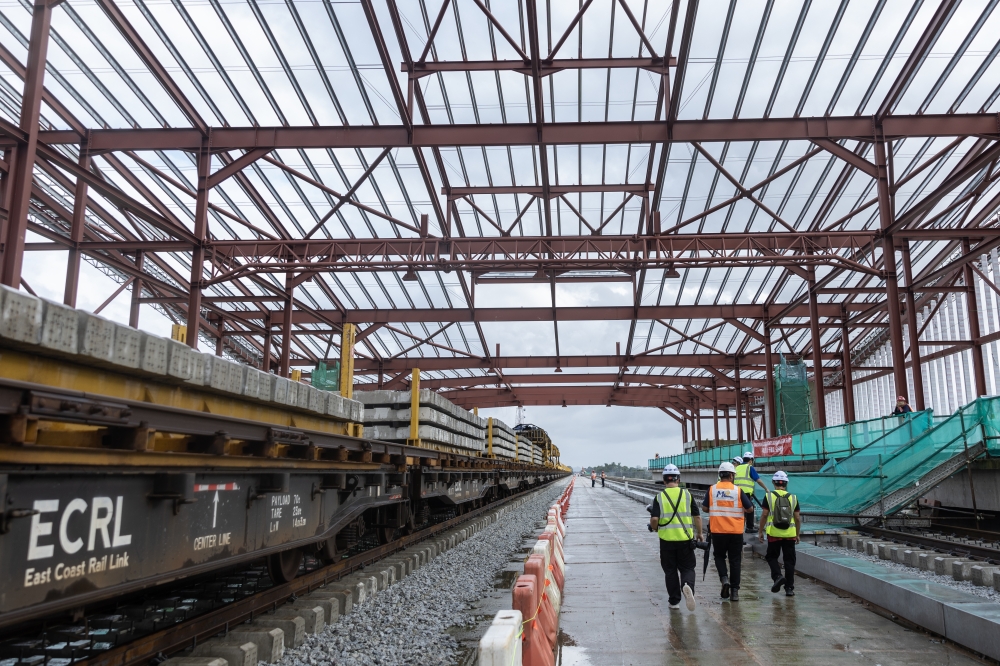
The Malaysian government has charted an ambitious development roadmap for Pasir Puteh parliamentary constituency, approving 46 projects worth RM207 million designed to harness the transformative potential of the East Coast Rail Link corridor. This coordinated investment strategy reflects Putrajaya's recognition that rail infrastructure alone cannot deliver lasting prosperity without complementary on-the-ground initiatives that strengthen local enterprise, connectivity, and social infrastructure.
Pasir Puteh, located in Kelantan on Malaysia's eastern seaboard, stands at a geographical and economic crossroads. The constituency's proximity to ECRL stations positions it as a natural logistics and commerce hub, yet realising this advantage requires deliberate intervention across multiple sectors. The government's project portfolio addresses this complexity by spanning transportation, industrial development, skills training, and public facilities—a holistic approach that acknowledges how rail connectivity succeeds only when paired with supporting ecosystems.
The ECRL itself has long been viewed as a potential game-changer for East Coast economies historically marginalised from the development corridors centred on Klang Valley and northern Selangor. By linking Kelantan, Terengganu, and Pahang to Kuala Lumpur and Port Klang, the rail line creates unprecedented opportunities for manufacturers, traders, and agricultural producers to access larger markets and international supply chains. Pasir Puteh's explicit inclusion in this federal investment window demonstrates that Putrajaya intends to distribute ECRL benefits beyond mere freight movement to encompass genuine economic transformation in participating communities.
Among the initiatives are infrastructure projects focused on last-mile connectivity, which remains essential even with a major rail artery in place. Poor road networks to industrial zones, markets, and rail terminals can nullify the advantages of rail access. The government's investment in roads, bridges, and local transport infrastructure therefore addresses a critical gap that private investors alone typically cannot fill. These foundational improvements lower logistics costs for businesses relocating to or expanding within Pasir Puteh, making the constituency genuinely competitive against alternative regional locations.
Skills development and vocational training represent another pillar of the strategy. Economic corridors fail when local populations lack qualifications for emerging opportunities. The RM207 million allocation evidently includes human capital initiatives—whether through technical colleges, apprenticeship programmes, or reskilling schemes—aimed at ensuring Pasir Puteh residents can access jobs generated by new industrial zones and commercial hubs. This forward-thinking approach avoids the common pitfall of job creation without local job-readiness, which would force businesses to import labour and limit community benefits.
The social infrastructure component—healthcare facilities, educational institutions, housing, and utilities—serves a dual purpose in this investment narrative. Improved amenities attract both businesses seeking locations with accessible workforces and families seeking quality-of-life stability. For a constituency competing against more developed areas, such investments are non-negotiable. Companies evaluating relocation consider not only production costs but whether they can retain skilled staff, and staff retention depends on schools, hospitals, and housing available for employees and their families.
Pasir Puteh's development also carries implications for Malaysia's broader regional rebalancing agenda. For decades, economic concentration in the Klang Valley created infrastructure deficits and opportunity gaps in peripheral states. The ECRL and associated investments represent a partial response to these imbalances, attempting to generate multiplier effects across Kelantan. If successful, Pasir Puteh could serve as a template for translating major infrastructure into sustained prosperity, validating the capital-intensive approach to regional development.
Yet implementation will determine outcome. The RM207 million will deliver value only if projects are executed efficiently, on schedule, and aligned with genuine market demand. Poorly designed schemes or mismatched investments—such as industrial parks without tenant interest or training programmes disconnected from employer needs—would waste resources without delivering promised growth. Accountability mechanisms and regular progress tracking will be essential.
The timing of this announcement is politically significant, signalling federal commitment to Kelantan's development amid evolving state-federal dynamics. Such visible investment in constituencies across Malaysia's political spectrum can influence voter perceptions and electoral dynamics, though the lasting impact depends on whether development translates into tangible improvements in residents' lives rather than merely serving symbolic purposes.
Regionally, Pasir Puteh's development fits into Southeast Asia's broader infrastructure revolution. As ASEAN nations integrate through rail, port, and digital connectivity, constituencies well-positioned within emerging corridors gain disproportionate advantages. Pasir Puteh's RM207 million investment reflects Malaysian policymakers' understanding that ECRL success requires deliberate complementary action to transform latent potential into actual economic activity and genuine prosperity for local communities.

