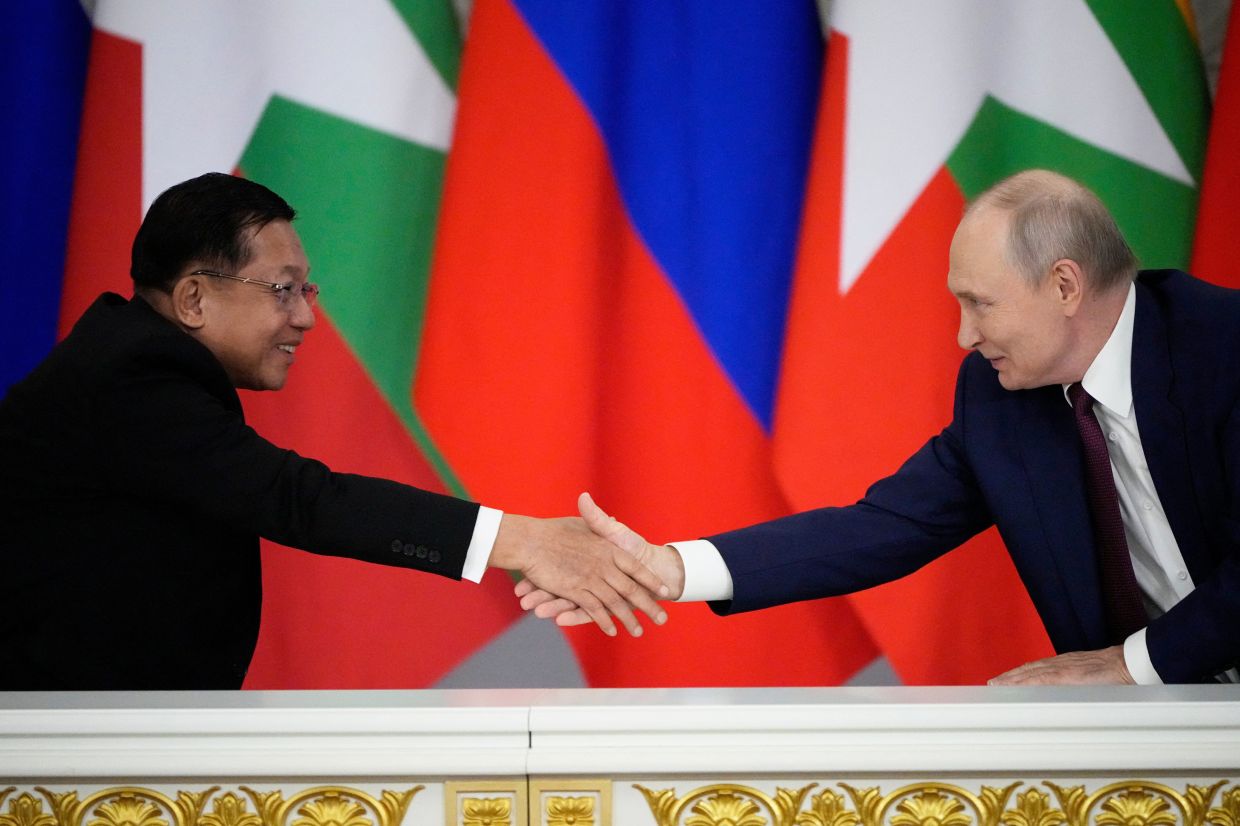
Russian President Vladimir Putin received Myanmar's leader Min Aung Hlaing in Moscow on Tuesday, signalling Russia's determination to cement bonds with the Southeast Asian nation at a time when most Western democracies have distanced themselves from its military-led government. The talks underscore Moscow's strategy to maintain influence in the region despite international sanctions triggered by its invasion of Ukraine, and represent a significant diplomatic win for Min Aung Hlaing as he seeks international legitimacy following a disputed election that brought him the formal title of president.
Putin described relations between the two countries as having become "especially trusting" in recent years, a phrase that carries particular weight given Russia's isolation from much of the global community. The Russian leader's choice of words and the high-level composition of officials present at the Kremlin meeting—including senior figures from defence, foreign policy, finance, and energy portfolios—underscored the strategic importance Moscow attaches to Myanmar in its broader geopolitical calculations. For Min Aung Hlaing, the visit represented validation of Myanmar's pivot towards Russia and China as alternatives to Western engagement, a positioning that has become increasingly important as his government faces sustained criticism over its democratic credentials.
At the heart of the bilateral relationship lie substantial energy infrastructure ambitions. Russia has signalled intentions to construct a power generation facility and petroleum refinery in Myanmar's southern regions, projects that would deepen Moscow's economic footprint within the country. Beyond these headline investments, Russia seeks involvement in geological surveys and hydrocarbon development, positioning itself as a key player in Myanmar's resource sector at a critical juncture when international companies have largely withdrawn. Putin additionally referenced promising prospects for cooperation in liquefied natural gas exports, suggesting that energy ties could expand significantly in coming years if current political trajectories persist.
The defence dimension of Russia-Myanmar cooperation has arguably proven even more consequential than economic ventures. A confidential United Nations report released in May 2023 documented that Russia had supplied Myanmar's military with weapons valued at more than US$400 million since the February 2021 coup that toppled the civilian government. This volume of military support establishes Russia as a principal arms supplier to Myanmar's armed forces and reflects Moscow's commitment to maintaining military-technical cooperation despite international condemnation of Myanmar's human rights record. Putin's explicit acknowledgment of "close military and military-technical cooperation" suggests this trajectory will continue unabated.
Nuclear technology cooperation represents another frontier in the relationship that carries long-term implications. Myanmar is collaborating with Russia's Rosatom State Corporation to develop a small nuclear power plant—an initial phase in adopting nuclear capabilities for applications spanning healthcare, agriculture, and industrial production. This partnership positions Russia as Myanmar's gateway to nuclear technology at a moment when Western nations have largely closed doors to such transfers. The commitment to nuclear cooperation indicates that Russia envisions Myanmar as a strategic partner worthy of sensitive technology transfer, elevating the relationship beyond transactional arms sales.
Min Aung Hlaing's Moscow visit forms part of a broader diplomatic offensive aimed at rehabilitating Myanmar's international standing following an election in August that drew withering criticism from Western governments and the United Nations. Since assuming the presidency through the military-backed parliament's selection process, the Myanmar leader has undertaken an intensive tour of regional and friendly nations, visiting China, India, Laos, and Thailand in succession. These travels reflect a calculated strategy to demonstrate that Myanmar retains international partnerships despite Western isolation, with each visit designed to project an image of legitimacy and normalcy around a government that many democracies regard as illegitimate.
Russia's willingness to receive Min Aung Hlaing—and to do so with considerable ceremony—contrasts sharply with the approach adopted by Western nations and many regional democracies. Russia has positioned itself as one of the few major powers willing to maintain substantive relations with Myanmar's military rulers since the 2021 coup, a stance that carries both political and economic advantages for Moscow. By offering investment opportunities and military support when other international actors have retreated, Russia has cultivated significant leverage over Myanmar's strategic orientation, effectively anchoring the country within Moscow's sphere of influence during a period of acute geopolitical competition.
This represents at least the fourth meeting between Min Aung Hlaing and Putin since Russia's February 2022 invasion of Ukraine, demonstrating remarkable continuity in bilateral engagement despite the seismic shifts in international relations triggered by that conflict. Earlier encounters included a meeting at the World Atomic Week Forum in Moscow in September, while Russia's Security Council Secretary Sergei Shoigu made a notable February visit to Myanmar, becoming the first foreign official to travel there following the disputed election. These repeated high-level contacts signal that both capitals view the relationship as sufficiently important to merit continued attention even amid other pressing international crises.
The composition of Min Aung Hlaing's delegation underscores the comprehensive nature of engagement Moscow seeks with Myanmar. The group included multiple cabinet ministers and significantly, the head of Myanmar's Space Agency, indicating that cooperation extends beyond traditional security and energy sectors into emerging technological domains. During his Moscow stay, Min Aung Hlaing conducted separate meetings with Prime Minister Mikhail Mishustin and Vyacheslav Volodin, speaker of Russia's lower house, alongside attending a Myanmar-Russia Business Forum designed to facilitate commercial connections between private sectors in both countries.
For Malaysia and broader Southeast Asia, the deepening Russia-Myanmar relationship carries important implications. Myanmar's strategic location and its role as a gateway to Indian and Southeast Asian markets give it disproportionate significance in regional geopolitics. Russia's successful cultivation of Myanmar as a reliable partner in a region where Western influence has traditionally predominated suggests a rebalancing of great power competition within Southeast Asia. The investment projects and military partnerships Putin has outlined could reshape regional supply chains, energy flows, and security dynamics in ways that extend beyond the bilateral relationship to affect the broader regional architecture that ASEAN members navigate.
Meanwhile, Myanmar's simultaneous efforts to improve relations with the United States and ASEAN, despite rejecting international pressure to release ousted leader Aung San Suu Kyi, reveal a government attempting to maintain multiple international alignments. This balancing act—cultivating Russia and China while signalling openness to dialogue with Western democracies—reflects Myanmar's desire to avoid total isolation while resisting pressure to restore civilian democracy. For Malaysia and fellow ASEAN members, Myanmar's trajectory remains a complex diplomatic challenge, as regional cohesion requires engagement with Myanmar while many member states share international concerns about democratic backsliding.

