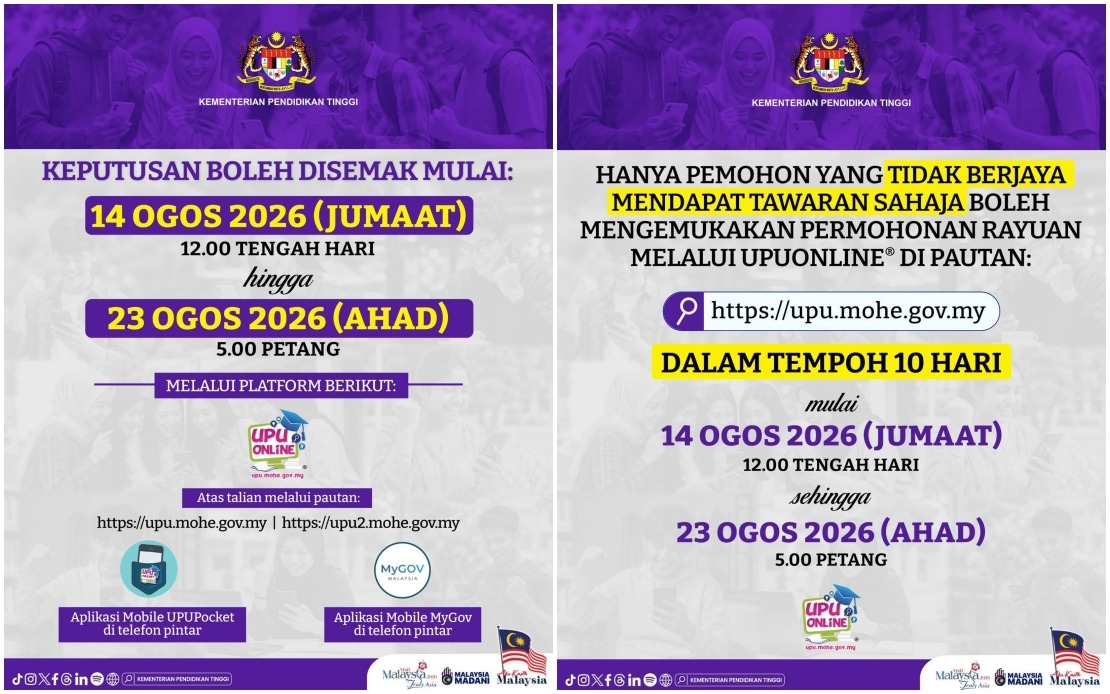
Hundreds of thousands of Malaysian STPM graduates and equivalent qualification holders will discover their university futures on August 14, when the Ministry of Higher Education releases admission results through the centralised UPUOnline portal. The announcement marks a pivotal moment for secondary school leavers navigating Malaysia's higher education landscape, as successful candidates learn which public universities and programmes have accepted their applications for the 2026/2027 academic session.
Prospective students can access their outcomes starting from noon on August 14 through multiple digital platforms designed for widespread accessibility. The ministry has established three primary channels for result checking: the dedicated UPUOnline portals at https://upu.mohe.gov.my and https://upu2.mohe.gov.my, alongside smartphone applications including Mobile UPUPocket and Mobile MyGov. This multi-platform approach reflects Malaysia's push toward digital accessibility in education administration, ensuring applicants in both urban and rural areas can retrieve their results without geographical constraints.
The confirmation process demands immediate action from successful applicants, who must formally accept or reject their offers between August 15 and August 23. This compressed nine-day window represents a critical juncture where candidates must make binding decisions about their academic paths. The Ministry of Higher Education has structured this timeline to balance candidate deliberation needs with institutional planning requirements, as universities must finalise enrolment figures for dormitory allocation, course section sizing, and resource distribution across the 2026/2027 intake.
Official offer letters will commence flowing from public universities to accepted candidates on August 15, initiating a formal contractual relationship between institution and student. These letters carry significant weight, as they represent institutional commitment and typically outline scholarship eligibility, residential arrangements, and programme-specific requirements. For Malaysian families, these documents often become treasured records marking generational educational achievement, particularly among first-generation university students whose parents themselves may not have pursued tertiary education.
The appeal mechanism provides crucial recourse for unsuccessful applicants, permitting them to contest initial rejections or seek alternative programme placements. Between August 14 and August 23, rejected candidates may submit formal appeals through UPUOnline, requesting reconsideration based on programme availability or changed circumstances. However, the ministry clarifies that successful appeals depend entirely on vacancy status following new student registration completion, meaning appeal prospects fluctuate based on acceptance rates across individual programmes and institutions.
A significant constraint embedded in this admission cycle is the prohibition on programme or institutional changes post-acceptance. The Ministry of Higher Education has reinforced that placement offers for the 2026/2027 session are final, eliminating the flexibility that characterised earlier admission rounds. This rigidity reflects systemic pressures within Malaysia's public university sector, where limited spaces require predictable enrolment numbers for resource allocation. For applicants, this inflexibility underscores the importance of thoughtful application strategy during the initial submission phase, when programme selection carries lasting consequences.
The appeal selection policy operates within pragmatic constraints, as universities can only accommodate additional students within genuine vacancy margins. These vacancies emerge when initially-accepted candidates decline offers or withdraw during the confirmation period, creating limited slots for appeal candidates. The prioritisation of registration completion before appeal processing ensures universities possess accurate headcount data, preventing over-enrollment situations that strain academic facilities and lecturer capacity. This sequential approach, while potentially frustrating for appeal applicants, protects institutional stability and educational quality across Malaysia's public university system.
For Malaysian families and career counsellors, this August timeline has become a landmark event in the secondary school calendar. Teachers and parents begin preparing students from June onwards, with guidance counsellors helping applicants align programme selections with academic strengths and career aspirations. The August results announcement triggers immediate conversations about scholarship options, hostel preferences, and course difficulty assessments. In many households, particularly in lower-income communities, university admission represents transformative opportunity for intergenerational economic mobility, making these results intensely significant beyond individual academic achievement.
The centralised UPUOnline system itself represents Malaysia's broader education digitalisation efforts, replacing paper-based processes that characterised university admissions for decades. This shift has accelerated since the COVID-19 pandemic, normalising remote result checking and digital documentation across education administration. For rural students without convenient access to city-centre offices, this system democratises information access, though digital literacy gaps and broadband connectivity remain challenges in certain areas.
The timing of these announcements carries implications for Malaysia's international competitiveness in talent retention. Graduates receiving public university offers in mid-August begin their academic preparation while international universities have already admitted their cohorts. Public university graduands typically enter the workforce 3-4 years later, during crucial economic periods. This timing influence extends to Malaysia's aspirations in high-skill sectors like technology and healthcare, where university training quality directly affects national capacity.
Successful applicants should recognise that acceptance marks commencement rather than conclusion of preparation. Orientation programmes, placement tests, and subject-specific pre-coursework typically occur in September and October, requiring continued engagement from newly-admitted students. Universities increasingly expect incoming cohorts to demonstrate readiness beyond examination scores, with emphasis on critical thinking, English proficiency, and collaborative skills. The August announcement thus initiates a transitional period where secondary school identity gradually transforms into university student identity.

