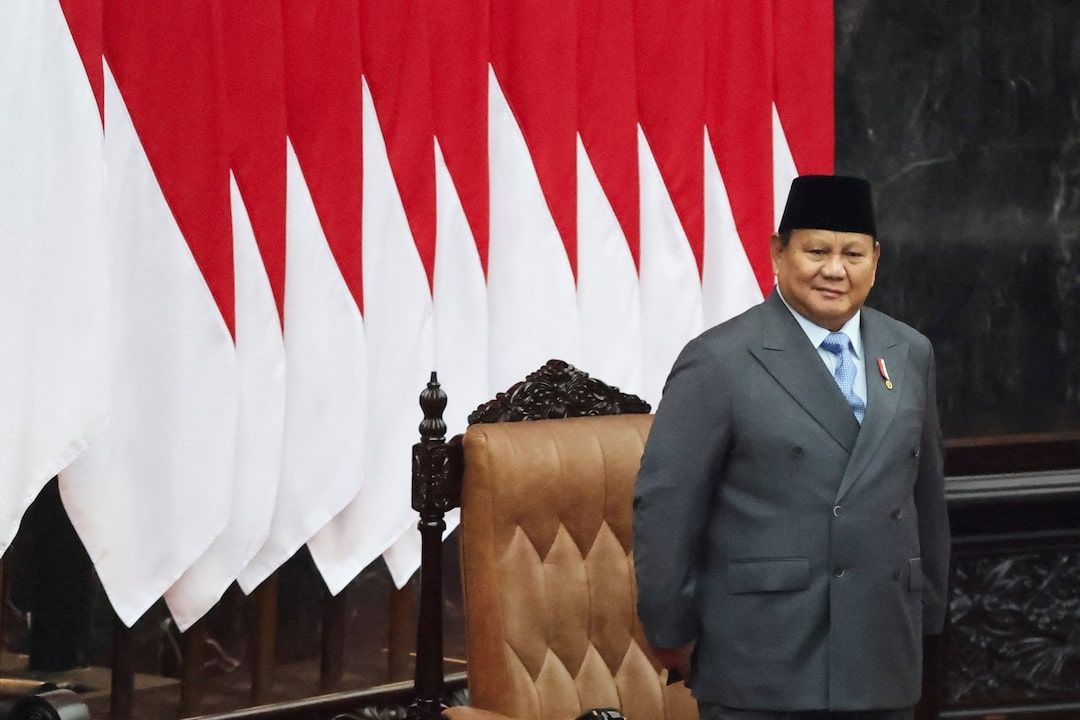
Indonesian President Prabowo Subianto faces one of the most consequential moments of his presidency this week as he unveils the 2027 budget framework against a backdrop of deteriorating public confidence and waning investor appetite for his administration's economic agenda. The former special forces officer, who swept to power last October on a mandate to eliminate corruption and accelerate growth to 8 percent annually, must now contend with the harsh reality that his opening months in office have disappointed both domestic constituencies and international capital markets.
When Prabowo took the helm in October 2024, the political landscape appeared firmly aligned in his favour. His electoral coalition commanded substantial parliamentary support, and his campaign messaging—rooted in anti-corruption rhetoric alongside ambitious promises of free meals for millions of schoolchildren—resonated across socioeconomic lines. The new president inherited an economy that had achieved roughly 5 percent growth, a respectable figure by regional standards, yet his administration committed to nearly doubling that trajectory. Today, however, the momentum has visibly dissipated. Recent polling data reveals that his approval rating has plummeted 30 percentage points in just eight months, settling at 51 percent. This dramatic erosion reflects widespread public frustration with the economic environment and perceived failures in law enforcement operations, undercutting the very foundations upon which his political legitimacy rests.
The economic reality confronting Prabowo's government has proven considerably more intractable than campaign rhetoric suggested. The Indonesian rupiah has depreciated meaningfully throughout the first half of 2025, pressuring inflation and import costs while constraining purchasing power across the middle class. Equity markets have underperformed expectations, with the stock exchange unable to generate the confidence typically required to attract substantial fresh capital inflows. These conditions have sparked genuine anxiety among multinational corporations and foreign asset managers regarding both near-term returns and the stability of the broader macroeconomic framework. The government's own fiscal position has become increasingly constrained, with the deficit approaching 2.8 percent of gross domestic product—dangerously close to the constitutional 3 percent ceiling that serves as a binding constraint on further expansionary spending.
One particularly contentious issue threatening to dominate Friday's budget presentation concerns the fate of Prabowo's flagship free meals initiative. When launched, this programme represented a marquee commitment to improving nutritional outcomes for vulnerable children while stimulating demand within rural communities. Yet the initiative has stumbled badly in execution. Budget allocations have been curtailed due to fiscal pressures, and damaging allegations of mismanagement have surfaced, raising uncomfortable questions about whether the programme represents genuine social investment or represents wasteful spending that drains resources from other priorities. For a president whose popularity hinges partly on delivering tangible improvements to ordinary Indonesians' living standards, this stumble carries substantial political weight.
Another major source of investor anxiety stems from Prabowo's May announcement regarding a sweeping commodities export strategy. In that address to parliament, he unveiled plans to consolidate all exports of critical natural resources—including palm oil, nickel, tin, and other strategic commodities—under a new state-controlled enterprise designated Danantara Sumberdaya Indonesia. The proposal sent shockwaves through international commodity markets, triggering concerns that Indonesia might follow a more nationalist trajectory reminiscent of resource-hoarding policies pursued elsewhere in the developing world. Global trading houses and multinational agricultural corporations immediately recalibrated their assessments of Indonesian investment risk.
Since that initial announcement, however, significant ambiguity has surrounded the entity's precise scope and operational mandate. Various officials within Prabowo's administration have subsequently suggested that Danantara Sumberdaya Indonesia would function primarily in a supervisory or regulatory capacity rather than assuming direct operational control over export flows. This retreat from the original proposal has created an information vacuum. Market participants remain uncertain whether the government has genuinely backed away from its centralisation agenda or whether officials are merely conducting a staged rollback to manage international political reaction. The distinction matters enormously for commodities traders and agricultural conglomerates calibrating their exposure to Indonesian supply chains. Any clarification regarding this entity's actual mandate could substantially move commodity futures prices and shape investment flows across Southeast Asia's resource-dependent economies.
Economic analysts have begun framing this week's budget presentation as a critical credibility test that will determine whether Prabowo's administration can restore investor confidence or whether it has irreversibly damaged its standing among international capital markets. Irman Faiz, an economist at Bank Danamon, observed that the 2027 budget represents perhaps the most important credibility checkpoint for global investors in recent years, particularly given that markets have already absorbed multiple policy surprises during Prabowo's first year. What distinguishes the current moment, Faiz argues, is that tolerance for uncertainty has become substantially thinner. Investors who tolerated early policy experimentalism are now demanding coherence and predictability. The budget must demonstrate that the government possesses both the fiscal discipline to manage inflation and currency pressures, and the policy clarity to reduce the uncertainty premium that now characterises assessments of Indonesian assets.
Yose Rizal Damuri, executive director of the Center for Strategic and International Studies, emphasised that clarifying Danantara Sumberdaya Indonesia's role and scope remains essential for restoring market confidence. Commodity traders watching closely for additional details on the state entity's operational parameters will be listening intently to whatever the president discloses. Any residual ambiguity regarding whether the government intends to control or merely supervise commodity exports will perpetuate the current investment hesitancy that has constrained capital inflows to the resource sector. Malaysian and Singaporean investors particularly keen on Indonesian mining and agricultural opportunities are waiting for definitive signals that the institutional framework remains sufficiently liberal to accommodate private enterprise.
Beyond the commodity conundrum, Prabowo must confront broader questions about the feasibility of his stated economic objectives. The 8 percent growth target now appears increasingly unrealistic given global headwinds, the rupiah's depreciation, and the loss of momentum in domestic demand. The fiscal deficit approaching constitutional limits constrains further expansionary spending precisely when growth impulses are fading. Analysts increasingly suspect that Prabowo's administration may face genuine tradeoffs between ambitious social spending and macroeconomic stability. Arya Fernandes, head of politics and social change at CSIS, notes that the president faces the unenviable task of addressing persistent doubts regarding economic management while simultaneously defending the political logic of his priority programmes. Given the current trajectory, this represents no simple challenge.
The timing of Friday's budget presentation, which will follow Prabowo's Independence Day address celebrating Indonesia's founding moment, carries symbolic weight. The juxtaposition suggests an attempt to reconnect with nationalist themes and historical legitimacy even as his administration grapples with contemporary economic vulnerabilities. For Malaysia and Southeast Asia more broadly, the outcome of this budget presentation carries important implications. Indonesia remains the region's largest economy and a crucial component of regional supply chains. Currency instability, policy uncertainty, and diminished investor confidence in Jakarta necessarily reverberate across the broader region, affecting everything from capital flows to commodity prices to regional political alignments. Whether Prabowo can restore the credibility lost over recent months remains an open question that will shape not only Indonesia's trajectory but also the stability and dynamism of Southeast Asia's entire economic architecture.

