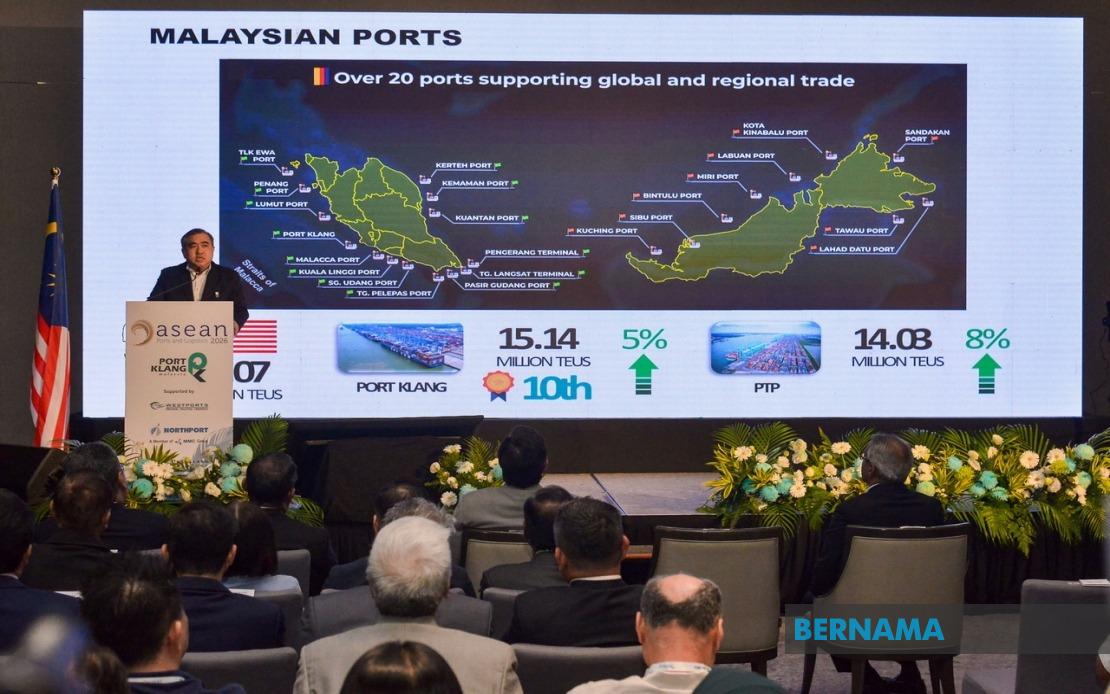
Malaysia is embarking on a transformative infrastructure project that could reshape its standing as a maritime power in Southeast Asia. Transport Minister Anthony Loke has outlined ambitious plans to develop Port Klang's Third Terminal on Carey Island, a phased mega-project expected to take nearly two decades for complete implementation. Speaking at the ASEAN Ports and Logistics Conference and Exhibition in Kuala Lumpur, Loke framed the initiative as essential to preserving the country's competitive edge in global shipping and trade over the next 20 to 30 years.
The disparity between Malaysia's current capabilities and those of regional competitors underscores the urgency of this undertaking. Port Klang presently operates with a handling capacity of approximately 20 million twenty-foot equivalent units annually, a figure that pales in comparison to Singapore's Tuas Port, which can process up to 60 million TEUs yearly—three times the volume of Port Klang's existing infrastructure. For a nation competing in the high-stakes arena of regional maritime trade, this gap represents both vulnerability and opportunity. Loke's candid acknowledgement of this disparity signals recognition within government circles that incremental improvements alone will not suffice to maintain Malaysia's relevance as shipping volumes continue climbing globally.
The proposed development represents a fundamental reimagining of Port Klang's role and capacity. Once fully realised, the Carey Island facility is designed to transform Port Klang into what officials describe as a mega-port capable of handling enormous volumes of containerised cargo. This vision reflects a deliberate strategy to position Malaysia not merely as a secondary player in regional logistics networks but as a destination of choice for major shipping lines and cargo operators. The phased approach to implementation allows for flexibility in adapting to changing market conditions while spreading infrastructure costs across an extended timeline.
Progress toward realisation of this vision has gathered momentum in recent months. The feasibility study, which commenced in 2018, has reached completion, demonstrating years of technical analysis and planning groundwork. The Cabinet has subsequently granted in-principle approval for the project to proceed under a public-private partnership model, a decision that signals confidence in the venture whilst distributing financial burden and operational risk between government and private investors. This PPP framework has become standard practice for Malaysia's major infrastructure initiatives, allowing public sector oversight whilst leveraging private sector expertise and capital.
Despite this progress, significant hurdles remain before shovels can hit the ground. Loke identified land-related issues with the Selangor state government as the primary obstacle currently preventing commencement of construction activities. These administrative and jurisdictional matters, whilst potentially resolvable, have repeatedly proven to be bottlenecks in Malaysian infrastructure projects requiring coordination between federal and state authorities. The minister's statement that the project will commence once these land issues are settled suggests both confidence in resolution and acknowledgement that bureaucratic clearance remains a prerequisite.
The timing of this expansion effort is influenced by broader geopolitical currents affecting global maritime trade. Tensions in West Asia have prompted shipping companies to reassess their operational strategies, with many exploring alternative routes and transshipment hubs. Malaysia's geographical position along the Strait of Melaka and Southeast Asian shipping corridors has transformed what could have been a regional liability into a strategic advantage. Loke highlighted that both Port Klang and the Port of Tanjung Pelepas recorded positive cargo volume growth during the first quarter of this year, demonstrating that geopolitical uncertainty in distant regions can paradoxically create opportunities for Malaysian maritime facilities.
This phenomenon reflects a broader shift in global supply chain dynamics. As security concerns mount around certain maritime passages, cargo operators increasingly seek alternative routing through ports perceived as safer and more stable. Malaysia's relatively neutral geopolitical positioning, combined with its strategic location astride critical shipping lanes, has made its ports more attractive to international operators. The expansion project thus capitalises on a temporary window of opportunity created by global instability, but one that could close if competing ports develop similar capacity or if regional security situations improve.
Loke's emphasis on ASEAN cooperation regarding neutrality and security in the Strait of Melaka reveals sophisticated understanding of how individual national interests intersect with regional stability. The Strait remains one of the world's most critical maritime chokepoints, through which trillions of dollars in international trade passes annually. Malaysia's interest in maintaining the corridor as a neutral, conflict-free zone serves both parochial national interests and broader regional prosperity. By calling for collective ASEAN commitment to these principles, Loke positioned Malaysia as a responsible stakeholder concerned with shared prosperity rather than narrow advantage.
The Third Terminal project carries significant implications for Malaysia's broader economic strategy. Expanded port capacity would strengthen the country's position as a logistics hub, potentially attracting downstream industries such as containerised goods distribution, trade financing services, and maritime support industries. The multiplier effects of a successful mega-port could extend well beyond shipping containers themselves, creating employment opportunities and attracting business investment throughout the region. This aligns with Malaysia's stated ambitions to transition toward higher-value activities in the regional economy.
Investors and industry observers will monitor the resolution of outstanding land issues with considerable interest. The timeline for clearing these administrative obstacles remains unclear, though Loke's assurance that commencement will follow swiftly upon their resolution suggests expected resolution within a defined timeframe. Given that the full project spans two decades, delays in the present phase could create cascading effects throughout the entire implementation schedule. The private sector partners eventually selected for the PPP arrangement will naturally seek clarity on timelines to justify their own capital commitments and planning processes.
The competitive context for this project extends beyond Singapore. Ports throughout Southeast Asia, including those in Indonesia and Vietnam, are simultaneously undertaking capacity expansions. Thailand's eastern seaboard ports and Cambodia's facilities under Chinese investment represent additional regional competitors seeking to capture growing containerised trade volumes. Malaysia's Third Terminal therefore represents not a leisurely modernisation effort but an urgent response to competitive pressure across multiple fronts. Success or failure in executing this project could fundamentally alter Malaysia's regional economic trajectory over the coming decades, determining whether the country secures or cedes its position as a premier maritime hub.

