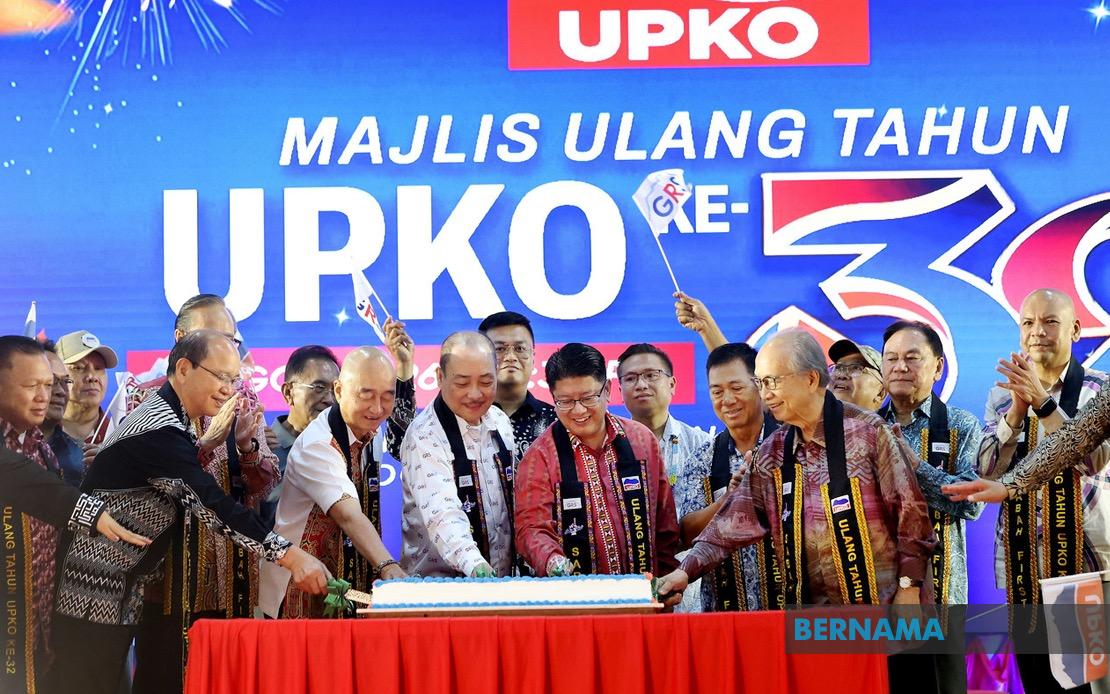
Sabah Chief Minister Datuk Seri Hajiji Noor has underscored the critical importance of maintaining political stability as a foundation for advancing the state's development agenda, economic growth and infrastructure projects. Speaking at the 32nd United Progressive Kinabalu Organisation anniversary celebration and the opening of UPKO's 17th Triennial Delegates Conference in Kota Kinabalu, Hajiji stressed that without a stable political environment, the government would struggle to execute its ambitious plans for the region.
The Gabungan Rakyat Sabah chairman emphasised that the coalition's strength lies not in uniformity but in the ability of its member parties to work cohesively despite their distinct political origins and ideological foundations. He articulated this sentiment through a symbolic message, describing GRS as a shared home under one roof with a common sky, where all constituent parties operate for the singular purpose of advancing Sabah's interests. This framing reflects a pragmatic approach to coalition management in a state where political alliances have historically been fluid and sensitive to local concerns.
Hajiji's remarks come at a time when Sabah's political landscape continues to evolve following institutional changes within the coalition structure. The recent acceptance of UPKO as a new member on June 18 represents a significant development in consolidating pro-government forces in the state. UPKO's integration into the coalition has expanded GRS from five to six component parties, now encompassing Parti Gagasan Rakyat Sabah, Parti Bersatu Sabah, Liberal Democratic Party, Parti Harapan Rakyat Sabah and Parti Cinta Sabah alongside UPKO itself.
For Malaysian observers and stakeholders monitoring Sabah's political trajectory, this expansion signals an attempt to create a more resilient governing structure capable of weathering the pressures that have historically destabilised state politics. The addition of UPKO, a party with deep historical roots in Sabahan politics and a substantial grassroots following, potentially strengthens the coalition's claim to represent diverse segments of the state's population. This inclusivity could provide the stability necessary for longer-term policy implementation, a concern that has plagued previous administrations struggling with frequent realignments.
The Chief Minister called upon all UPKO leaders and members to sustain their collaborative efforts in pursuit of four interrelated strategic objectives encapsulated in the phrase Sabah First, Sabah United, Sabah Forward and Sabah Prosper. These aspirations represent more than rhetorical flourishes; they reflect a governance philosophy prioritising state-level interests while building consensus across diverse political constituencies. For a state that has experienced repeated cycles of political turmoil affecting economic productivity and investor confidence, the emphasis on unity carries practical significance.
Also present at the gathering was UPKO president Datuk Ewon Benedick, who holds the position of Sabah Deputy Chief Minister III and doubles as Minister of Industrial Development, Entrepreneurship and Transportation. Benedick's prominent role within the state administration underscores the coalition's commitment to providing UPKO substantive influence over policy areas critical to economic development. His portfolio spanning industrial development and entrepreneurship suggests that the government intends to leverage UPKO's participation to address job creation and business growth, areas of persistent concern among Sabahan voters.
The stability that Hajiji advocates extends beyond symbolic unity to encompass practical governance cooperation. Political coalitions in Malaysian states frequently fragment when resource allocation becomes contentious or when component parties perceive themselves as marginalised in decision-making processes. By explicitly valuing the diverse foundations from which GRS members originate while emphasising their shared commitment to state welfare, Hajiji attempts to establish a framework for managing these inevitable tensions constructively.
For the broader Malaysian political context, Sabah's coalition dynamics merit close observation. As a state with unique constitutional arrangements and electoral characteristics, developments in Sabah often presage trends affecting national politics. A coalition that successfully maintains internal cohesion while delivering tangible development outcomes could serve as a model for stabilising other multiparty arrangements across the country. Conversely, should internal pressures fragment the coalition despite current rhetoric of unity, the implications would reverberate through Malaysia's political system.
The infrastructure and economic development initiatives that Hajiji suggests political stability will enable remain largely undefined in his public statements, yet they likely encompass everything from transport connectivity improvements to diversifying an economy historically dependent on commodities. Sabah's geographic remoteness from peninsular Malaysia and its vast resource endowment create distinctive development challenges requiring sustained political commitment and inter-agency coordination that fragmented governments struggle to deliver consistently.
Moving forward, the true test of GRS's durability will emerge through the practical allocation of ministerial portfolios, development funds and electoral support mechanisms during the next state election cycle. Coalition members will assess whether their participation in GRS translates into genuine influence over policy directions and benefits for their respective constituencies. If grievances accumulate regarding unequal distribution of resources or decision-making authority, the unity rhetoric on display at UPKO's conference will face its most severe examination.

