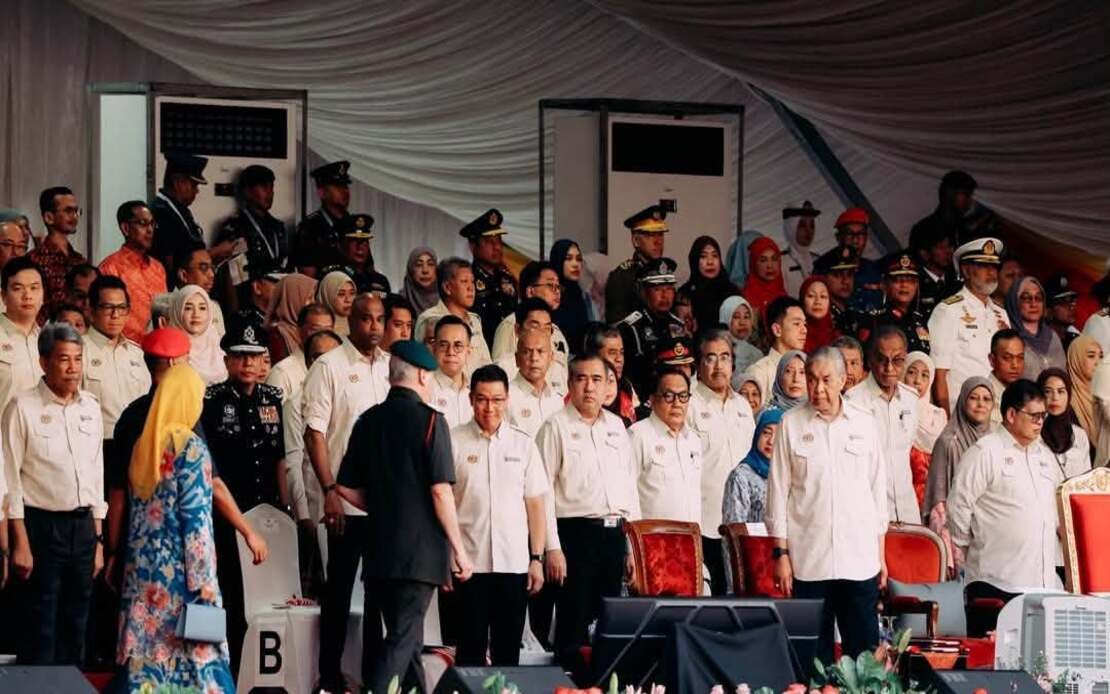
Malaysia's coalition government requires a fundamental shift in political culture centred on maturity and collective responsibility, according to Domestic Trade and Cost of Living Minister Datuk Armizan Mohd Ali, who offered his perspective on the delicate balance required to sustain the current administration following the 15th General Election.
In remarks made on National Day, Armizan highlighted that the country's evolving political landscape, shaped by the end of single-party dominance that characterised Malaysian politics for decades, demands deliberate acceptance and understanding from all stakeholders. The transition to a multi-party coalition framework represents not merely an institutional shift but a fundamental reimagining of how Malaysia's elected representatives approach their roles and responsibilities to the nation.
The minister drew a stark contrast between the current administration's cohesion and the turbulent period from 2018 to 2022, a four-year span marked by extraordinary political upheaval. During that interregnum, Malaysia experienced three changes of prime minister and corresponding reorganisations of the Cabinet—a revolving door of leadership that Armizan characterised as detrimental to long-term economic planning and social progress. That experience, he suggested, provides a cautionary tale about the consequences of prioritising factional advantage over institutional stability.
Armizan's observations about Cabinet dynamics offer an intriguing window into how the Unity Government functions behind closed doors. While activists and party members at grassroots levels have engaged in heated public disputes and rhetorical exchanges over the intervening months, the minister noted a striking disconnect: senior leadership has maintained professional, constructive engagement during formal Cabinet sessions. This compartmentalisation—the ability to separate partisan competition from collaborative governance—represents precisely the kind of political maturity he identifies as essential to governmental continuity.
The minister's framing of political maturity centres on a crucial philosophical proposition: that individual politicians and their parties must consciously subordinate immediate partisan gains to broader national interests and institutional health. This argument directly addresses a persistent vulnerability in Malaysia's coalition arrangement, where competing political entities with divergent ideological commitments and voter bases must coexist within a single government structure. The tension between these competing loyalties creates constant pressure that threatens cohesion.
For Malaysian and Southeast Asian observers, Armizan's commentary carries implications that extend beyond domestic politics. Coalition governments, increasingly common across the region as traditional political alignments fragment, face similar sustainability challenges. Thailand, Indonesia, and the Philippines have all grappled with unstable coalitions collapsing under internal pressures. Malaysia's experiment in maintaining a broad-based coalition over an extended period offers either a positive model or a cautionary example depending on whether current arrangements hold.
The minister positioned political responsibility as a counterweight to political rights—a formulation that merits careful examination. He argued that in a democracy, while parties and individuals retain legitimate rights to compete and advocate for their interests, these rights must be exercised within a framework that acknowledges reciprocal obligations to national stability and citizen welfare. This represents a sophisticated argument about the conditions necessary for coalition governance to function effectively.
Armizan's emphasis on consensus-building and solidarity within leadership circles suggests an awareness that the Unity Government's legitimacy rests substantially on demonstrable unity at the apex of power. If senior Cabinet members appeared divided or engaged in open conflict, public confidence would erode rapidly, and pressure would mount for the coalition to fracture. The maintenance of professional relationships among leaders from competing parties therefore serves a function beyond mere civility; it becomes a foundational element of governance itself.
The National Day occasion provided Armizan with a platform to articulate a broader vision of national identity transcending political divisions. He characterised the coming together of various stakeholders—government officials, business leaders, civil society actors, and ordinary citizens—as essential to building Malaysia's future. This inclusive framing attempts to reposition political competition as subordinate to a shared project of national development, an important rhetorical move in a diverse, plural society where political conflicts can easily acquire communal or ethnic dimensions.
The minister's remarks also implicitly acknowledge the fragility of Malaysia's current arrangements. If political maturity were genuinely embedded in institutional structures or reliably produced by political culture, there would be no need to emphasise it repeatedly or invoke it as a prerequisite for stability. The fact that Armizan felt compelled to articulate these principles on National Day suggests underlying anxieties about whether commitment to coalition governance remains sufficiently robust among all parties and factions.
For Malaysia's business community and international investors—constituencies significantly affected by political instability—Armizan's message offered partial reassurance. A government genuinely committed to institutional stability and demonstrating cooperative Cabinet dynamics presents a more predictable environment for long-term economic planning than the chaos of 2018-2022. However, the dependence on voluntary adherence to political maturity rather than structural safeguards leaves meaningful risks unaddressed.
Looking forward, the sustainability of Malaysia's Unity Government will depend on whether the political maturity and consciousness of responsibility that Armizan praised can be maintained as immediate electoral pressures mount and coalition partners increasingly contemplate their standing with voters. The next general election will test whether the consensus forged post-GE15 remains sufficiently durable or whether accumulated grievances and competitive impulses overwhelm the commitment to coalition discipline that the minister has championed.

