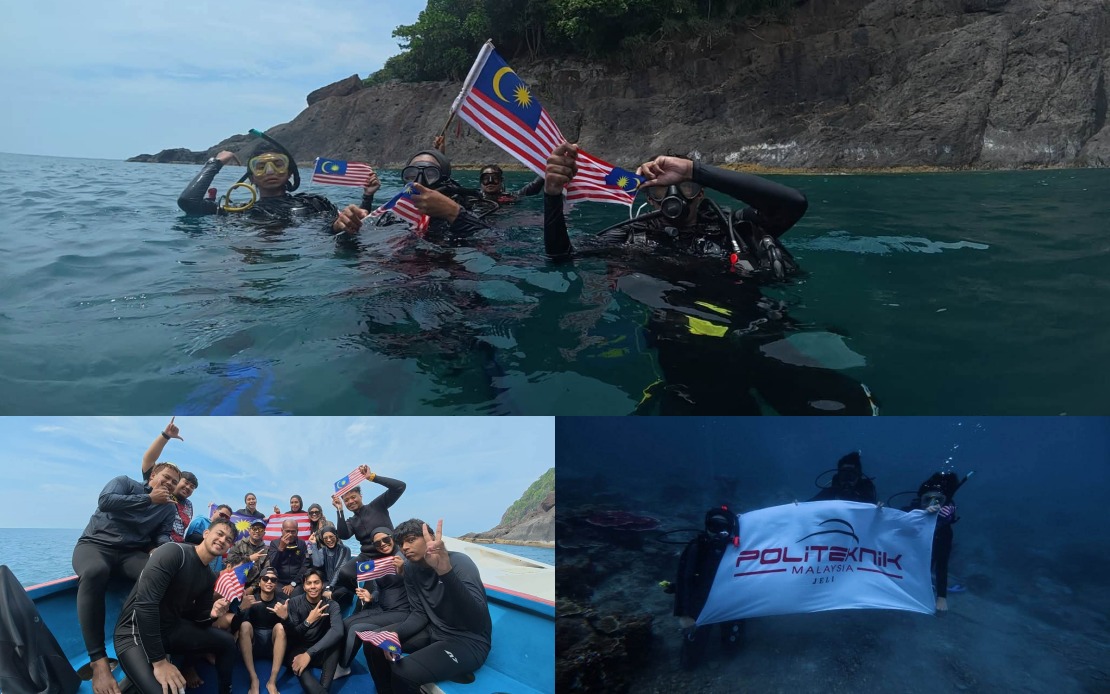
Staff and students at Politeknik Jeli Kelantan (PJK) chose an unconventional path to celebrate the 69th National Day on August 31, descending to the ocean floor off Pulau Tenggol in Terengganu to plant the Jalur Gemilang 18 metres beneath the surface. The gesture, executed during a structured training exercise, demonstrated how vocational education institutions in Malaysia are increasingly weaving patriotic observance into their curriculum and practical learning programmes.
Mohd Adam Nashriq Bani Yamin, an Aquaculture lecturer at PJK, framed the underwater flag display as more than ceremonial symbolism. The initiative formed part of a professional scuba diving training and certification programme conducted between August 27 and 30 at Dive Buddy Dungun, involving the PJK Aquaculture Technology Unit and the Department of Agrotechnology and Bio-Industry. By integrating the National Day flag deployment into an accredited training exercise, the institution transformed a patriotic moment into a substantive educational experience with real vocational value.
The participation structure reflected the seriousness with which PJK approached the exercise. Two lecturers and two fifth-semester students from the Diploma in Aquaculture Technology programme completed the full scuba diving certification pathway, with training delivered by Dr Nabila Talib, an instructor from Dive Buddy Malaysia. The students pursued Professional Association of Diving Instructors (PADI) Open Water Diver certification, a globally recognised qualification that significantly enhances career prospects in marine-related fields.
Yasmin emphasised that water safety competency represents a critical component of graduate readiness in the aquaculture and marine biotechnology sectors. By combining safety protocols with certification training, PJK addressed a genuine industry need while preparing students for the operational realities they will encounter after graduation. Many positions in marine farming and underwater research require workers to operate confidently and safely in aquatic environments, making diving proficiency a tangible career asset rather than an optional enhancement.
The underwater deployment also included the PJK institutional flag, creating a dual patriotic message that acknowledged both national identity and institutional pride. This layered symbolism underscored how vocational colleges are positioning themselves as custodians of professional excellence within broader national development goals. The visibility of flags from both Malaysia and the polytechnic conveyed a unified commitment to excellence in marine education and environmental stewardship.
For students pursuing careers in marine aquaculture and marine biotechnology, the practical diving skills acquired during this programme open doors to specialised roles that may require seabed work, underwater infrastructure inspection, or direct involvement in marine farm operations. The certification carries international recognition through PADI, enabling graduates to work across Southeast Asian markets where marine resource development represents an expanding economic frontier. This cross-border credential relevance amplifies the value of such training within Malaysia's regional education positioning.
The pedagogical approach demonstrated at PJK reflects a broader shift in Malaysian vocational education toward experiential, competency-based learning that directly mirrors industry requirements. Rather than confining water safety and diving instruction to classroom theory, the institution embedded certification within authentic operational contexts. Students did not simply learn diving protocols; they applied them to accomplish a meaningful institutional objective, reinforcing both technical skill and professional responsibility.
Beyond immediate career preparation, the diving skills framework extends into marine research, coastal ecosystem monitoring, and marine conservation initiatives. As Southeast Asian nations increasingly focus on sustainable ocean management and blue economy development, graduates equipped with diving certifications and marine biotechnology knowledge become assets for both private aquaculture operations and government environmental agencies. PJK's approach thus aligns individual student development with broader national priorities around marine resource management.
The water safety curriculum component that culminated in this National Day exercise addresses a practical vulnerability in vocational training. Students destined for maritime work require systematic exposure to emergency response protocols, equipment operation under pressure, and risk assessment in dynamic aquatic environments. By formalising this training through an internationally credible certification pathway, PJK ensures that safety competency is not treated as incidental but as foundational to professional practice.
Institutional initiatives of this nature also contribute to Malaysia's positioning as a regional centre for marine vocational excellence. When polytechnic students gain PADI certification and underwater operational experience through structured programmes, they become competitive across Southeast Asia's growing marine industries. This regional advantage extends to aquaculture development, with Malaysia potentially attracting investment and expertise in sustainable marine farming technologies.
The integration of patriotic expression into professional training demonstrates how National Day observance can transcend ceremonial formats and contribute meaningfully to educational outcomes. Rather than diverting institutional attention and resources toward traditional flag-raising or parade participation, PJK channelled patriotic motivation into an initiative that advanced student learning, institutional credibility, and career readiness. This alignment of national commemoration with vocational substance offers a model that other technical institutions might adapt to their own disciplinary contexts.
Mohd Adam Nashriq highlighted that such experiential exposure equips graduates with portfolios extending beyond academic credentials to encompass practical competencies and additional professional certifications. Employers in marine industries increasingly value workers who arrive with validated technical skills and safety credentials, reducing recruitment training burdens and accelerating productivity. PJK's approach thus serves both immediate institutional interests and genuine graduate employment prospects.
The underwater National Day tribute ultimately encapsulates how Malaysian vocational education can simultaneously honour national identity and serve industrial development. By deploying the Jalur Gemilang 18 metres below the Terengganu seabed, PJK transformed patriotic expression into a vehicle for skills acquisition, safety certification, and career advancement. As Malaysia navigates the blue economy transition and marine sector expansion, such integration of patriotism with technical excellence becomes increasingly valuable for positioning the nation's workforce and educational institutions competitively.

