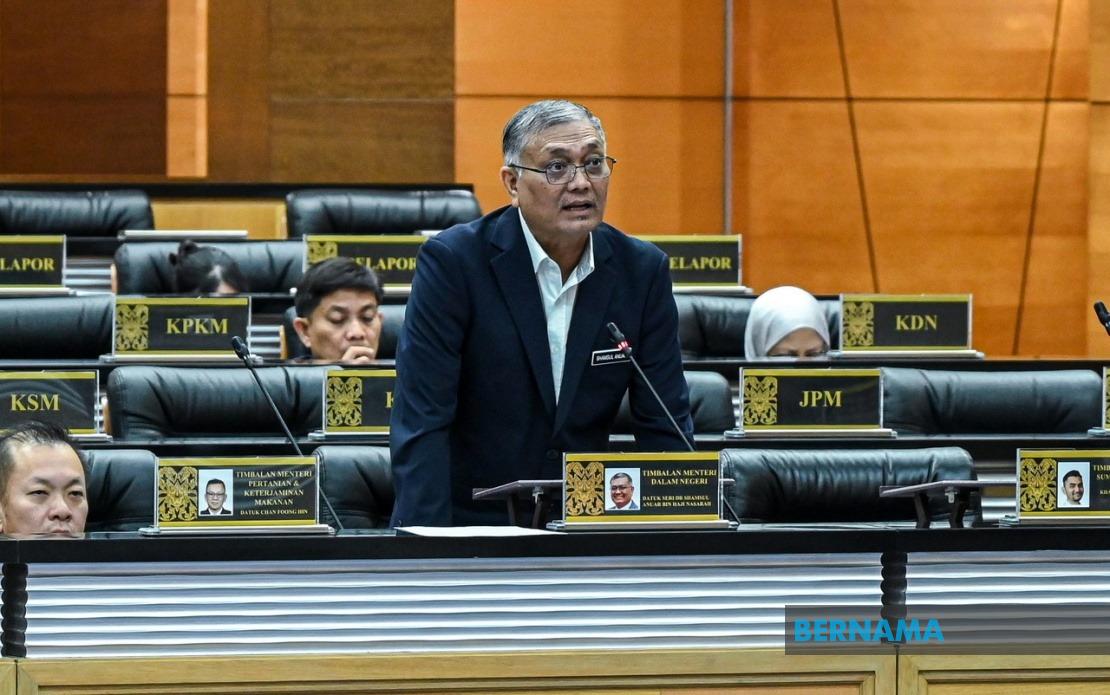
Deputy Home Minister Datuk Seri Dr Shamsul Anuar Nasarah has sought to reassure lawmakers that the Royal Malaysia Police apply consistent standards when investigating sensitive cases involving prominent figures, signalling that no individual receives preferential treatment based on their political position or party affiliation. The statement came during parliamentary proceedings on July 15 as the government faced questions about the handling of several high-profile investigations that have attracted public scrutiny and raised concerns about the impartiality of law enforcement.
The remarks were prompted by enquiries from opposition parliamentarian Datuk Wan Saifulruddin Wan Jan regarding the progress of multiple sensitive investigations, most notably an intimate video recording that gained widespread circulation in 2019 and became associated with a former government minister. The circulation of such material had generated considerable public controversy at the time and raised questions about how authorities would handle the case going forward.
Shamsul Anuar indicated that investigative efforts into the video incident remain active, with officers focused on locating the original recording and identifying all devices and equipment implicated in its distribution. The investigation draws on several legal provisions, including Section 292, Section 377B and Section 504 of the Penal Code, as well as Section 233 of the Communications and Multimedia Act 1998, demonstrating the multi-faceted legal approach authorities are applying to what prosecutors view as a serious matter involving potential violations of privacy, obscenity, and harassment statutes.
The Deputy Home Minister's emphasis on professional and transparent investigative practices reflects growing international scrutiny of Malaysia's justice system and domestic pressure from civil society organisations advocating for rule of law. By publicly stressing that investigations proceed without consideration of political connections or government position, Shamsul Anuar sought to counter perceptions that Malaysia's law enforcement apparatus operates selectively or shields politically connected individuals from accountability.
In a related matter, the Deputy Home Minister confirmed that investigations into allegations involving the son-in-law of former Prime Minister Tan Sri Muhyiddin Yassin have been transferred to the Malaysian Anti-Corruption Commission. The MACC has already moved to issue an arrest warrant in the case, indicating a serious escalation in the investigation. Shamsul Anuar declined to elaborate further on the specific allegations or the nature of the MACC's investigation, citing the ongoing nature of the proceedings and established protocols governing the disclosure of information about active investigations.
The involvement of Malaysia's premier anti-corruption body underscores the gravity with which authorities are treating the allegations, positioning the matter within the broader framework of national integrity and asset declaration requirements. The MACC's jurisdiction signals that the case involves potential breaches of anti-corruption legislation rather than other criminal statutes, though the Deputy Home Minister's refusal to elaborate prevents fuller understanding of the precise allegations at issue.
Beyond these two high-profile cases, the parliamentary exchange reflected broader questions about Malaysia's capacity to conduct impartial investigations into matters involving senior politicians and their associates. Public confidence in the independence and fairness of law enforcement agencies has been tested repeatedly over recent years by various high-profile cases and shifting political alignments. For Malaysian readers accustomed to observing how different governments have handled politically sensitive investigations, the Deputy Home Minister's statement carried significance primarily as a public commitment rather than necessarily as a guarantee of implementation.
The government also addressed broader matters of international legal cooperation during the parliamentary session, particularly regarding extradition arrangements. Shamsul Anuar confirmed that Malaysia currently maintains extradition treaties with eleven countries and has signed the ASEAN Extradition Treaty, providing legal mechanisms for pursuing and transferring criminal suspects across borders. He indicated that Malaysia remains open to negotiating additional extradition agreements with other nations, reflecting an international approach to combating transnational crime and preventing fugitives from exploiting jurisdictional gaps.
The extradition framework assumes particular relevance for Southeast Asia given the region's interconnected economies and the increasing mobility of criminal actors. Malaysia's participation in multiple bilateral and multilateral extradition arrangements enhances regional capacity to pursue white-collar crimes, financial frauds, and other offences that frequently cross national boundaries. For Malaysian businesses and citizens operating across Southeast Asia, the expansion of such agreements offers greater certainty regarding the enforceability of legal judgments and the apprehension of criminal actors.
The Deputy Home Minister's responses, taken collectively, seek to project an image of an impartial justice system capable of investigating even the most sensitive matters without regard to political considerations. However, the efficacy of such public assurances ultimately depends on observable outcomes in concrete cases rather than rhetorical commitments. Malaysian legal observers and civil society groups will likely scrutinise the pace and outcomes of these investigations to assess whether the stated principles of professional and transparent investigation translate into actual practice.
For readers following Malaysian politics and governance, the parliamentary exchange highlights ongoing tensions between the desire to demonstrate law enforcement impartiality and pervasive concerns about political influence over investigative and prosecutorial decisions. The assignment of high-profile cases to different investigative bodies—the PDRM and MACC—may also reflect efforts to enhance public confidence by distributing responsibility rather than concentrating all sensitive investigations within a single agency.

