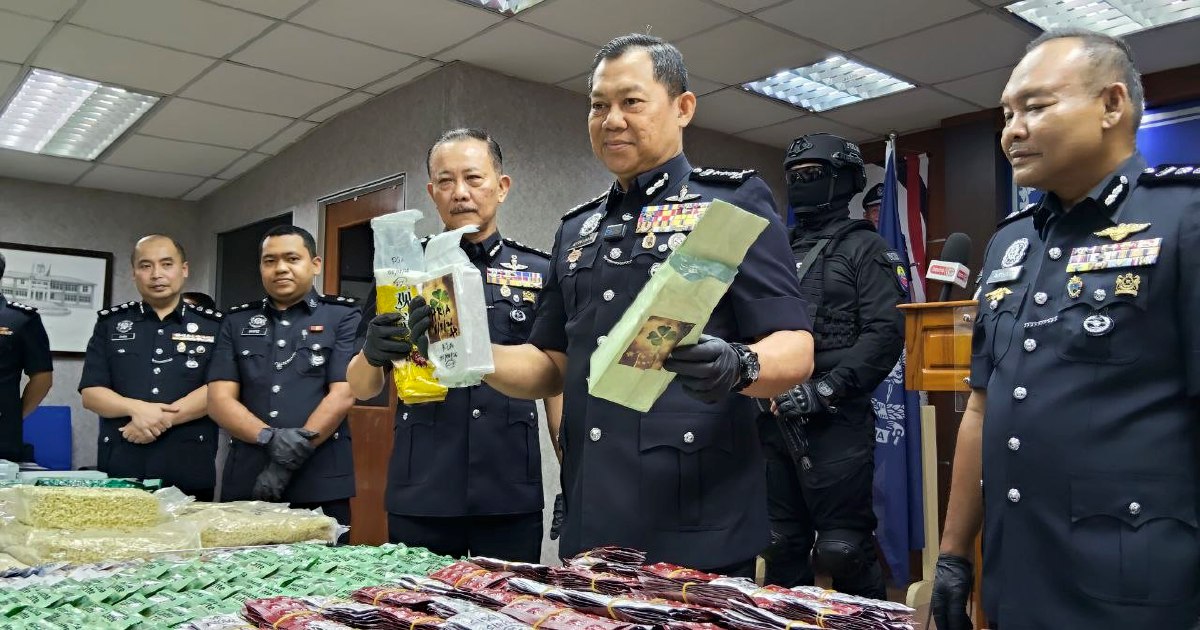
A major drug distribution network operating in Johor has been brought down following a coordinated police operation that recovered nearly RM8.49 million in narcotics from a residential apartment in the Masai district. The raid on the unit located along Persiaran Senibong resulted in the seizure of 96.76 kilograms of various controlled substances, marking a significant blow to organised drug trafficking operations in the state. The discovery came after authorities identified the apartment as a clandestine storage and distribution hub serving the wider region.
Investigators determined that the premises had been deliberately rented by members of the syndicate specifically to function as a depot for their illegal operations. Rather than being used as a conventional residence, the apartment served as a logistics node where large quantities of drugs were stored before being distributed to street-level dealers and customers. This operational structure is typical of sophisticated organised drug groups that seek to insulate themselves from direct involvement in retail transactions, thereby reducing their exposure to law enforcement detection at ground level.
The coordinated intervention by police authorities represents the culmination of an intelligence-gathering effort that tracked the movement of narcotics through the supply chain. By identifying and targeting the storage facility rather than merely apprehending individual users or low-level dealers, authorities have struck at the organisational backbone of the distribution network. This strategic approach aims to disrupt the supply side of the drug trade, where intervention is generally more impactful than enforcement focused solely on demand reduction.
Two individuals were apprehended in connection with the operation, though further details regarding their identities and specific roles within the syndicate hierarchy remain under investigation. Their detention will likely yield intelligence that could lead to additional arrests further up or down the distribution chain. The information gathered during interrogation may prove crucial in dismantling associated networks and identifying other members operating in adjacent areas.
The scale of the seizure underscores the magnitude of drug trafficking through the Johor region, which sits strategically positioned near Singapore and serves as a critical transit zone for narcotics destined for markets throughout Southeast Asia. The state's geography and proximity to international shipping routes make it particularly attractive to trafficking organisations seeking to move contraband efficiently. Johor's role as a major commercial and logistics hub inadvertently provides cover for illicit operations that blend into legitimate supply chains.
For Malaysian law enforcement, operations such as this represent an ongoing challenge in combating organised drug syndicates that grow increasingly sophisticated in their methods. Distribution networks now frequently employ compartmentalised operations where individual members have limited knowledge of the wider organisation, making it difficult for authorities to unravel entire chains through single arrests. The apartment storage model, while offering convenience to traffickers, also creates opportunities for police surveillance and intervention at a concentrated point.
The street value estimate of RM8.49 million reflects the substantial profits driving drug trafficking operations. At these price points, even seizures of this magnitude represent only a fraction of the overall narcotics flowing through regional markets. The economics of drug trafficking ensure that organisations remain committed to their operations despite enforcement risks, as potential profits vastly exceed the costs of replacing lost shipments or imprisoned personnel.
This bust occurs within the broader context of Malaysia's national war on drugs, which has evolved in recent years to encompass more intelligence-led operations targeting major suppliers rather than exclusively focusing on user arrest and rehabilitation. The strategy recognises that supply-side interventions, when directed at organised distribution networks rather than street-level activity, can produce more measurable reductions in overall drug availability. However, the persistence of major seizures suggests that trafficking networks continue to operate effectively despite sustained police action.
For Johor residents and business communities, the discovery serves as a reminder that organised drug operations frequently conduct their activities in ordinary residential spaces within populated areas. The apartment in Masai represents a location that would have appeared unremarkable to neighbours and building management, allowing the syndicate to operate with minimal suspicion. This reality underscores the challenge facing both law enforcement and communities in identifying criminal activities occurring behind closed doors in residential neighbourhoods.
The investigation into the seized materials and the arrested individuals is expected to continue, with authorities likely pursuing charges under Malaysia's dangerous drug legislation that carries substantial penalties including lengthy imprisonment. The case will proceed through the court system as part of the ongoing judicial response to serious drug offences. Beyond the immediate prosecutions, police will attempt to leverage intelligence from this operation to target related distribution networks and identify upstream suppliers contributing to the regional drug trade.

