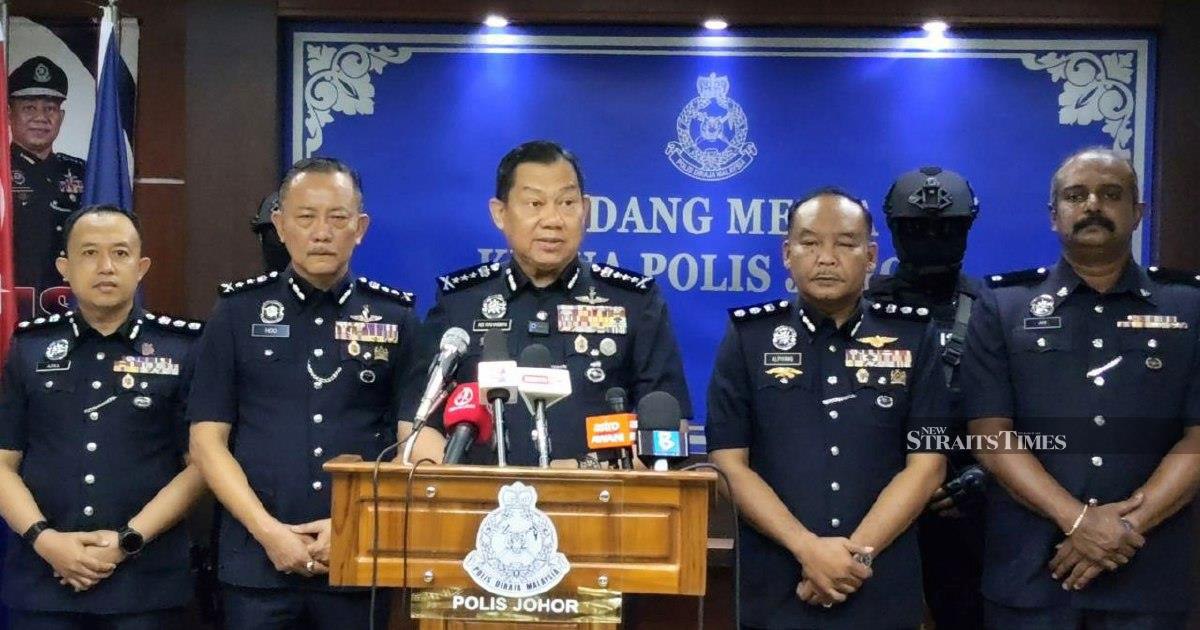
Law enforcement authorities in Johor Baru struck a major blow against drug traffickers during a coordinated operation on Saturday, uncovering a substantial methamphetamine cache and dismantling what appears to be an active distribution network. The seizure of 60.78kg of the highly addictive substance, valued at RM3.04 million, represents a significant haul in the state's ongoing battle against narcotics trafficking. The raids, which resulted in eight arrests, illustrate how criminal organisations continue to recruit young and vulnerable individuals to participate in their illegal operations, placing both these individuals and the broader community at considerable risk.
Among the eight men detained is a school dropout whose involvement as a transporter exposes a troubling trend whereby criminal syndicates deliberately target youths with limited educational prospects and economic opportunities. This deliberate exploitation of young people reflects a calculated strategy by traffickers to insulate higher-ranking members from direct law enforcement exposure while maximising operational efficiency. The use of teenage couriers has become increasingly common in Southeast Asian drug networks, as such individuals often face reduced judicial penalties and may be seen as more expendable by kingpins orchestrating these operations from a distance.
The scale of the seizure demonstrates that Johor, Malaysia's gateway to Singapore and a major transit corridor, remains a critical battleground in the region's drug war. The state's geographic proximity to significant consumption markets and its extensive road and maritime borders create ideal conditions for traffickers moving narcotics through the region. The sophistication of the operation that authorities dismantled suggests organised crime groups continue to maintain robust supply chains capable of moving substantial quantities of drugs despite increased enforcement efforts.
Methamphetamine, commonly known as methamphetamine or crystal meth, remains one of the most destructive drugs circulating in Malaysia, driving addiction, crime, and social degradation across affected communities. The drug's highly addictive nature means demand remains strong despite public health campaigns and intensive law enforcement action. Regional production facilities, particularly in Myanmar and along the Thailand-Myanmar border, continue to flood Southeast Asian markets with cheap, highly pure product, creating a seemingly endless supply that traffickers distribute through established networks.
The operation demonstrates the sustained commitment of Johor police to disrupt drug trafficking activities, though authorities acknowledge that interdiction efforts alone cannot eliminate the problem. Street-level busts and mid-level trafficker arrests represent important tactical victories but do not address the structural drivers of supply and demand that sustain the market. International cooperation, particularly with Thai and Singaporean authorities who share Johor's border, remains essential for identifying major trafficking routes and disrupting cross-border operations.
The involvement of a teenage transporter raises significant questions about how effectively existing rehabilitation and prevention programmes reach at-risk youth. Schools in economically marginalised areas report difficulties engaging students from backgrounds characterised by family instability, poverty, and limited employment prospects—precisely the demographic that traffickers target for recruitment. Such young people often lack mentorship, stable income, and awareness of long-term legal consequences when approached with offers of quick money.
From a legal standpoint, Malaysian law distinguishes between trafficking and trafficking for the purposes of distribution, with sentences for large-quantity offences reaching life imprisonment or capital punishment. The eight individuals arrested face serious charges that will likely result in lengthy custodial sentences, though the involvement of the teenage defendant will factor into sentencing considerations. However, many criminal justice experts argue that Malaysia's emphasis on punishment rather than rehabilitation leaves young offenders with limited prospects for reintegration upon release, potentially perpetuating cycles of criminality.
The RM3.04 million valuation assigned to the seized methamphetamine reflects typical street-level wholesale prices in Malaysia, where a gram of high-purity crystal meth typically commands between RM50 and RM100 depending on quantity and local market conditions. This pricing structure means even modest seizures represent substantial financial losses for trafficking organisations, creating incentive for rapid replacement through increased production and smuggling efforts. The financial calculus of drug trafficking remains compelling for criminal enterprises, as potential profits continue to dwarf risks despite enhanced penalties.
Regional experts monitoring narcotics trends note that Southeast Asian drug markets are becoming increasingly fragmented and professionalised, with larger operations employing compartmentalised management structures that insulate leadership from frontline exposure. The Johor operation appears consistent with this pattern, suggesting police disrupted a lower tier of a larger distribution network while principal organisers likely remained undetected. Dismantling such networks requires sustained investigation, informant development, and financial tracking capabilities that many regional police forces struggle to maintain given competing resource demands and limited intelligence-sharing mechanisms.
Moving forward, addressing methamphetamine trafficking will require multifaceted approaches combining enhanced border controls, improved regional intelligence sharing, community-based youth programmes offering genuine economic alternatives, and investment in treatment and harm reduction services for dependent users. The Saturday seizure in Johor Baru, while operationally significant, remains one engagement in a protracted struggle against deeply entrenched trafficking networks that continue reshaping themselves in response to enforcement pressure.

