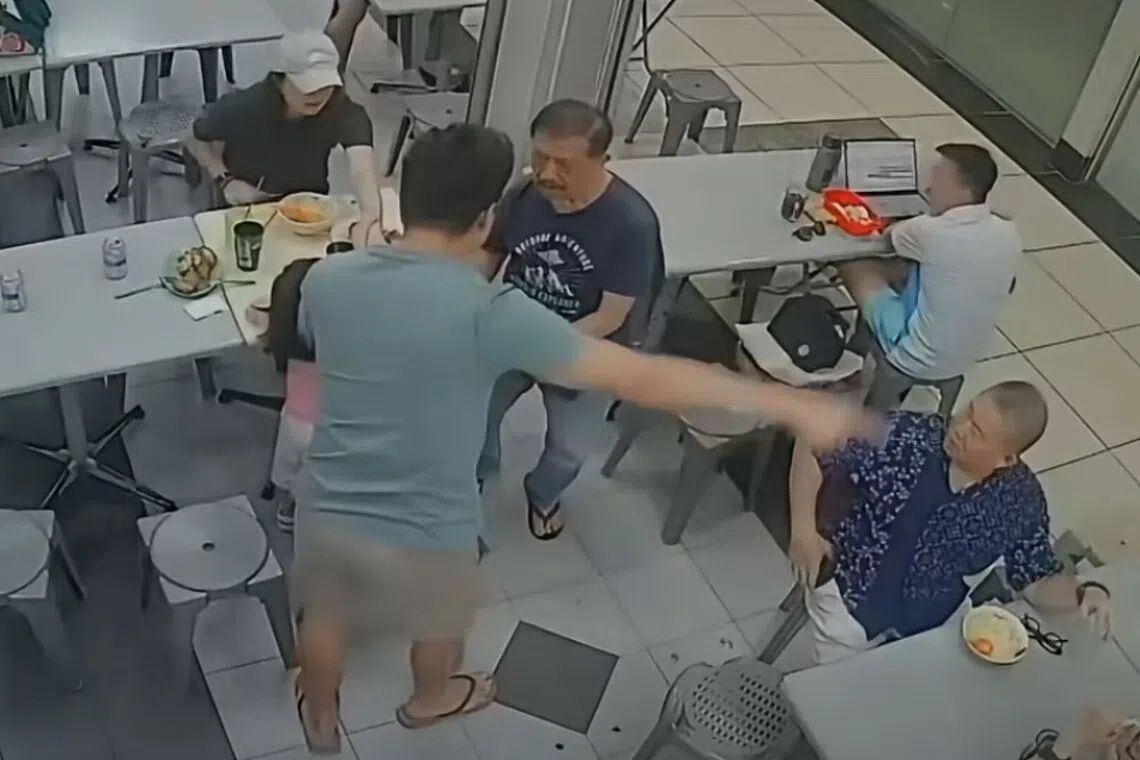
Singapore's police force has initiated investigations into a confrontation at a coffee shop in the East Coast area that resulted in an elderly man being forcefully pushed to the ground. The incident, which unfolded in the presence of multiple patrons and was captured on security camera footage, has raised questions about appropriate community responses and the safety of seniors in public spaces. Police confirmed on Sunday, August 16, that a report had been filed and that officers are actively pursuing the matter.
The elderly man at the centre of the incident, described as being in his 70s and experiencing mobility challenges, was spending time at the coffee shop where he assists with operations at a stall. Security footage reveals him navigating through the establishment by holding onto tables on either side for balance, a reflection of his physical limitations. As he moved through the crowded space, he paused to pat a young girl sitting at one of the tables on her head—an action that would trigger an unexpected and forceful response from a bystander.
The gesture, which in many Asian cultures can be interpreted as a benign or even affectionate acknowledgment, prompted an immediate reaction. A woman accompanying the girl at the table moved to deflect his hand away, attempting to prevent further contact. However, the situation escalated rapidly when a man at the same table, who had momentarily stepped away, returned and confronted the elderly man verbally. Witnessing what he perceived as inappropriate behaviour, the man then physically shoved the elderly patron to the ground with considerable force, causing him to fall in front of the assembled crowd.
The incident might have concluded there, but the assailant's subsequent actions introduced an element of contrition that has complicated the narrative. According to the elderly man's son, who shared the security footage on Facebook under the account name Bei-ing Wanton Noodle, the man who pushed his father later returned to apologise and even offered to buy the elderly man a drink. This apparent remorse, however, did not prevent the family from reporting the matter to authorities or from seeking the public's assistance in identifying the assailant more formally.
The elderly man's family emphasised the physical consequences of the altercation. Following the push, the senior citizen suffered severe back pain, a particularly concerning outcome given his already compromised mobility and his advanced age. Such injuries in the elderly population carry heightened risks and can lead to complications that extend far beyond the initial incident. The son's Facebook post, published at 7.14pm on August 15, appealed directly to the public for information about the man's identity, treating this initial disclosure as an urgent call for community assistance.
The security footage accompanying the posts serves as crucial documentary evidence of the encounter. It clearly captures the sequence of events, from the elderly man's careful navigation of the coffee shop environment to the moment of contact with the girl and the subsequent physical altercation. The visual record has been instrumental in allowing observers to assess the nature of the gesture and the proportionality of the response, making it a valuable resource for both police investigations and public discourse.
This incident touches on several important social questions relevant to Singapore and urban Southeast Asia more broadly. The interaction raises issues about cultural norms regarding intergenerational contact, the boundaries of acceptable behaviour in public spaces, and the responsibility communities bear toward their elderly members. The rapid physical escalation also prompts reflection on contemporary attitudes toward protecting children and whether the force used was commensurate with the perceived threat.
The family's initial resort to social media rather than immediate police involvement reflects evolving patterns in how Singaporeans address disputes and seek justice. By August 16, the son had updated his Facebook followers to express gratitude for public concern and to note that information about the assailant's identity had been provided to authorities. The shift from social media appeal to formal police involvement represents a common trajectory in high-profile community incidents, where online amplification helps gather witnesses and accelerates official responses.
The police investigation now proceeds with the advantage of security footage, witness accounts, and public awareness generated through social media exposure. The case will likely examine questions of proportionality, the intentions behind the elderly man's action, and whether the physical response constituted an unreasonable use of force. Officers will need to balance the protective instincts that may have motivated the assailant against the principle that minor gestures do not justify violent physical retaliation, particularly against vulnerable senior citizens.
For Malaysia and the broader Southeast Asian region, this incident serves as a reminder of evolving community tensions in dense urban environments where diverse values around child safety, respect for elders, and personal boundaries intersect. As Asian cities become increasingly multicultural and younger populations may hold different cultural attitudes from immigrants or older residents, such misunderstandings carry potential for conflict. The incident also highlights how quickly social media can mobilise public attention and investigation resources in ways that complement but also sometimes complicate formal law enforcement processes.
The outcome of this investigation will carry implications beyond the immediate parties involved. It may establish precedent regarding what constitutes reasonable self-defence or protection of minors in Singapore's legal framework, and how the balance should be struck between these concerns and the protection of elderly citizens. The case underscores broader questions about social cohesion and mutual respect in Southeast Asia's increasingly complex urban centres, where traditional patterns of community life are continuously negotiated against modern pressures and expectations.

