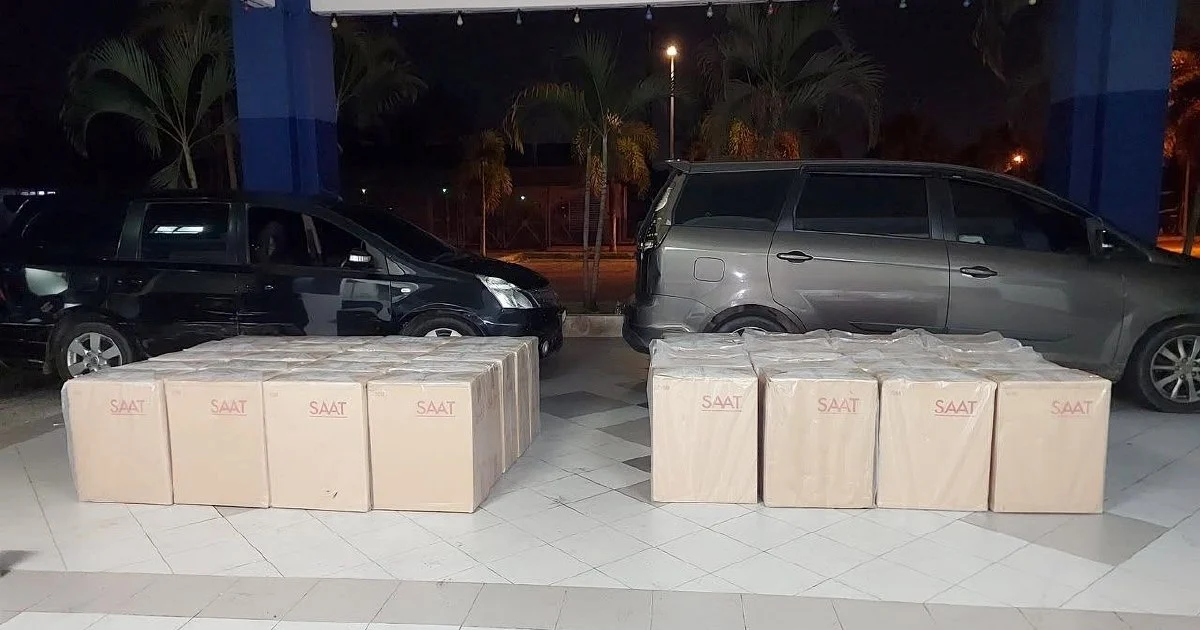
Kelantan police have arrested a 29-year-old suspect and uncovered a significant stash of contraband cigarettes valued at RM813,000 following a chase operation in Kampung Pulau Panjang, Kota Baru, on the night of the incident. The seizure represents another blow to smuggling networks that have long plagued Malaysia's northeastern state, where porous borders and complex supply chains create persistent vulnerabilities in tobacco enforcement.
The operation unfolded after authorities detected suspicious activity in the rural village, prompting officers from the General Operations Force (GOF) to pursue the suspect's vehicle. The chase culminated in the apprehension of the individual, leading investigators to discover approximately 400,000 sticks of cigarettes concealed within the vehicle. The sheer volume of the seizure underscores the scale at which smuggling operations have been conducted across Malaysia's states, particularly in regions with ready access to maritime and land smuggling routes.
Cigarette smuggling remains one of Malaysia's most persistent enforcement challenges, driven largely by substantial price differentials between domestic and regional markets. The RM813,000 valuation placed on this particular haul reflects the lucrative nature of the illicit trade, where substantial markups await operators willing to navigate legal consequences. For context, cigarette prices in Malaysia are considerably higher than in neighbouring countries, creating powerful incentives for cross-border trafficking that continues to frustrate authorities across multiple states.
The General Operations Force, tasked with tackling organised crime and border security threats, has intensified operations in recent months to intercept smuggling routes that funnel contraband goods through Kelantan. The state's geography makes it particularly vulnerable, with access to both maritime corridors and land borders that facilitate the movement of illicit cargo. This latest operation reflects the broader counter-smuggling strategy being deployed along the eastern coast, though enforcement officials acknowledge that such seizures represent only a fraction of the total contraband flowing through regional networks.
Kelantan has emerged as a focal point in Malaysia's anti-smuggling efforts, given its historical significance as a transit point for contraband goods destined for markets across Southeast Asia. The persistence of such operations despite regular enforcement actions points to the resilience of criminal networks, which continuously adapt their methodologies and routes to evade detection. The arrest of a single operator often yields limited intelligence without supporting investigations into upstream suppliers and downstream distribution channels, a reality that complicates long-term disruption of these networks.
The financial dimensions of this case deserve particular attention for Malaysian policymakers. Beyond the immediate seizure, the RM813,000 valuation highlights the substantial revenue that government loses through uncollected excise taxes and duties. Tobacco taxation forms a meaningful component of Malaysia's fiscal framework, with cigarette duties serving dual purposes: generating revenue and discouraging consumption through pricing mechanisms. Effective anti-smuggling operations thus represent investments in both law enforcement and public health policy.
For consumers, cigarette smuggling's prevalence suggests that illicit products remain readily accessible despite enforcement efforts, potentially undercutting legitimate retailers and distorting market dynamics. The availability of untaxed contraband creates perverse incentives that protect price-sensitive consumers from experiencing the full fiscal cost of tobacco consumption, thereby reducing the intended deterrent effect of high taxation. This dynamic extends beyond simple economics into public health considerations, as smuggled cigarettes frequently lack proper regulatory oversight and standardised packaging warnings.
The arrest underscores Kelantan's continued vulnerability to transnational smuggling operations, reflecting both geographical proximity to potential source countries and the sophistication of criminal networks operating in the region. Authorities have noted that modern smuggling operations employ increasingly complex logistics, utilising multiple vehicles, transhipment points, and compartmentalised operations to disperse risk. A single arrest, while significant operationally, typically disrupts only a small fraction of total illicit movement through any given route.
Moving forward, sustained enforcement will require multi-agency coordination extending beyond Kelantan to encompass regional cooperation mechanisms with neighbouring states and potentially international partners. Malaysia's commitment to addressing tobacco smuggling has manifested through various initiatives, though critics argue that resource constraints and coordination challenges continue to hamper effectiveness. The incident in Kota Baru demonstrates both the capacity of Malaysian law enforcement and the continued determination of smuggling networks to maintain profitable operations despite heightened vigilance.

