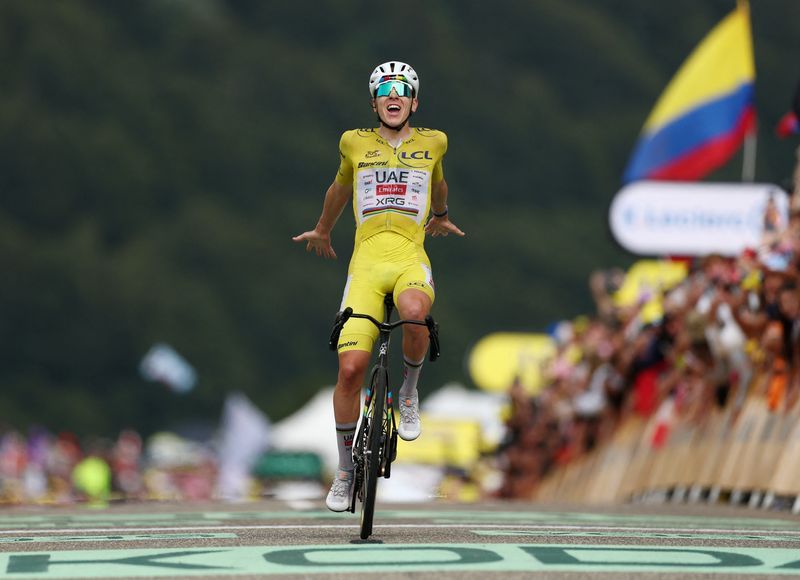
Tadej Pogacar continued his commanding performance at the Tour de France on Saturday, securing a fourth stage victory on the 14th mountain stage that stretched his overall advantage over nearest rival Jonas Vingegaard to four minutes and 30 seconds. The four-time champion executed a perfectly timed attack on the steepest gradients of the Col du Haag climb, breaking clear of his competitors to claim another solo triumph on a route that traversed the demanding Vosges mountains in eastern France.
The 155.3-kilometre journey from Mulhouse to Le Markstein Fellering presented one of the race's most testing challenges, with three category one climbs punctuating the route and unpredictable weather conditions making tactical positioning crucial. Competitors faced heavy rain and slippery descents throughout the afternoon, conditions that typically favour experienced climbers capable of maintaining composure on treacherous terrain. The mountainous character of the stage, combined with technical descents, created numerous opportunities for aggressive riders to establish breakaways, a dynamic Pogacar's UAE Team Emirates team exploited with precision.
In the early phase of the stage, a seven-rider breakaway group formed as the peloton allowed attacking moves to develop. Frenchman Valentin Paret-Peintre of Soudal Quick-Step claimed the sprint across the summit of Grand Ballon, the day's first major climb, holding nearly a two-minute advantage over the main field. His efforts were supported by Richard Carapaz, but as the race progressed through subsequent climbs, the composition of the leading group continued to shift as stronger climbers moved forward and others faded. The breakaway's eventual dissolution on the Col du Haag summit marked the stage's critical moment, where classification contenders finally made their decisive moves.
Navigating wet conditions on the descent from Col du Page, Carapaz and his EF Education–EasyPost teammate Ben Healy briefly lost their way through a navigational error but managed to rejoin their companions. Such incidents, seemingly minor, carry significant consequences in a three-week race where seconds accumulate into decisive advantages. By the time the leaders began their ascent toward Ballon d'Alsace, they maintained roughly a three-minute gap over a peloton increasingly controlled by Pogacar's domestiques, whose coordinated pacing worked to steadily whittle away the breakaway's advantage.
Pogacar's attack came with surgical timing as the Col du Haag gradient intensified beyond 16 percent in its final two kilometres. Richard Carapaz had launched an early assault approximately 2.5 kilometres from the summit, with Tobias Johannessen following initially, but the arrival of the general classification competitors neutralized their threat. When Pogacar made his decisive move on the steepest section, his superior strength in extreme climbing conditions proved decisive. He crested the summit with a 30-second cushion, then accelerated further on the remaining five-kilometre descent to the finish, ultimately crossing the line 38 seconds ahead of Isaac del Toro, his UAE Team Emirates teammate who finished second.
Del Toro's second-place finish represented a significant achievement for the American rider, particularly given his earlier stage victory this race. His performance demonstrated the strength of Pogacar's team throughout the Tour, where multiple domestiques possess the fitness to place highly in individual stages. Del Toro's progress also elevated him ahead of Egan Ayuso in the overall classification standings, positioning him fourth overall and reinforcing UAE Team Emirates' dominance in this edition of the race. Local French interest was served by Paul Seixas, who secured third place and earned considerable support from the enthusiastic crowds lining the Vosges climbs.
Vingegaard's fourth-place finish represents a concerning position for the French champion attempting to reclaim his Tour title after Pogacar's dominance of the previous two editions. A 4:30 deficit with multiple mountain stages remaining suggests the Colombian-born challenger faces an increasingly difficult path to closing the gap. Vingegaard's Visma–Lease a Bike team appears to lack the tactical depth or horsepower of Pogacar's unit, with the defending champion's teammates consistently controlling the race's crucial moments. The stage result underscores the psychological challenge facing every competitor: Pogacar does not merely win stages, he wins them decisively, broadcasting his superiority across the mountains.
Pogacar acknowledged the favourable conditions and his team's effective execution. "A really perfect day, we marked this stage since the beginning. I know it very well, it is beautiful and an incredible place for cycling," the Slovenian rider stated after crossing the finish line. His familiarity with these specific climbs and the consistent excellence of his support structure combine to create a formidable combination. Teams preparing for major Tours typically conduct detailed reconnaissance of key mountain stages, and Pogacar's remark suggests his preparation extended beyond mere fitness considerations to tactical and psychological readiness.
Looking forward, Pogacar signalled that Sunday's 15th stage from Champagnole to Plateau de Solaison will present even greater challenges than Saturday's mountainous ordeal. His measured acknowledgement that "it will be a hard day for us, but we will be ready to fight and see what will happen" reflects appropriate caution rather than overconfidence, particularly given the compressed schedule of consecutive mountain stages. The remaining week of racing will determine whether his current advantage proves insurmountable or whether competitors can exploit potential tactical opportunities as fatigue accumulates.
For Malaysian and Southeast Asian cycling enthusiasts, Pogacar's performance provides instructive lessons in elite-level mountain climbing and team coordination. The sophistication of modern professional cycling—the coordination of domestiques, the timing of attacks on optimal gradient sections, the psychological management of extended races—mirrors strategic complexity found in Southeast Asian sports and beyond. Pogacar's pursuit of a third consecutive Tour title carries historical significance comparable to legendary achievements that define careers. His dominance this year suggests the 27-year-old Slovenian will likely feature prominently in cycling's pantheon of great champions, particularly if he continues executing performances of such commanding precision.
The remaining stages will reveal whether any competitor possesses the tactical creativity or superior strength necessary to challenge Pogacar's apparent control of the race. Current indications suggest his overall victory remains the most probable outcome, barring unforeseen circumstances such as mechanical failure or injury. The consistency of his performances across different mountain terrains, combined with his team's tactical flexibility and his own mental fortitude, have constructed a seemingly unassailable position. However, the Tour de France's unpredictability—its length, its demands, and its capacity to surprise even the most dominant competitors—ensures that final victory remains technically uncertain until the finish in Paris.

