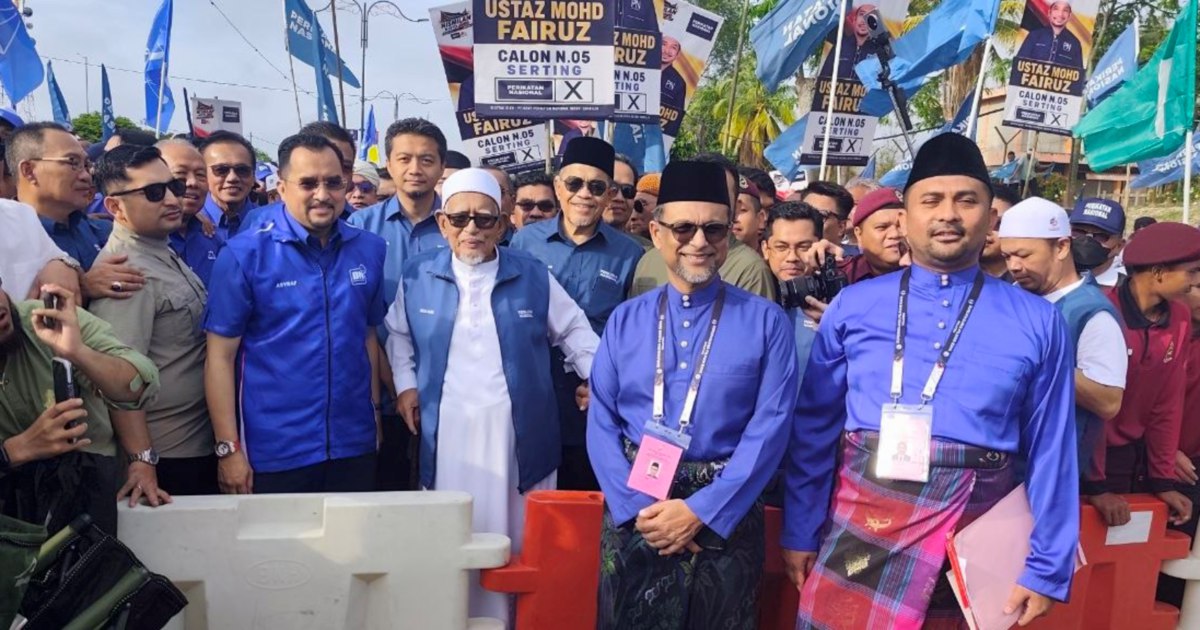
The Perikatan Nasional coalition has committed to lending campaign assistance to Barisan Nasional during the forthcoming Negri Sembilan state election, PAS president Tan Sri Abdul Hadi Awang declared in Jempol on Tuesday. The backing signals a continuation of the political alignment between the two major coalitions that has defined Malaysian politics in recent years, even as both groupings maintain ostensibly separate identities at the national level.
Hadi's announcement underscores the intricate web of inter-coalition cooperation that has become commonplace in Malaysian electoral politics. Rather than presenting themselves as competitors, the PN leadership has chosen to actively participate in bolstering BN's position in a state where both coalitions hold considerable political stakes. This pragmatic approach reflects a shared strategic interest in preventing the opposition Democratic Action Party-led Pakatan Harapan from consolidating power in Negri Sembilan.
The Negri Sembilan election represents a critical test of voter sentiment in a state that has long been considered a swing territory in Malaysian politics. The state's relatively balanced demographic composition and mixed urban-rural characteristics make it a bellwether for broader national political trends. A strong performance by either BN or PN in the state would send significant signals about the respective coalitions' ability to mobilize support and maintain party discipline across multiple electoral battlegrounds.
PN's decision to assist rather than contest independently in Negri Sembilan appears calculated to maximize the combined conservative vote share. By consolidating behind BN's slate of candidates, PN effectively leverages its grassroots organizational capacity and party machinery without fragmenting the anti-PH vote. PAS, as PN's dominant Islamic component and a party with deep roots in many Malaysian constituencies, brings particular organizational strength to campaign efforts, particularly in rural and semi-urban areas where religious sentiment carries electoral weight.
This cooperation dynamic also reflects practical lessons both coalitions have learned from previous electoral contests. Divided conservative and Malay-Muslim votes have historically benefited PH by allowing the opposition to win pluralities in closely contested constituencies. By coordinating campaign efforts now, PN and BN signal their commitment to avoiding such splits that could hand victory to candidates they both wish to defeat. The partnership approach suggests an implicit understanding that defeating PH remains a higher priority than inter-coalition rivalry in this particular contest.
For BN, particularly its dominant UMNO component, the PN support provides a significant force multiplier at a moment when the coalition has been working to rebuild its political credibility following electoral setbacks and internal organizational challenges. Having PN's campaign machinery and party activists work alongside BN campaigners allows BN to stretch its resources further and reach voters who might respond more positively to PN-aligned messengers. This is especially relevant in communities where PN parties, particularly PAS, have cultivated stronger grassroots connections than BN representatives.
The timing of Hadi's announcement also carries political significance, coming as it does during a period when both PN and BN are attempting to project an image of stability and effective governance. The Negri Sembilan election provides an early opportunity to demonstrate that the coalition dynamics at the federal level can translate into concrete electoral support at state level. A successful joint campaign effort would validate the political calculations that have held PN and BN in rough alignment since the 2022 general election.
For Malaysian voters in Negri Sembilan, this cooperation arrangement means campaign messaging will likely emphasize the complementary strengths of both coalitions while avoiding the kind of internecine attacks that characterized some previous election cycles. Rather than PN and BN campaigning against one another, both will focus their messaging on policy contrasts with Pakatan Harapan, emphasizing themes of Malay-Muslim interest protection, economic management, and governance experience.
The broader implications extend to how Malaysian politics continues to evolve post-2022. The Negri Sembilan campaign will serve as a testing ground for whether the PN-BN understanding can be maintained across multiple election cycles and whether such cooperation can actually translate into coordinated governance at state level. If successful, it may encourage similar arrangements in other state elections, further cementing the bipolar structure of Malaysian politics around these two coalitions.
Regionally, Malaysia's electoral dynamics remain closely watched by neighbouring Southeast Asian democracies grappling with their own coalition politics and questions about how rival political forces calibrate their competitive and cooperative instincts. The PN-BN arrangement in Negri Sembilan offers an intriguing case study in pragmatic political alliance-building within democratic contexts where multiple parties must decide whether to compete or cooperate on particular contests.

