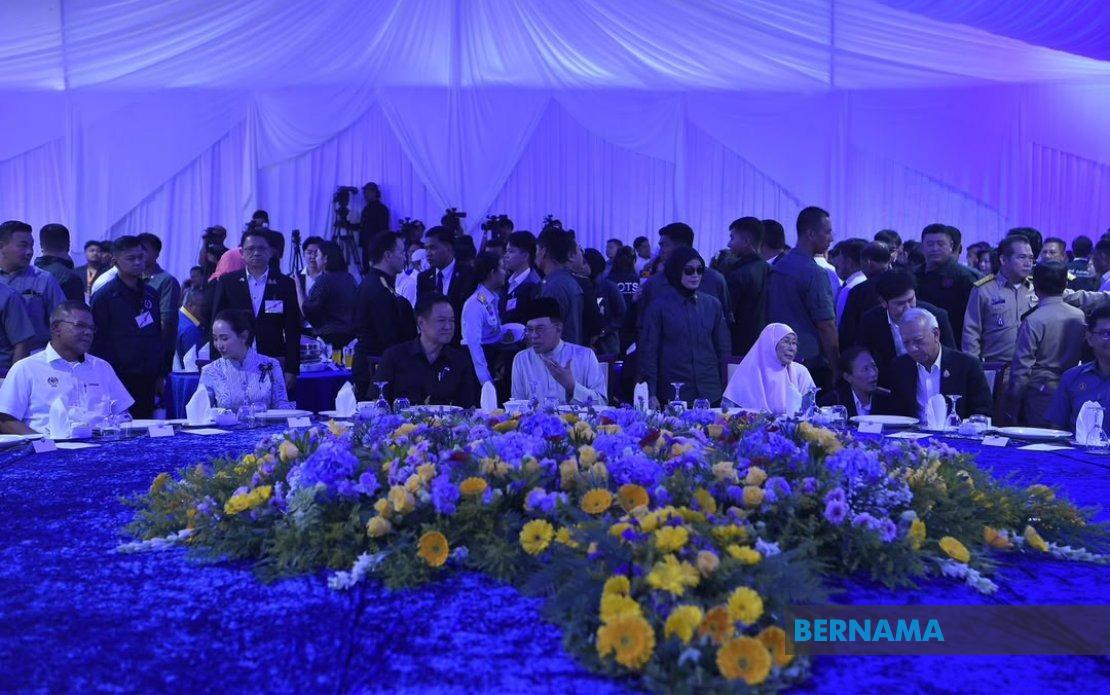
Prime Minister Datuk Seri Anwar Ibrahim and Thai Prime Minister Anutin Charnvirakul jointly launched a new cross-border thoroughfare on July 10, connecting Malaysia's Bukit Kayu Hitam Immigration, Customs, Quarantine and Security Complex directly with Thailand's corresponding Sadao Customs, Immigration and Quarantine facility. The ceremonial opening represents a tangible advancement in bilateral infrastructure and signals renewed regional commitment to seamless border management in Southeast Asia.
According to Malaysia's Home Ministry, the new corridor demonstrates both nations' dedication to deepening diplomatic partnerships and facilitating integrated cross-border operations. The timing reflects broader regional efforts to modernize entry points and reduce friction in the movement of goods and people across one of Asia's busiest land borders. For Malaysian and Thai citizens, as well as regional travellers and traders, the development promises more streamlined clearance procedures and reduced bottlenecks that have historically characterized the northern land crossing.
The new road commenced operations at 6 am Malaysian time on July 11, while simultaneously the longstanding Bukit Kayu Hitam-Danok crossing was permanently decommissioned from midnight the same day. This synchronized transition minimizes disruption to cross-border traffic and signals meticulous planning between the two governments. The old Danok route, which served the region for decades, had become increasingly strained by rising commerce and tourism flows between Malaysia and Thailand, making its replacement a logical step in infrastructure evolution.
The Home Ministry emphasized that this project epitomizes the success of sustained bilateral cooperation on infrastructure development. Beyond ceremonial significance, the new road incorporates modern integrated control systems and unified customs procedures, allowing authorities to process travellers and cargo more efficiently. Such technological integration reduces manual processing times and enhances transparency in border administration—factors crucial for businesses relying on predictable cross-border logistics networks.
The initiative aligns closely with Malaysia's broader MADANI framework and ASEAN's wider connectivity agenda, which prioritizes reducing transport costs and improving regional supply chain efficiency. By upgrading the Malaysia-Thailand border corridor, both nations remove a key bottleneck affecting trade flows throughout the North-South Economic Corridor. Manufacturers in Malaysia's northern states and southern Thailand now benefit from faster access to each other's markets, potentially stimulating localized economic activity in border regions that have historically lagged behind capital cities.
Trade facilitation represents one of the most tangible benefits for Malaysian businesses. The new road's improved design and integrated customs infrastructure are projected to slash clearance times substantially, reducing logistics expenses for companies exporting automotive components, rubber products, and agricultural goods to Thailand. Similarly, Thai manufacturers seeking Malaysian raw materials or access to regional markets gain a more efficient entry point. Enhanced border efficiency translates directly into competitiveness for small and medium enterprises operating in both nations.
Tourism flows are expected to increase as well. The improved crossing experience will encourage both leisure and business travellers to explore opportunities on either side of the border. Malaysian tourists visiting Thailand's southern provinces and Thai visitors to Malaysia's northern regions may find travel less tedious, potentially boosting hospitality and retail sectors in border towns. This human-to-human connectivity reinforces the diplomatic warmth that underpins the infrastructure project itself.
Security improvements constitute another critical dimension. The modern infrastructure and integrated control systems allow Malaysian and Thai authorities to coordinate more effectively in screening travellers and cargo, strengthening both nations' ability to intercept contraband and identify security risks. This enhanced capability protects citizens on both sides and demonstrates how infrastructure modernization can serve security objectives alongside economic ones—a balance increasingly important in the post-pandemic era.
The closure of the Danok crossing does require travellers and shippers to adjust routing and procedures, but the Home Ministry's coordination with Thailand minimizes confusion. Comprehensive public communication campaigns preceded the transition to ensure businesses and individuals understood the timeline and new operational requirements. Such administrative care reflects the professionalism with which both governments approached what could have been a disruptive changeover.
For Malaysia's position within Southeast Asia, this achievement reinforces the nation's role as a regional transport hub. As ASEAN economies deepen integration, efficient border infrastructure becomes a competitive advantage. Malaysia's investment in modern crossing facilities at Bukit Kayu Hitam signals ambition to capture greater shares of regional trade and investment flows. The initiative also demonstrates that bilateral relations can deliver concrete benefits beyond political rhetoric, boosting public confidence in government efficacy.
The project's successful completion carries implications for other ASEAN border corridors. If Malaysia and Thailand's experience proves beneficial to both economies, neighbouring countries may accelerate similar upgrades, creating a virtuous cycle of improved regional connectivity. Vietnam, Laos, and Cambodia are watching such initiatives closely as they pursue their own ASEAN Connectivity goals. A successful Malaysia-Thailand model could inspire broader infrastructure standards across the region.
Looking ahead, both governments have signalled intention to further strengthen border management through ongoing technology adoption and strategic partnerships. The new road represents not an endpoint but a foundation for deeper integration. Future enhancements might include digital customs clearance systems, harmonized regulations, and joint training programmes for border officials—measures that would build upon the physical infrastructure already established.
The launch thus occupies a notable position in contemporary Malaysian-Thai relations. While the road itself is concrete and steel, the underlying significance involves trust, cooperation, and shared vision for a more prosperous Southeast Asia. In an era of geopolitical uncertainties, visible collaboration on practical mutual benefits provides reassurance that regional integration, despite challenges, continues advancing.

