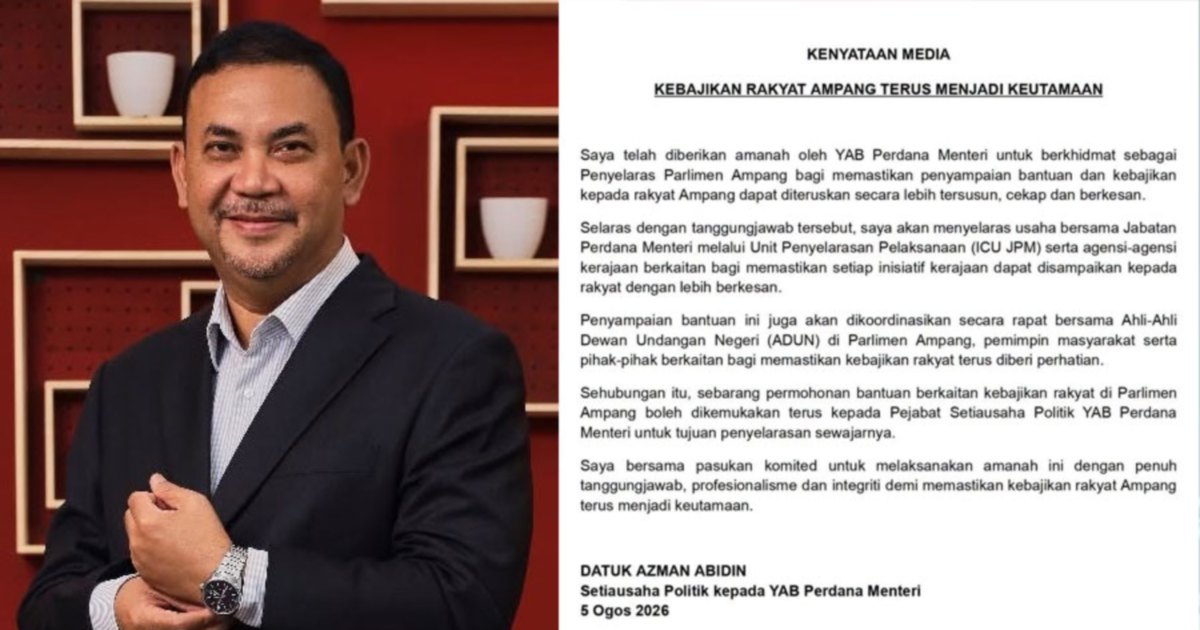
The Prime Minister's office has moved to fill the parliamentary coordinator position in Ampang by appointing one of Datuk Seri Anwar Ibrahim's political secretaries to the role, a decision that emerged following the suspension of PKR's Rodziah Ismail's privileges over the MyKhas constituency allocation system. The appointment signals a significant intervention in the management of parliamentary affairs in the Ampang constituency and raises questions about the operational independence of elected representatives within the ruling coalition.
Rodziah Ismail, the sitting Member of Parliament for Ampang, has been cut off from accessing the MyKhas platform, which serves as the primary mechanism through which Malaysian parliamentarians manage and distribute constituency development allocations to their constituents. The suspension effectively limits her ability to channel funds to community projects, local initiatives, and constituent services that form the backbone of parliamentary representation in Malaysian electoral politics. This suspension represents an unusual administrative measure that directly impacts the capacity of an elected representative to serve her constituency.
The appointment of a Prime Minister's aide to oversee parliamentary coordination in Ampang appears designed to maintain continuity in constituency management during this period of restricted access. However, such arrangements raise constitutional and political questions about the proper relationship between the executive office of the Prime Minister and the individual Members of Parliament, particularly those from coalition partners. The coordinator role traditionally encompasses liaison duties between the parliamentary office and federal administrative structures, though the precise responsibilities in this instance remain undefined.
MyKhas, the constituency allocation management system, functions as a digital gateway through which Malaysian MPs administer their parliamentary allocations. These funds represent a critical resource for community development, emergency assistance, and local infrastructure projects within constituencies. Access to MyKhas is typically an automatic entitlement of elected parliamentarians, and suspension of this access is a rare administrative action that would ordinarily require formal justification and documented procedures. The circumstances surrounding Rodziah Ismail's suspension have not been publicly detailed, leaving ambiguity about the underlying cause or the anticipated duration of the restriction.
Ampang, a densely populated parliamentary seat in Selangor with over 140,000 registered voters, encompasses multiple urban and semi-urban communities with diverse development needs. As one of Malaysia's key urban constituencies, Ampang carries political significance within the broader Greater Kuala Lumpur region. The appointment of a centralised coordinator from the Prime Minister's office suggests that the federal government is taking direct administrative involvement in managing the constituency's parliamentary functions during this transitional period.
The insertion of a Prime Minister's political secretary into Ampang's parliamentary structure introduces elements of direct executive oversight into constituency-level operations. While political secretaries commonly serve as intermediaries between ministerial offices and external stakeholders, their appointment to formal parliamentary coordination roles represents an expansion of their traditional scope. This development may establish a precedent for similar arrangements elsewhere should comparable situations arise with other MPs across the coalition.
PKR, as the ruling coalition's largest component party, has maintained its dominant role within the government since the formation of the current administration. Internal party management and the handling of elected representatives who face disciplinary or administrative measures remains an exercise in political accountability within the party structure. The involvement of the Prime Minister's office in appointing a coordinator for Ampang may reflect collaborative governance arrangements between the Prime Minister's secretariat and coalition party machinery.
For Malaysian constituencies and their residents, the practical implications of such arrangements centre on service continuity and fund accessibility. Constituents in Ampang will likely experience delays or complications in accessing development allocations and parliamentary assistance services traditionally channelled through the MP's office during the period when direct MyKhas access remains suspended. The coordinator arrangement attempts to mitigate such disruptions by establishing an alternative administrative channel, though this may introduce bureaucratic layers that complicate direct constituent-MP interaction.
This situation also highlights the evolving role of digital management systems in Malaysian parliamentary administration. MyKhas operates as both a financial control mechanism and an administrative tool that can restrict individual MPs' operational capacity. The system's capacity to suspend or restrict access represents a significant centralised control mechanism over parliamentary spending authority, which carries implications for parliamentary independence and the autonomy of elected representatives in serving their constituencies.
Looking forward, the resolution of Rodziah Ismail's MyKhas access suspension remains uncertain. Whether this represents a temporary administrative measure or a longer-term restriction will substantially affect both her capacity to represent Ampang and the necessity for continued coordination arrangements. The appointment of a Prime Minister's aide in a parliamentary coordinator capacity appears intended as an interim solution, yet it establishes questions about the appropriate balance between executive supervision and parliamentary autonomy within Malaysia's federal system.
The Ampang development also occurs within the broader context of coalition governance tensions and the management of party discipline across multiple political parties sharing executive responsibility. How this precedent evolves and whether similar arrangements become common practice across constituencies with comparable situations could indicate broader shifts in how the federal government oversees parliamentary administration and manages the operational independence of elected representatives from coalition parties.

